Believing on the Bayou: a Sox/Tigers Narrative
The whys and hows associated with extraordinary happenings in sports can only be thoroughly assessed with the assistance of hindsight. That’s the beauty of The Moment: it rips you from reality, sweeps you up, and spits you out in a state of euphoria. Reflection is not possible when living The Moment. Only realization. Realization that wherever you are and whatever the circumstances, The Moment will always be with you.
—————————————————————————————————————————
It was Saturday morning, October 20. Curt Schilling was approximately eight hours from throwing the first pitch of Game 6 of the ALCS at Fenway. I was in Baton Rouge, Louisiana, priming myself for what I knew could end up being the most intense sports experience of my life. Not only was I preparing for another Game 6 with the Sox in the midst of another furious ALCS comeback, I was preparing to miss it.
Friends of mine had come through with dynamite tickets to the completely sold out LSU-Auburn game. A game, for LSU-faithful, that was equally as important to the Tigers as Game 6 was to the Sox. One loss for either squad meant no  championship in ’07. Of course, the predicament these two odds-on favorites had to contend with was a result of their own doing. The Red Sox played uninspired baseball for three straight games against Cleveland, pushing them to the brink of elimination. LSU, meanwhile, a week after pulling a cat out of a hat against the defending-national champs, Florida, lost a back-breaker in triple overtime to Kentucky. Just like that, two teams that had visions of perfection were left with the disturbing actuality that seasons so full of haughty expectation were improbably teetering on the brink.
By mid-afternoon outside Tiger Stadium all you could see were purple tents; all you could hear was classic rock and all you could feel were Tiger-fans zoning themselves in for a showdown with…the Tigers (of Auburn). Then there was me. I was, you might say, a fish out of water. But not to most of the tens of thousands milling around me. Garbed in a yellow-LSU t-shirt and Red Sox cap, I tacitly fit in. No matter how much I appeared to belong, the ritual I was engulfed in was like nothing I had ever been a part of. Baking under the scorching southern-sun, I drank beer, ate gumbo and jambalaya, and did my best to engage the Fighting Tiger-faithful.
However, as the hours passed and the bodies multiplied, the angst started to take form. As I wrote before, a Sox-Indians ALCS was nowhere near as angst-inducing as another Sox-Yankees would have been. That said, with the way my heart was palpitating around 7:00 pm, my future cardiologist thanks Cleveland for ousting the Yankees. Because I literally could no longer sit still, I decided to make some rounds.
I crossed the street outside the stadium, and as I was peering through a steel fence into one of the cavernous tunnels that marks a point of entry, I heard a voice that seemed to be addressing me. I was already toasty enough to not really care about acknowledging the belligerence around me, but next thing I knew a guy was in front of me, asking if I knew how to traverse the fence and get to the tunnel. Before my synapses had a chance to fire, I was doused with an affront that made me see New York.
“AWWWWWW,” the guy said. “You’re a Red Sox fan!?”
“Abso-(expletive)-lutely,” I retorted.
Typical of a Yankees fan, he threw a few more barbs about my allegiances before again asking me for directions. I wish I had known where he was trying to get, so I could have then sent him in the exact opposite direction. As we were parting, I on my own and he with another couple, he turned.
“Later bro,” he said. “I’m going to meet my ex-girl and her new guy so I can beat his ass.”
“Sounds good pal,” I returned. “Maybe he’s a Red Sox fan. At least it’ll be worth it.”
 Chuckling at the fact that Sox-Yanks beef really does invade all environments, I decided to test out my new headphones and old-school AM/FM walk-man, which beginning in about thirty minutes, was going to be my lifeline to Schil and the Sox. I had already researched the ESPN Radio affiliate in Baton Rouge, which was AM 1300. Tuning into the station expecting to hear some ALCS pregame, I instead heard LSU pregame. I wasn’t worried, since I knew that the LSU games were broadcast on FM. I received a call from my friends, who said they were heading into the stadium. I told them I was going to try and catch the beginning of the baseball game on TV and I’d meet them for kickoff.
I began gravitating in and out of various tailgates, accepting beers and talking to different people while waiting for some piece of Red Sox bait that I could gobble up and parlay into a first-inning viewing. Opportunity presented itself when I found myself inside a tent the size of a tractor trailer. I got talking to a guy who quickly noticed my hat, and conveyed his support for my team. He had given his tickets to his sons, so he would be sedentary for the duration, which made him one of few not attempting to imminently enter the stadium. I asked him if, by chance, I could take in the first forty minutes of the Sox game. He obliged, told me to take a seat, handed me a 22 ounce can of Natural Light, and we exchanged formal greetings. SCORE.
The game began, and still a bit wary about the lack of any pregame coverage on the radio, I decided once and for all to locate the broadcast. For the entire first half inning, during which Schilling set down the Indians, and throughout the bulk of the Red Sox half of the first, I desperately tried to find the right station, to no avail. When Manny came up with nobody out and the bases loaded, I resolved to the fact that the first inning would be it for me because this game definitely wasn’t being broadcast in Baton Rouge. An early score had never been so imperative.My palms were drenched as Manny pin wheeled the bat, while my host (whose name I had long forgot) popped open another Natty Light. Strikeout. You’ve got to be kidding me. Mike Lowell the run producer was next up. Pop out.
Kill me now.
J.D. Drew was up with two outs and the bases loaded. I was about to see a microcosm of his entire Red Sox season as my final send off into Tiger Stadium. Then, without me even knowing it, the seeds of The Moment were planted.
 “Now that J.D. Drew is a ballplayer,” said the guy.
I cringed. Luckily I was too frozen in place to produce any identifiable reaction, because had I been able to, it would not have been a very polite reciprocation of my new friend’s hospitality. Drew worked the count to 3-1, which helped me temporarily emerge from my comatose state.
Just a walk, J.D. Puhhhhh-leeeease, J.D.!!! Do the one thing we’ve paid you $14 million to do this year. Just take ball fou—
—CRACK!!!!!!
“There it goes,” said the guy.
No way.
No EFFING WAY.
GRAND SLAM!!!!!! J.D. DREW!!!!!!!!!
I don’t know what I did next; that’s usually how it goes when you encounter The Moment. I think I ran around a few tents screaming at the top of my lungs before returning to my new best friend.
“THAT J.D. DREW IS A BALLPLAYER!!!!!!” I bellowed. “HE PLAYS BASEBALL!!!!!!!!”
All I needed to do before jigging my way into Tiger Stadium was solidify one piece of information for my official recollection of The Moment.
“What’s your name again, sir?” I asked the guy.
“Bobby,” he said. “Bobby Sage.”
“Thank you, Bobby Sage!” I said. “I will never forget you, Bobby Sage!!”
On that ecstatic note I headed into the stadium, visions of Drew rounding the bases consuming my mind and prickly chills stinging my spine. What greeted me was an abyss of purple and gold, over 92,000 strong, packed into an imposing  structure, aptly deemed “Death Valley”. The noise level was so high even my thoughts were deafened. Our seats were in the North endzone, next to the student section. Mayhem.
Unfortunately, the ensuing Tiger-performance bore no resemblance to what inhabitants of Death Valley know to be the norm; namely dominant football. Auburn moved the ball on a seemingly-porous LSU-defense. The Tigers offense turned the ball over; receivers dropped passes. By halftime, the deficit was 17-7, and LSU fans started resembling Red Sox fans after Game 4. Specifically, there was a pervasive sense of frustration bordering on incredulity. Never, however, was there a sense of defeat among the fans, which made me feel right at home as a Sox fan.
Sure enough, the Tigers battled back, and led in the fourth quarter, 23-17, until Auburn scored a touchdown with 3:21 remaining. With the extra point, it was a 24-23 deficit for LSU. As was the case in the game against Florida (when LSU converted five out of five fourth downs), the Tigers played their best with their backs against the wall. An authoritative drive led by quarterback Matt Flynn culminated with the closest a regulation-football game can come to a walkoff victory: Flynn threw a touchdown pass to Demetrius Byrd with one second remaining to end the game.
And in the dwelling of Baton Rouge, a place that feels its heartbeat determined by the play of its Tigers, The Moment took over.
—————————————————————————————————————————
Only after the campus of LSU stopped shaking sometime Sunday morning, and after the Red Sox formally clinched their 12th pennant later Sunday night, was I able to start to reflect on the weekend that was. The Moment, which had officially spanned more than 24 hours, three historic games and two sports, ultimately subsided. In its place came the whys and hows. Why is it that the Red Sox become unbeatable only when they’re at their most beaten? How is it that the Tigers never say die in Death Valley?
The latter is an easier question to answer: teams get scared when darkness descends on Tiger Stadium. In their last 25 Saturday night home games, the LSU Tigers are a perfect 25-0. While the Tigers have been a force in college football for the last five years (a cumulative 51-9 record and national champions in 2003), the home-field advantage on a Saturday 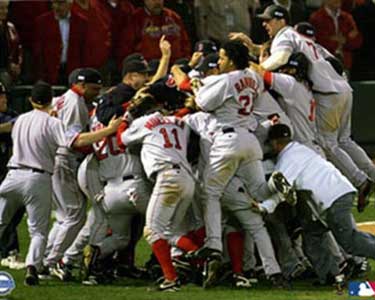 night in Death Valley goes way back and is unparalleled in college football. Whenever 92,000 people flow into Tiger Stadium on a Saturday night, they are determined to emerge victorious; so too are the players and team they support. Many times the games are laughers. A handful of nights turn magical. What stays unchanged is a collective assertion of will over the adversary and the constancy of winning under the Louisiana stars.
As for the Red Sox, the transformation this team has undergone since 1999, from uncanny chokers to torchbearers of comebacks, is both glorious and amazing. It’s also completely impossible to diagnose. As you’ve probably read or heard somewhere by now, the Red Sox are 14-3 in their last 17 elimination games, and have seemingly instilled trepidation in the opposition to such a degree that in the future teams are actually going to dread getting up in a series against this team. Beginning in ’99, continuing in ’03, culminating in ’04, and returning in ’07, the Red Sox have changed the face of playoff baseball. Since ’99, they’ve played .823 baseball when each game could be their last, and .438 baseball (14-18) when it’s just another meaningless, non-life-or-death battle in October. Wow.
Now it’s time to look ahead. With triumph again born from tribulation, the Sox and Tigers are each ready to resume pursuit of all that matters in the eyes of their faithful: hanging a banner in ’07. Great moments are often the impetus of and the driving force behind what ultimately become great teams. On the weekend of October 20, the towns of Boston and Baton Rouge officially started believing; believing that for their teams, greatness was indeed again on the horizon.
 become buyers. GMs who are looking to add talent fall into two categories. The first is for those like Schuerholz, who have assessed the landscape of their division and league, in addition to the weaknesses of their own team, and determine that one big piece can be the difference between a second place finish and a spot in the postseason. Suffice to say Schuerholz believes Teixeira will solidify the middle of the Braves lineup and give his offense the kick it needs to run with the the likes of the Mets and Phillies down the stretch. The second category is reserved for GMs of the top couple of teams in baseball, who conclude that one major addition can put their already-playoff bound teams over the top. Epstein’s rationale was that with a deep lineup and consistent rotation, sticking a guy like Gagne in between Hideki Okajima and Jonathan Papelbon would officially vault the Red Sox into “team to beat” status.
 Dombrowski
 three, while your offense has been woefully unproductive you can afford to trade one or even two of those big guns for some big-time offense back (guys like Carlos Lee or Ichiro or Ryan Howard). Since only about thirty percent of the season remains, the categories that you’ve been at the top of the league in shouldn’t fluctuate too much, because of the hundred games over which you’ve had that production. On the flip side you’re now positioning yourself to make a run at the categories that have held you’re team back, and if you can find a way to acquire any of those handful of late-season performers, well then, you just might be in position to make a league-leader start sweating.