Skip to content

Posts from the ‘Strictly Ballgame’ Category

Deal or No Deal? Three Keys to Makin’ Deadline Moves

With another MLB trade deadline upon us and most fantasy deadlines looming soon thereafter, it’s time to start dealing. Now is it always imperative to make a move just because some predetermined date in time says you must? No, I’ve never been a proponent of dealing for the sake of dealing.

However…

Unless your team has been leading the pack from the word go (in which case it’d be wise to stick with what you’ve got) or been feeding on the sewage of the basement since April (in which case it’d be wise to bounce that overdue check to the commish), chances are you need to make a trade.

Of course, sometimes making a move can be detrimental. I swung a deadline swap with a buddy last year, sending him Gary Sheffield (at the time a Top-5 fantasy player) for Roy Oswalt and Placido Polanco. Oswalt went 6-2 with a 2.57 ERA in the second half while Polanco batted .348. Sheffield hit .203 before going on the shelf.

(Yes, the trade was only detrimental to him, and yes, our friendship was temporarily bludgeoned.)

Truthfully, I got lucky considering before that move I had an ultimately nixed proposition on the table with another friend that would’ve netted me Eric Gagne (you know, the Texas closer who saved 12 games with a 1.32 ERA before the All-Star break, remember him?). I can’t recall off the top of my head what I was going to be giving up for him, but I do know that it was more than Richie Sexson and a bag of baseballs.

Needless to say, hindsight gave way to elation when Gagne pitched his way into the recesses of the Boston bullpen and onto the waiver wire, sparing me the regret of having been party to the worst fantasy deal of all-time.

So you see? That’s the glory of swinging deals at the deadline, that element of the unknown. Because of that, there remains no fool proof method to deadline maneuvering. Though there are a few keys.

Without further ado…

Key No. 1 — Be thorough with assessments This is the most basic, yet most integral aspect of crafting the successful deadline deal. With two-thirds of the season on the back burner, the only direction you should be looking is forward. However, within this context more often than not that requires looking back to previous years. For various reasons, certain guys simply live for the twilight. You must seek them out, for these are the players who will bring home the most bread in the shortest period of time. Some don’t heat up until the pressure starts to mount (Bobby Abreu, Robinson Cano, David Ortiz) while others just don’t seem to find their stroke until they’re waist deep in the dog days of summer (Garrett Atkins, Mark Teixeira, Nick Markakis) So before locking in a proposal be sure to, you know, cover your bases. (Sorry, I couldn’t resist.)

Key No. 2 — Don’t be afraid to shake things up (aka the Theo Epstein Corollary) A mere four trade deadlines ago, Theo Epstein literally put his career on the line by trading away the iconic Nomar Garciaparra for Orlando Cabrera and Doug Mientkiewicz. The Red Sox were an underperforming .500 ballclub in need of an overhaul. So Theo pulled the trigger on one of the most controversial trades in Red Sox history, a deal that marked a watershed moment for a tortured franchise. My point being, if Theo was willing to assume the burden of seven generations of rabid and crazy Red Sox fans, don’t balk at the prospect of pulling something of a fantasy equivalent. If your team has been sitting middle of the pack, the time has come to part with a titan. Max out the value of a Josh Hamilton, Adrian Gonzalez, Carlos Quentin or Nate McLouth by packaging one of them and going in a different direction. It’s worked before. (And as opposed to Theo, if it all fails you won’t have to board up your windows.)

Key No. 3 — There’s no harm in asking (aka the Danny Ainge Corollary) When Ainge (the Celtics GM) sent to his buddy Kevin McHale (the Timberwolves GM) a pu pu platter wrapped in a green ribbon, not many believed Kevin Garnett would emerge in return. True, most fantasy commissioners would scream collusion if something similar happened between friends in fantasy baseball, but hey, if Ainge and McHale were able to pull one over David Stern, I say anything is possible. So for all you owners out there still stewing over the 11th pick you received in the draft, make your play for Hanley or Utley. Worst case scenario is a rejection. (Or put another way: A supermodel isn’t going to ask you out. You just gotta try your luck.)

Why the All-Star Break’s Not All-Fun

Look, I love the All-Star break. Watching the Howards and Brauns of the world take aim at Tim Wakefieldesque fastballs in the Home Run Derby while the Mannys and Chippers soak it all in with camcorders in one hand and tykes in the other, that’s always cool. Seeing the AL and NL band together against one another with home field in the World Series on the line is a great twist. And if you’ve ever had the opportunity to attend a FanFest, you know what I’m talking about. I mean, who wouldn’t want the virtual experience of stepping into the batters box against Pedro in his prime?

So yeah, All-Star festivities are awesome and there’s no disputing it. There’s just one small problem.

No fantasy baseball for three days. Three days! That’s 72 hours. Or about 65 hours longer than the longest I’ve gone in between checking the progress of my squads these last three months and change. Chances are if you’re reading this column you’re nodding your head right now in acknowledgment of this hobby/sickness we share.

(Take some deep breaths, they help.)

Indeed, it only took that first day to slip into a full scale fantasy withdrawal. I’m not kidding; I woke up Monday — forgetting that it was that Monday, the one like no other from April through September — and per habitude groggily opened up Yahoo Fantasy Sports. I was horrified to discover that not only was I about to embark on my annual thrice-sunset fantasy fast, but Yahoo was performing site maintenance and the entire fantasy shebang was going to be shut down for at least 24 hours.

(Paper bags, they also help.)

So there I was, totally in the dark, no idea of what the latest standings were or what new smack talk was up on the rumor mill — two of the only things that can lighten up a Monday morning. Sure, it will be better Tuesday, but there still won’t be any pitching matchups to troll through or stats from the previous night to digest. The wait will continue.

Some of the sparse contingent of fantasy haters like to point out that it’s pure folly to invest so much time and effort into something that produces no monetary return other than prize pool money. (Yes, some of these folks call Wall Street home.) That notion introduces the other tier of this fantasy withdrawal we’re experiencing.

Work. Of the estimated 19.4 million fantasy sports participants in North America (according to Ipsos), I would assume a good deal of them are among the working class. I’d also surmise that a decent proportion of them probably feel something ranging from mild discontent to outright hate for their vocation. Fantasy is figuratively and — within this context — literally their escape.

Only fantasy baseball can allow someone to indulge a daily passion and also scorn a boss — all while on the clock. In other words, the list of people who scour fantasy stats on their own time is a lot shorter than the list of those who do it on their employer’s buck.

Take two of the guys in my league. One of them is an investment banker who spends so much time making sure he’s on top of all baseball intel I wouldn’t be surprised if he knew about Edinson Volquez before the Texas Rangers. The other is a public school teacher that the kids love because of all the movies he shows during homeroom while simultaneously bootlegging Wi-Fi and meticulously adjusting his roster before the night’s games. They, like so many during this mandated fantasy catnap, are feeling the emptiness and that sense of a loss of equilibrium.

I wish I had a remedy, but I don’t. My only intention is let you know that it’s aright, you’re not alone. There are lots of others out there just like you — starving souls, breathlessly waiting for Thursday to come, for that singular pursuit to resume.

Second Half will Tell All in MLB, Fantasy

Something funny happened last weekend. The Red Sox and Yankees played a pretty darned good split four-game series, yet nobody seemed to notice. Of course the talking heads will cite how the Yankees aren’t that good (they aren’t) and how the whole Sox-Yanks thing has become totally watered down (it has).

Fact is, the rivalry hasn’t been close to what it was in the glory days of 2003-05 — when five hour, extra-inning, extra hating blood matches were the norm, and seven-game epics with pennants on the line were the closing acts. It had, however, maintained its standing as the story of the moment whenever it renewed itself — until now.
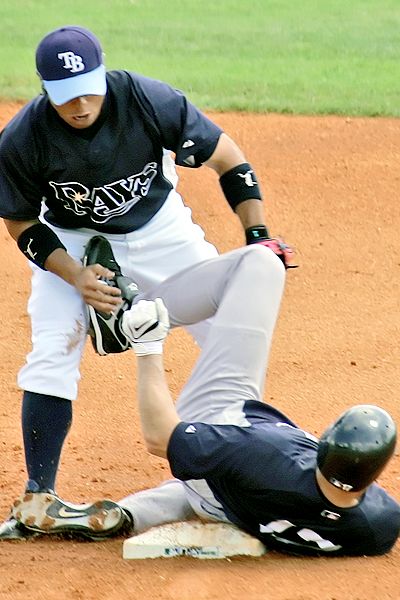
Alas, thanks to a devilish doormat promptly shedding half of its moniker and undergoing a hasty metamorphosis, Sox and Yanks are now as dated as the Devil Rays themselves.

The Rays though? Now there’s a story.

Spawned by predecessors who could never fare better than worst — and were most noteworthy for sporadic “jayvee vs. varsity” dustups with the Sawx and Bombers — this new and improved and monosyllabic contingent from Tampa has taken baseball by the jugular in ’08.

They’ve been a lap ahead of New York all year and have swept Boston twice at Tropicana Field. The most recent broom job, culminating on July 2, had those talking heads foaming at the mouth. Some waxed poetic, associating the Rays’ many weapons with the various tentacles emerging from the body of an octopus. Others boldly proclaimed that the Rays would use the thrilling series as a springboard to a championship. And all this gushing was amid constant reminders that — you might want to be sitting for this one — Rays fans somehow managed to outnumber Sox fans at the Trop! Three games in a row! Heady stuff.

Look, as a Red Sox fan with a keen interest in the Rays after what they did to my team (twice), I’m not about to dismiss the path traveled by this young and redoubtable ballclub. Though I will point out the possibly hazardous path that lies ahead.

Any team that can pull into the All-Star break improbably leading its division is automatically branded with expectation. When play begins in the second half and that bullseye is suddenly squarely on your back, that’s when things can start going awry. It should be noted that the term “second half” is a bit misleading. When the Rays begin playing again after the All-Star break, they will do so with 94 games (or 58 percent) already in the books. That leaves just over 40 percent (or 68 games) of the season to be played, which means after a handful of contests the Rays are going to find themselves in the thick of a pennant race.

It’s a pennant race that’s going to have to be waged over two months against a couple of Goliaths who have no love lost for this new flavor in the AL East (and if anything, have softened a bit on each other as they mutually acknowledge the new blood).

If the baseball season as a whole is like a marathon, the second half is more like an 800-meter race — pacing remains critical but the event feels more like a sprint. One poor road trip while your competitors are taking care of business can be fatal. The pressure mounts with each passing day.

While the Red Sox (two titles in the last four years) and Yankees (a combined 147-80 over the last three second halves) have proven themselves to be the standard-setters for finishes, the Rays have no basis for comparison because they have played the spoiler role down the stretch every year of their existence.

Am I writing the Rays off? Far from it. I’m just calling for some tempering of October predictions until the young guns have actually experienced an existence with bona fide expectations. Lest we forget, expectations have been known to weigh down even the fleetest of foot.

And now here are some players who — like the Red Sox and Yankees — are established second half destroyers, and should be accordingly protected/coveted.

Garrett Atkins One of the true all-around hitters in the game. Atkins hones his batting eye over the course of the season and by the time the All-Star break comes and goes, the third baseman is locked in. He batted .354 with a .437 on-base percentage, 18 homers and 62 RBIs after the hiatus in 2006 and followed that up with a .349/.409/12/58 second half last year. Hold onto him tight, his best is still to come.

Nick Markakis He may be one half German and the other half Greek, but the young outfielder is all about the second half. In 2006 — his first year in the bigs — Markakis batted .311 with 14 homers and 41 RBIs after the break. Last year his second half was even bigger, as he sported a .325 average with 14 homers and 61 RBIs over the last 40 percent of the season. Do what you can to secure the services of an established twilight performer.

Mark Teixeira Of all the blue-chip sluggers out there, Teixeira is the one who has made second half dominance his calling card — at least over the last two years. In the first halves of 2006 and 2007, Teixeira meandered along, doing his best Brian Daubach impression (9 homers/49 RBIs in ’06 and 12/41 in ’07). Then, after the All-Star respites, he got mad (maybe because some fool dared utter his name in the same breath as Brian Daubach), going off for 24 bombs and 61 RBIs in ’06 with an encore of 18 and 67 last year. If someone offered me Teixeira for Adrian Gonzalez today, I’d do it in a heartbeat. But that’s just me.

Johan Santana Second half surges from the rubber begin and end with Johan. Forgetting last year — when Johan was less himself than John Malkovich was in “Being John Malkovich” — Santana has been downright nasty when the margin for error becomes smaller. Please allow his second half numbers to speak for themselves: 10-1, 2.54 ERA in 2006; 9-2, 1.54 ERA in 2005; 13-0, 1.21 ERA in 2004. So… Yeah… You might want to keep the guy around for the remainder of ’08.

MLB “Cinco de Mayo” Fantasy Points

It’s Cinco de Mayo. 30 games are in the books. You know what that means.

Time to begin critically evaluating your fantasy team.

What is your injury situation? Who has underperformed? Who has exceeded expectations? Do you have good balance between offense and pitching? What’s the greater makeup of the league you are competing in? How are you feeling about your squad?

Unless your team is sitting pretty at the top of the standings, chances are you have concerns; chances are most, if not all of the above stated questions are relevant.

Let’s tackle the most cut and dry topic first: Injuries. They are often unforeseen, and are usually unavoidable. That goes for real and fantasy teams alike. Whenever a blue-chipper goes down, a ripple effect ensues. What’s interesting so far this year is that injuries to big name players (Jimmy Rollins, Alfonso Soriano, Scott Kazmir, John Lackey) have had no negative impact on their clubs.

The Phillies and Angels have withstood the losses of Rollins and Lackey; both lead their respective divisions. The Cubs are two games ahead of their pace from last year (18-13 as opposed to 16-15) despite the loss/abysmal start of Soriano. And the Rays just polished off their best April in team history without the services of their ace, Kazmir. Even predictable injuries to Rich Harden and Pedro Martinez have not slowed down their clubs. The A’s and Mets are each within a game of first place in the loss column.

Fantasy owners haven’t been so lucky. While guys like Pedro and Harden have become mid to late round “high risk/high reward picks”, Rollins and Soriano are first and second rounders; Kazmir and Lackey are frequently among the top 10 or 15 starters chosen. Their absence has been an early critical blow to fantasy teams far and wide, specifically in roto leagues.

Even though Lackey and Rollins are close to coming back (Kazmir and Soriano are already playing again) their roto value is automatically diminished because of the time they missed. Barring a supersonic final five months from these guys, you can expect about a 15 percent drop-off in their 2008 stats. Because every fantasy team is built around a few choice stars like them, that can be the difference between a top-three finish and middle of the pack.

In head to head leagues, as long as your team isn’t buried in the standings today, you’ve got nothing to worry about. Since cumulative stats don’t matter in head to head, it’s of no consequence that Lackey finishes with 14 wins instead of 18 or that Rollins scores 108 runs as opposed to 135. You will still maximize their production from here on out.

The next major issue confronting fantasy owners is trying to diagnose the poor starts of established blue-chippers. Jose Reyes, David Ortiz, Ryan Howard, Justin Verlander and Travis Hafner headline this category. With the exception of Hafner–who seems to have lost his craft–roto owners should not be sweating the paltry numbers put up by those perennial fantasy catalysts. Play them everyday; when all is said and done the numbers will be there.

This time it’s the head to head owners who must start rethinking strategy. Since stats are only accrued on a weekly basis, consistently starting a slumping-Ortiz (.216/5/24) or Howard (.167/6/14 and 45 K’s) can be detrimental. They currently carry too much baggage to warrant putting them out there everyday. Of course there’s always the chance they’ll go off for multiple home runs on any given night, but so goes the double edged sword that is head to head fantasy management.

Be it head to head or roto, it is frustrating to managers that the Howards and Verlanders have been so unproductive, but baseball is a long season. The players we have talked about are too good at what they do to fizzle for longer than what equates to a small sample size (again, with the exception of Hafner).

Looking at the other end of that spectrum is important as well. That’s right; role players who have far exceeded expectations to the point of becoming overvalued. Xavier Nady (.347/4/30). Nate McLouth (.323/7/25). Josh Willingham (.341/6/16). Ryan Church (.318/4/22).

All are on ridiculous, career defining paces at the moment, but all will come back to earth sooner or later. This can be a delicate situation in roto leagues. Ideally for each fantasy manager employing a Nady, that manager also has a Howard. That way when the sample size becomes larger (ie when Howard turns it up and Nady levels off), the players will continue to offset one another and the overall team quality will be sustained.

However, if Nady is carrying your team and you’ve suffered no major injuries or slumps, it might be time to make a move. Maximize his selling value now and see if you can’t shore up a weakness (this is a good time to address bullpen issues). Of course, making deals requires having a feel for the climate of the league — are the managers generally tight, therefore hesitant to make deals (designated NBFT: Need Based Fantasy Trader)? Or are they ready and wanting to trade at will (designated CFT: Compulsive Fantasy Trader)?

If you’re in a league with primarily CFTs, don’t hesitate and wait for the other shoe to drop. Now is the time to sell high. If there are predominately NBFTs in your league, keep an eye on the waiver wire, maintain faith in the players you drafted, and wait another month or so before pondering deals. That’s what the real GMs do.