17 for Them … and One for Us
One day long after Russell and the Cooz and Hondo have joined Red, Reggie and D.J. upstairs, one day when Bird too is talked about in the past tense and TD Banknorth Garden is referred to as “the old house”, I’ll look back on this day. Maybe I’ll be bouncing a grandkid on my lap. Maybe I’ll be perched on a park bench talking to anyone who’ll listen. But I’ll have a story. A story worth telling. One worth hearing. And I’ll recount it as if it were yesterday…
——————————
If one non-defensive play in Game 6 of the 2008 NBA Finals typified the champs it came in the second quarter with the Celtics leading 32-29. Paul Pierce drove and missed a four-footer; Glen Davis grabbed the rebound and went back up with  authority but missed. Pierce beat everyone to the ensuing board and after gaining control of the ball kicked it out to Eddie House for a corner trey, which he struck off the back of the iron. James Posey hustled after the long board, hauled it in and threw it back up top for a reset. He went on to assume his place in the left corner, and on cue, received the ball on a crisp rotation from House and buried a three.
All told it was a 34-second possession for the Celtics, a possession that not only defined their stranglehold on the ’08 Finals but underscored what had been the m.o. of the champs from the word go: An undying total team commitment to hustle. From Player 1 (Pierce) to Player 6 (Posey) to Player 11 (Big Baby) — on coach Doc Rivers’ very loosely interpreted depth chart — the focus and dedication was there from the beginning and was highlighted by one microcosmic play that effectively marked the end. The 35-29 spread that resulted from that play would prove to be the closest the Lakers would ever get in what became the most lopsided clinching game in NBA Finals history.
The Lakers as a team were overmatched, which in light of Game 6 was an understatement. And while it would be difficult to find anyone who would dispute that Pierce was the best player in the series (he was the unanimous MVP on all nine ballots), you need look no further than the end of Game 5 for confirmation of said fact. A day after mounting the greatest comeback in Finals history the Celtics had staged yet another furious rally in the fourth quarter of Game 5, cutting a 14-point LA lead to two in the final minute. Much of the damage had been inflicted by Pierce, who through his trademark herky-jerky drives was getting to the basket with such consistency and ease that he had the entire Lakers team on its heels — literally.
As Paul crossed midcourt, ball in hand with the Celtics trailing 97-95, Kobe Bryant — the best player to lace em up since the best of all-time hung em up — waited in his defensive stance. When Pierce went to make his move Kobe darted behind him and back-tapped the ball away from a stunned Pierce. Lamar Odom scooped up the loose ball and threw a lob to Kobe — whose momentum had carried him into the backcourt — and Bryant threw down a two-handed slam that unofficially sent the series back to Boston for Game 6.
Dig a little deeper and you might be perplexed. For Kobe to make such a calculated gamble (back taps are successful about 25 percent of the time and fatal the other 75 percent because failed ones turn into five-on-four situations) with the lead meant only one thing: He knew he couldn’t stop Pierce.
 Kobe couldn’t handle the Truth blowing by him for a game-tying or series-clinching bucket on his floor, in his town.
So he gambled (something, by the way, one Michael Jordan only did recreationally off the court). And while the gamble paid off (think going all in preflop in Texas Hold’Em with a pair of twos), Kobe showed his hand. He, the three-time champ and league MVP, needed one man-em-up defensive stand to seal the game and send the Lakers back to Beantown. But he chose not to man up Pierce, who had already dropped 38 in his house and was sniffing 40, 41, and most significantly, 17. Instead he resorted to a playground maneuver reserved for crafty old guys whose knees no longer permit them to get into a crouch and shuffle their feet.
That was the moment I knew it was over, even if it was actually the moment when we found out it was not. But it didn’t matter because Kobe had already given up. Not on his teammates, he had pretty much given up on them after Game 2. By virtue of that desperation play in a non-desperation situation Kobe essentially made it known he had come as far as he could, that there was a player in green who wanted it more than he did and could back it up on the court. And there wasn’t anything the MVP could do about it except roll the dice.
Of course Paul’s performance in itself was MVP-worthy. But it was validated by the best player in the world when he simply yielded to a colleague performing at a higher level. I never thought I’d view a turnover as a watershed moment in defining the greatness of someone I considered to be one of my heroes, but 40 years from now I’ll remember Game 5 of the ’08 Finals as the night Paul Pierce lost the game yet still owned LA.
I’ll also recall the Posey trey in Game 6, how on that 34-second possession the Celtics threw the final knockout blows by refusing to cede the ball, the game, the opportunity. The series ended then and there. The party began while the game turned into an up and down affair with one team playing its best ball in 22 years and another looking a lot like the Washington Generals. Like all vacations, the one that spanned the last two and a half quarters of the 2008 season didn’t last long enough.
Celtics 131
Lakers 92
I wasn’t ready for any of it. The score, the green confetti, the chills. But then I watched them react to it, and the crowd in turn to them, and it started to make sense. Nobody was prepared for it. For about an hour after the Celtics won their 17th championship the Garden was an uncensored window into the reactive mechanisms of a delirious team and its loyal followers.
First Pierce — apparently forgetting what sport he was playing — snuck up behind Doc Rivers and emptied a Gatorade cooler over the head of the (genuinely) surprised coach. The result was a few gallons of fruit punch splashing onto a parquet historically known to be covered in cigar ashes in similar moments. That prompted play-by-play guy Mike Breen to let us know that we’d be having “one more timeout.”
Let’s not forget about the crowd, which likely became the first fan contingent to get a “Dee-fense” chant going during the Larry O’Brien trophy presentation. These folks have always known the game of basketball, and when Doc Rivers responded to a question about how the whole thing got started by saying “defense”, they knew it was an appropriate final  laudatory chorus for the champs.
Then there was Kevin Garnett. KG. The literal beating heart of the champs. On the verge of collapsing and nearly in convulsions while being propped up by Leon Powe, who assured him, “I got you, I got you”, Garnett had transformed into a half paralyzed, blissful wreck of a man.
When Michele Tafoya pulled him aside — with confetti already starting to dot the floor — and asked him what it meant to finally be an NBA champion, KG was speechless. He stood still for a few seconds, intense as ever, trying to harness millions of thoughts and emotions, before rearing back and bellowing “Anything’s possible!!! Anything’s possibllllllllllllle!!!”. By the time he gathered himself he was foaming at the mouth and letting out an exuberant and passionate train of thought, half screaming, half whimpering, wholly fulfilling.
As soon as he finished he found his mentor waiting for him a few hardwood squares away. Bill Russell embraced Garnett, the greatest champion to ever compete in athletics and one of the most emotionally drained champions you’ll ever see.
One-to-seventeen, they were all accounted for in that embrace.
————————-
By the time I’m on that park bench or at a birthday party in outer space for my 10-year old grandkid the Celtics may very well have won another 17 titles. Or perhaps not. Maybe they’ll go into a 22-year drought beginning with the 2037 season. Scores more or zero more, I’ll remember only one like it was yesterday. That’s number 17. The one that connected the old generation to the new. The one that gave life to the tradition after years upon years of retold stories of unseen glories.
Thanks to the 2008 Celtics, one day that job — the duty of adding a personalized link to the most storied basketball chain for the benefit of a younger and possibly less fortunate Green generation — will finally be mine.
 Boston.
 None of them matched the vibe inside the Garden on Sunday night. From the second the lights went down and the lineups were introduced the place became a force unto itself. With 18,000-plus unified, the building felt like it was taking on a life of its own. There was always a sustained level of clamor. It would subside slightly when the Celtics had the ball and rise to spine-tingling crescendos when the Lakers did.
 to sway the outcome and render the officials mere bystanders. But time was, that’s how it went down; that’s one of the reasons why the Boston Garden and LA Forum produced nearly half of all NBA titles. That sense of intimacy, of a stake in the action, that’s what has made basketball the unique professional sport from a fan perspective.
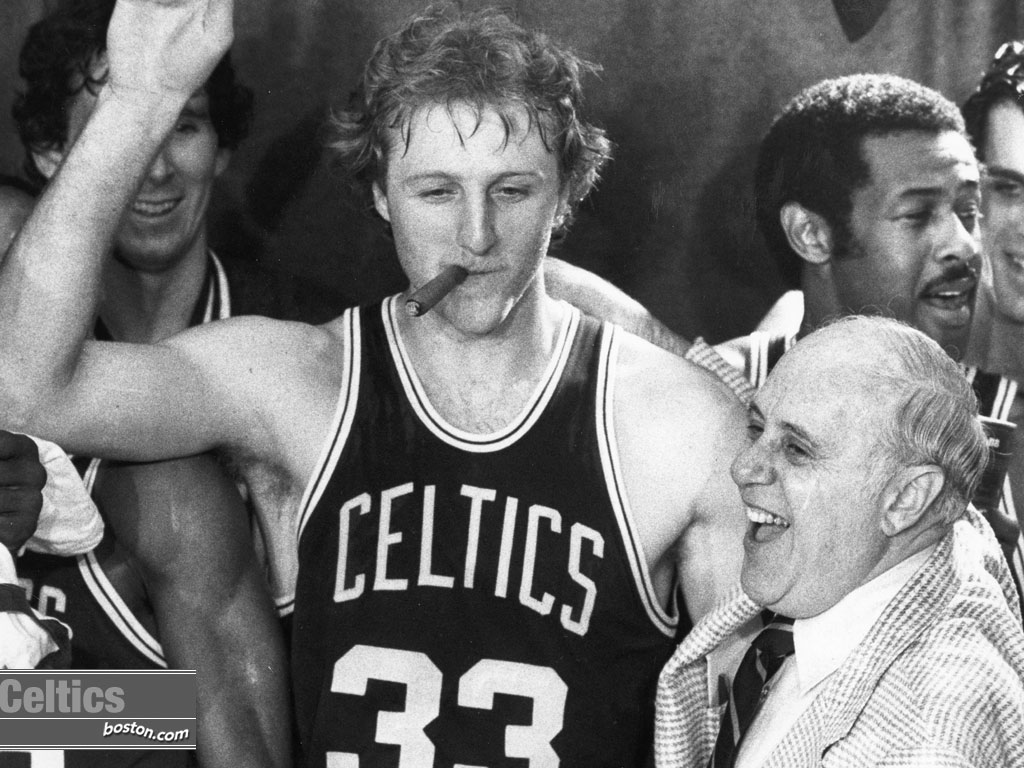 Hello, I’m a 25-year-old Celtics fan. There are many others like me.
 Wildcats and a certain “door”. Reality for us is not-Tim Duncan.
 I did know it was the proudest moment I’d ever had as a Celtics fan because the pride I felt was 100 percent genuine and solely my own. It was also the most unique moment I’d ever had as a sports fan because it had nothing to do with winning or losing.
 In decoded speak, the previous paragraph reads like this: Ray Allen (finally!) became Ray Allen again, Kendrick Perkins went all Bill Russell on us for three quarters, and the Celtics positioned themselves within a win of the NBA Finals for the first time in 21 years.
 of the third quarter Kevin Garnett missed a long jumper; Perkins positioned himself and hauled in the offensive board, felt single coverage from Antonio McDyess and calmly backed him down before sinking a turnaround shot. A few minutes later he swatted Jason Maxiell’s layup attempt, which led to a shot clock violation for the Pistons. He sported a KG-like scowl running back up the floor as the arena wildly applauded.
 vanquish an opponent in a Game 6 with the safety net of a final decisive game in Beantown on a Sunday.
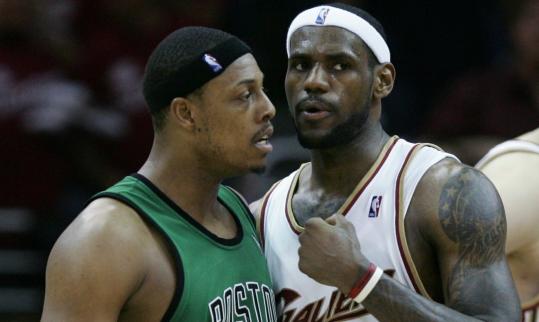 Then, as if sensing its visceral reaction was slightly misplaced and maybe premature, the stadium came to a prompt hush as Pierce was about to release the ball.
 When it was over and the Celtics had prevailed, survived, escaped–however you want to put it–the clock read 6:31 pm. Afternoon may have turned into evening outside on Causeway Street, but inside TD Banknorth Garden for three hours on a Sunday, time stood still.
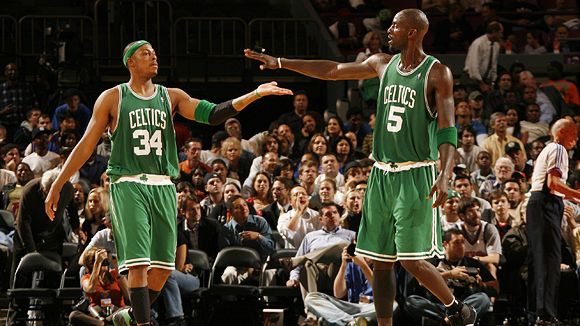 permanently tagged “if necessary” on the schedule–I can’t help but think: Maybe this was a good thing.
 forced to reevaluate, forced to reflect — not on 66 wins, but on two losses.
 they were forced to preserve an identity without their centerpiece.
 who have led the team. Take, for instance, Allen’s comments prior to unquestionably the biggest game of the season against Detroit on March 5. “What is this game 59 for us? It’s business as usual.”
 ego is accordingly robust. He could conceivably be a problem for the incumbent and up-and-comer at his position, Rajon Rondo. Just don’t count on it.
 set by the Russells and Havliceks and Birds and McHales. It’s a standard that, in light of tragedy and incompetence, was almost wiped clean from our memories.
 objected to such a proclamation, retorting that, “If they win 72 games I’ll walk from here to Phoenix…in a speedo.” Let the record show that TNT headquarters are in Atlanta (and who’s to say Barkley doesn’t walk from his hotel to the studio in a speedo everyday?). But I digress.
 Pierce is 30, Garnett is 31 and Allen is 32. That makes a huge difference when talking about a minimum-100 game season. So the easy answer will be to get the three stars some time to collect their breath before the real games commence.
 ever-fading tradition. Then some pieces of s–t tried to take that away from us in 2001, tried to murder our first star in more than ten years. Not only did they fail, not only did Paul survive 11 stab wounds but he returned to lead the Celtics to 49 wins and their first birth in the playoffs since Larry Legend. They won nine games that postseason, all thanks to Paul. His surreal decisive-Game 5 (46 points) in the first round against Allen Iverson and the 76ers was one-upped only by his pantheon performance in the Fleet Center’s first Eastern Conference Finals game against New Jersey. In that contest the Celtics entered the fourth quarter trailing by 21 points. Paul responded by playing the most jaw-dropping 12 minutes of basketball I’ve ever seen, slashing into that deficit with 19 points of his own to win the game and snag a slice of history. That one playoff run, with those two games intertwined, was good enough to place Paul at the top of lists in Celtics-record books co-populated by some of the greatest and most prolific champions in the history of the game.
 off a stretch in his career where he wasn’t given a whole lot to work with in the jungle that is the West. Like Paul he never complained, always played with a smile on his face and continued being the long range assassin that he’s been since he took to the hardwood. And like Paul, he plays with a distinct passion and rises to the occasion when the occasion warrants it (translation: when the game’s on the line he wants that rock). All and all he’s the guy Paul deserves to have as his wingman and yes, while it would’ve been nice if this had happened five years ago, I have news for you: it didn’t. Nothing has happened in the past five years and no one knows that better than Paul. Furthermore, unlike colleagues of similar stature he’s never used his spotlight to shake down front offices and toss around ultimatums, and when he’s called for change he’s done so respectfully. Granted, at times he’s been angry, but he’s only human, not to mention a fierce competitor who tasted a morsel of postseason glory as an up and comer.