Skip to content

Archive for

See Ya Manny, So Long Dynasty

I received a text from a friend the night before the trade deadline when it looked like Manny Ramirez was headed to South Florida to join the Marlins. The text read: “Worried yet?”

My response: “They won’t do it. Not with a dynasty on the line.”

(One of the great sports debates is what constitutes a dynasty. It’s clearly a subjective interpretation of greatness. In this scribe’s opinion a team must win back-to-back titles plus another one within a few years, which is to say any franchise that wins three out of five championships is worthy of some manifestation of the term “dynasty”. A banner in 2008 would mean three out of five for the Sox.)

So my rationale was the Red Sox brass would not threaten what is at least arguably a potential dynasty in the making, particularly given that David Ortiz spent a significant period of time on the shelf and the team didn’t fade.

Given that Josh Beckett is fixing to turn it up, that Dice-K has been far from the liability most believed he would be this year and Jon Lester is the second-best lefty in the American League.

Given that Jonathan Papelbon is still the surest thing this side of Mariano Rivera when it comes to closing games in October.

Given that the most prolific offensive tandem since Babe Ruth and Lou Gehrig was intact again for the first time since it co-slugged its way to a second World Series in four years.

Given that cumulatively this team was unequivocally gearing up for another title run.

I didn’t think it would happen because I’ve come to understand the whims of this ownership. John Henry, Tom Werner and Larry Lucchino have personalized the experience of being a Red Sox fan because they themselves are Red Sox fans — ones who happen to be ridiculously wealthy businessmen who assumed control of the enterprise.

Too often in sports business and figures detract from what is ultimately best for a team. With Manny’s eight-year, $160 million deal, it was at times a wise business move for the ownership to remove all those dollars from its weighty payroll. Hence irrevocable waivers in 2003, a busted trade for Alex Rodriguez in 2004, and annual deadline talks with the Mets’ Omar Minaya about a Manny move to Flushing.

In all instances, getting rid of Manny was the smart business move, the best for the bottom line. But Theo Epstein — acting on behalf of the trio — abstained from ever pulling the string because of one prevailing reason: The guy was too damned good and too vital to the most important end of winning. Winning superseded personal relationships. Winning supplanted smart business.

To this ownership, winning mattered most. And in pennant races and pursuits of October glory, Ramirez behind Ortiz gave the Red Sox a decisive inside track to victory.

I’ll be frank: Manny has always been a pain in the rear (to put it gently) through the eyes of ownership and his colleagues. It was just always kept more or less under wraps, in that Manny for the most part squawked privately and off the record, which meant only bits and pieces were divulged.

I’m sorry, but it’s no coincidence that the historically publicly soft-spoken Manny signed with Scott Boras before (essentially) a contract year — the Red Sox held two $20 million club options for 2009 and 2010 on Ramirez — then proceeded to start voicing all the displeasures he’s traditionally voiced behind the scenes directly to the media.

Boras, who’s likely still peeved at the Red Sox for holding him hostage two summers ago over the Dice-K contract, saw the perfect opportunity to turn the tables on the only contingent to have gotten the better of him at the negotiating table.

He knew that unleashing the Manny circus on the public would force the hand of the club, force them to 1) pay monetarily to get rid of Manny (which they have, $7 million), 2) dispose of him for seventy cents on the dollar (which they did, for Jason Bay), and 3) line Manny up to get shown the money come this offseason (which if I were a betting man…).

Done and done. And just like that the Manny Ramirez era came to a prompt conclusion in Boston.

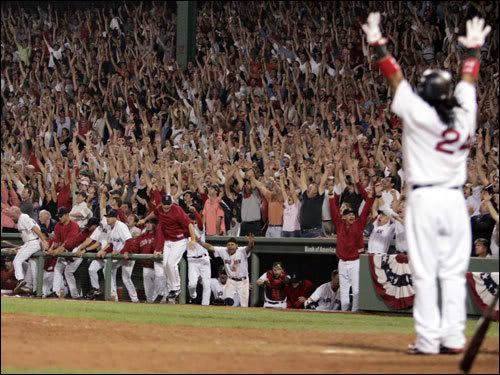
What truly perplexes me is the fact that lots of fans and writers are on board with the move. Proponents of the trade would point to the fact that Manny’s bullheadedness was tearing the team apart from the inside, that his antics have been far worse this year than in the past.
Not true.

Manny has always been Manny. To the fans and outside world he was frequently endearing, quirky and warm, while behind closed doors he was consistently self-centered, obstinate and vexing. Bottom line is he has forever lived in Manny World, in spite of everyone around him — be it media, teammates or bosses.

(If you’re not convinced, pick up Seth Mnookin’s Feeding the Monster. It is the single most illuminating piece of writing about Manny and the organization.)

Due to that longstanding discord it was obvious that Manny and Boston would part ways after this season. After finishing what unofficially kicked off in 2003, the most prosperous era in Red Sox history. Like it or not, like him or not, the Red Sox with Manny Ramirez were most sufficiently primed to defend a World Series crown for the first time in nearly a century.

Debating team chemistry, managing motives and money is moot. Through everything that has gone down in the last week, only two facts have emerged: 1) The Red Sox are a decidedly worse team today than they were on the morning of July 31, 2008, and 2) If they should get there, the Red Sox will be a far less intimidating force in October than they were in ’04 or ’07.

Don’t believe me?

Just ask any Angels or Yankees fan.

Deal or No Deal? Three Keys to Makin’ Deadline Moves

With another MLB trade deadline upon us and most fantasy deadlines looming soon thereafter, it’s time to start dealing. Now is it always imperative to make a move just because some predetermined date in time says you must? No, I’ve never been a proponent of dealing for the sake of dealing.

However…

Unless your team has been leading the pack from the word go (in which case it’d be wise to stick with what you’ve got) or been feeding on the sewage of the basement since April (in which case it’d be wise to bounce that overdue check to the commish), chances are you need to make a trade.

Of course, sometimes making a move can be detrimental. I swung a deadline swap with a buddy last year, sending him Gary Sheffield (at the time a Top-5 fantasy player) for Roy Oswalt and Placido Polanco. Oswalt went 6-2 with a 2.57 ERA in the second half while Polanco batted .348. Sheffield hit .203 before going on the shelf.

(Yes, the trade was only detrimental to him, and yes, our friendship was temporarily bludgeoned.)

Truthfully, I got lucky considering before that move I had an ultimately nixed proposition on the table with another friend that would’ve netted me Eric Gagne (you know, the Texas closer who saved 12 games with a 1.32 ERA before the All-Star break, remember him?). I can’t recall off the top of my head what I was going to be giving up for him, but I do know that it was more than Richie Sexson and a bag of baseballs.

Needless to say, hindsight gave way to elation when Gagne pitched his way into the recesses of the Boston bullpen and onto the waiver wire, sparing me the regret of having been party to the worst fantasy deal of all-time.

So you see? That’s the glory of swinging deals at the deadline, that element of the unknown. Because of that, there remains no fool proof method to deadline maneuvering. Though there are a few keys.

Without further ado…

Key No. 1 — Be thorough with assessments This is the most basic, yet most integral aspect of crafting the successful deadline deal. With two-thirds of the season on the back burner, the only direction you should be looking is forward. However, within this context more often than not that requires looking back to previous years. For various reasons, certain guys simply live for the twilight. You must seek them out, for these are the players who will bring home the most bread in the shortest period of time. Some don’t heat up until the pressure starts to mount (Bobby Abreu, Robinson Cano, David Ortiz) while others just don’t seem to find their stroke until they’re waist deep in the dog days of summer (Garrett Atkins, Mark Teixeira, Nick Markakis) So before locking in a proposal be sure to, you know, cover your bases. (Sorry, I couldn’t resist.)

Key No. 2 — Don’t be afraid to shake things up (aka the Theo Epstein Corollary) A mere four trade deadlines ago, Theo Epstein literally put his career on the line by trading away the iconic Nomar Garciaparra for Orlando Cabrera and Doug Mientkiewicz. The Red Sox were an underperforming .500 ballclub in need of an overhaul. So Theo pulled the trigger on one of the most controversial trades in Red Sox history, a deal that marked a watershed moment for a tortured franchise. My point being, if Theo was willing to assume the burden of seven generations of rabid and crazy Red Sox fans, don’t balk at the prospect of pulling something of a fantasy equivalent. If your team has been sitting middle of the pack, the time has come to part with a titan. Max out the value of a Josh Hamilton, Adrian Gonzalez, Carlos Quentin or Nate McLouth by packaging one of them and going in a different direction. It’s worked before. (And as opposed to Theo, if it all fails you won’t have to board up your windows.)

Key No. 3 — There’s no harm in asking (aka the Danny Ainge Corollary) When Ainge (the Celtics GM) sent to his buddy Kevin McHale (the Timberwolves GM) a pu pu platter wrapped in a green ribbon, not many believed Kevin Garnett would emerge in return. True, most fantasy commissioners would scream collusion if something similar happened between friends in fantasy baseball, but hey, if Ainge and McHale were able to pull one over David Stern, I say anything is possible. So for all you owners out there still stewing over the 11th pick you received in the draft, make your play for Hanley or Utley. Worst case scenario is a rejection. (Or put another way: A supermodel isn’t going to ask you out. You just gotta try your luck.)

Why the All-Star Break’s Not All-Fun

Look, I love the All-Star break. Watching the Howards and Brauns of the world take aim at Tim Wakefieldesque fastballs in the Home Run Derby while the Mannys and Chippers soak it all in with camcorders in one hand and tykes in the other, that’s always cool. Seeing the AL and NL band together against one another with home field in the World Series on the line is a great twist. And if you’ve ever had the opportunity to attend a FanFest, you know what I’m talking about. I mean, who wouldn’t want the virtual experience of stepping into the batters box against Pedro in his prime?

So yeah, All-Star festivities are awesome and there’s no disputing it. There’s just one small problem.

No fantasy baseball for three days. Three days! That’s 72 hours. Or about 65 hours longer than the longest I’ve gone in between checking the progress of my squads these last three months and change. Chances are if you’re reading this column you’re nodding your head right now in acknowledgment of this hobby/sickness we share.

(Take some deep breaths, they help.)

Indeed, it only took that first day to slip into a full scale fantasy withdrawal. I’m not kidding; I woke up Monday — forgetting that it was that Monday, the one like no other from April through September — and per habitude groggily opened up Yahoo Fantasy Sports. I was horrified to discover that not only was I about to embark on my annual thrice-sunset fantasy fast, but Yahoo was performing site maintenance and the entire fantasy shebang was going to be shut down for at least 24 hours.

(Paper bags, they also help.)

So there I was, totally in the dark, no idea of what the latest standings were or what new smack talk was up on the rumor mill — two of the only things that can lighten up a Monday morning. Sure, it will be better Tuesday, but there still won’t be any pitching matchups to troll through or stats from the previous night to digest. The wait will continue.

Some of the sparse contingent of fantasy haters like to point out that it’s pure folly to invest so much time and effort into something that produces no monetary return other than prize pool money. (Yes, some of these folks call Wall Street home.) That notion introduces the other tier of this fantasy withdrawal we’re experiencing.

Work. Of the estimated 19.4 million fantasy sports participants in North America (according to Ipsos), I would assume a good deal of them are among the working class. I’d also surmise that a decent proportion of them probably feel something ranging from mild discontent to outright hate for their vocation. Fantasy is figuratively and — within this context — literally their escape.

Only fantasy baseball can allow someone to indulge a daily passion and also scorn a boss — all while on the clock. In other words, the list of people who scour fantasy stats on their own time is a lot shorter than the list of those who do it on their employer’s buck.

Take two of the guys in my league. One of them is an investment banker who spends so much time making sure he’s on top of all baseball intel I wouldn’t be surprised if he knew about Edinson Volquez before the Texas Rangers. The other is a public school teacher that the kids love because of all the movies he shows during homeroom while simultaneously bootlegging Wi-Fi and meticulously adjusting his roster before the night’s games. They, like so many during this mandated fantasy catnap, are feeling the emptiness and that sense of a loss of equilibrium.

I wish I had a remedy, but I don’t. My only intention is let you know that it’s aright, you’re not alone. There are lots of others out there just like you — starving souls, breathlessly waiting for Thursday to come, for that singular pursuit to resume.

Second Half will Tell All in MLB, Fantasy

Something funny happened last weekend. The Red Sox and Yankees played a pretty darned good split four-game series, yet nobody seemed to notice. Of course the talking heads will cite how the Yankees aren’t that good (they aren’t) and how the whole Sox-Yanks thing has become totally watered down (it has).

Fact is, the rivalry hasn’t been close to what it was in the glory days of 2003-05 — when five hour, extra-inning, extra hating blood matches were the norm, and seven-game epics with pennants on the line were the closing acts. It had, however, maintained its standing as the story of the moment whenever it renewed itself — until now.
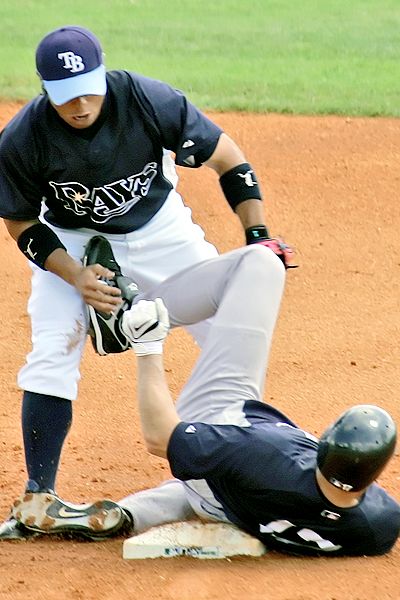
Alas, thanks to a devilish doormat promptly shedding half of its moniker and undergoing a hasty metamorphosis, Sox and Yanks are now as dated as the Devil Rays themselves.

The Rays though? Now there’s a story.

Spawned by predecessors who could never fare better than worst — and were most noteworthy for sporadic “jayvee vs. varsity” dustups with the Sawx and Bombers — this new and improved and monosyllabic contingent from Tampa has taken baseball by the jugular in ’08.

They’ve been a lap ahead of New York all year and have swept Boston twice at Tropicana Field. The most recent broom job, culminating on July 2, had those talking heads foaming at the mouth. Some waxed poetic, associating the Rays’ many weapons with the various tentacles emerging from the body of an octopus. Others boldly proclaimed that the Rays would use the thrilling series as a springboard to a championship. And all this gushing was amid constant reminders that — you might want to be sitting for this one — Rays fans somehow managed to outnumber Sox fans at the Trop! Three games in a row! Heady stuff.

Look, as a Red Sox fan with a keen interest in the Rays after what they did to my team (twice), I’m not about to dismiss the path traveled by this young and redoubtable ballclub. Though I will point out the possibly hazardous path that lies ahead.

Any team that can pull into the All-Star break improbably leading its division is automatically branded with expectation. When play begins in the second half and that bullseye is suddenly squarely on your back, that’s when things can start going awry. It should be noted that the term “second half” is a bit misleading. When the Rays begin playing again after the All-Star break, they will do so with 94 games (or 58 percent) already in the books. That leaves just over 40 percent (or 68 games) of the season to be played, which means after a handful of contests the Rays are going to find themselves in the thick of a pennant race.

It’s a pennant race that’s going to have to be waged over two months against a couple of Goliaths who have no love lost for this new flavor in the AL East (and if anything, have softened a bit on each other as they mutually acknowledge the new blood).

If the baseball season as a whole is like a marathon, the second half is more like an 800-meter race — pacing remains critical but the event feels more like a sprint. One poor road trip while your competitors are taking care of business can be fatal. The pressure mounts with each passing day.

While the Red Sox (two titles in the last four years) and Yankees (a combined 147-80 over the last three second halves) have proven themselves to be the standard-setters for finishes, the Rays have no basis for comparison because they have played the spoiler role down the stretch every year of their existence.

Am I writing the Rays off? Far from it. I’m just calling for some tempering of October predictions until the young guns have actually experienced an existence with bona fide expectations. Lest we forget, expectations have been known to weigh down even the fleetest of foot.

And now here are some players who — like the Red Sox and Yankees — are established second half destroyers, and should be accordingly protected/coveted.

Garrett Atkins One of the true all-around hitters in the game. Atkins hones his batting eye over the course of the season and by the time the All-Star break comes and goes, the third baseman is locked in. He batted .354 with a .437 on-base percentage, 18 homers and 62 RBIs after the hiatus in 2006 and followed that up with a .349/.409/12/58 second half last year. Hold onto him tight, his best is still to come.

Nick Markakis He may be one half German and the other half Greek, but the young outfielder is all about the second half. In 2006 — his first year in the bigs — Markakis batted .311 with 14 homers and 41 RBIs after the break. Last year his second half was even bigger, as he sported a .325 average with 14 homers and 61 RBIs over the last 40 percent of the season. Do what you can to secure the services of an established twilight performer.

Mark Teixeira Of all the blue-chip sluggers out there, Teixeira is the one who has made second half dominance his calling card — at least over the last two years. In the first halves of 2006 and 2007, Teixeira meandered along, doing his best Brian Daubach impression (9 homers/49 RBIs in ’06 and 12/41 in ’07). Then, after the All-Star respites, he got mad (maybe because some fool dared utter his name in the same breath as Brian Daubach), going off for 24 bombs and 61 RBIs in ’06 with an encore of 18 and 67 last year. If someone offered me Teixeira for Adrian Gonzalez today, I’d do it in a heartbeat. But that’s just me.

Johan Santana Second half surges from the rubber begin and end with Johan. Forgetting last year — when Johan was less himself than John Malkovich was in “Being John Malkovich” — Santana has been downright nasty when the margin for error becomes smaller. Please allow his second half numbers to speak for themselves: 10-1, 2.54 ERA in 2006; 9-2, 1.54 ERA in 2005; 13-0, 1.21 ERA in 2004. So… Yeah… You might want to keep the guy around for the remainder of ’08.

Southside Baller

So I was at a Talib Kweli show at the Museum of Natural History last weekend, and I bumped into an old buddy that I studied abroad with in Paris back in 2003-04. He was a former collegiate athlete who played soccer at Morehouse College, and his story was the first feature I ever put together. Set partly against the backdrop of Paris, the piece never made it into print. Feeling a wave of nostalgia, I decided to dig into the vault and pull out the story. It’s both a window into the life of an interesting guy as well as a case study of my formative years.

——————————


Khalil Um’rani sits in his eighth-floor bedroom, which overlooks the sprawling east side of Paris. A storm is moving in, the jet-black clouds inching closer to the outskirts of the city. However, in the 11th arrondissement of Paris the sun is shining bright.

“More rain out in the banlieue,” Um’rani observes. He huffs. “Whatever, I just go and play soccer, then get the hell out.”

While the thirty-minute trip he takes out to the suburbs of Paris every week may not be a long journey, it is indeed a voyage to a different world. But then again, Um’rani is a voyager. One who happens to be pretty good at a game more global than even Um’rani himself.


He grew up on the Southside of Chicago with a passion. He looks like a soccer player, tall and lean, his features sleek. The contrast between his dark skin and light eyes gives off an air of competitiveness. His friends were athletes too, but while they were practicing cross-over dribbles and touchdown-jigs, Um’rani was traveling two hours out to the suburbs of Chicago to play club soccer.

“My friends didn’t even understand where I was coming back from,” Um’rani remembers. “And they definitely didn’t understand what I was doing with these weird white boys.”

Even he may not have been able to answer that question, but Um’rani knew one thing: he wanted to play soccer. Ever since seeing it on television and wishing he had a goal in his backyard, soccer was it for Um’rani. So he went to the only school on the Southside, Hyde Park Elementary, which offered the sport. He was the best. He then tried his hand at youth soccer, scoring 20 goals in an eight-game season. Undisputed.

Club soccer seemed to be the best venue for this talented young player. But that meant dedication, time, and money. And that was just for his parents, Rashad and Deborah.

“Soccer was what he took to,” his father recalls. “It was kind of an oddball hobby, but it was what he wanted to do.”

Um’rani knows that his parents had to make sacrifices in order for him to play, especially when he decided to go out for the city’s most elite club team, the Chicago Magic. Um’rani joined the team in sixth-grade, and continued right through high school. Spending an average of six hours per-day dedicated solely to club soccer, Um’rani honed his self-proclaimed “fast and gritty skills” into a package worthy of competing at the next level.

Sure, he played high school too, starting and scoring 19 goals as a freshman for St. Ignatius College Prep. But in terms of significance, high school soccer was a distant second to club.

“Club soccer is a year-round event,” Um’rani says. “Kids are dropping two, three grand a year to play. All the coaches are professional, and, as opposed to high school, you don’t have to watch your teammates smoking weed before games.”

On the club, it was all business: kids who wanted to be there, kids who wanted to be discovered. Whenever college coaches came to Chicago, they came to see the Magic.

“Recruiting is all in the club leagues,” Um’rani explains. “It doesn’t matter if you score forty goals in a school season, you’re not going to get the looks.”

Um’rani started to get the looks junior year in high school, after the Magic joined forces with Chicago’s other major club, the Sockers, and won Nationals in Florida. A little more than a year later he was headed to Atlanta to play Division II soccer at Morehouse College.

It was there that Um’rani learned valuable lessons. They were not, however, lessons that he wanted to learn. He knew something was wrong when he red-shirted his freshman year, but still appeared in a few games under the names of active players. The team finished 16-3, but because Morehouse is an independent school, it did not receive a bid to the Division II tournament.

The following season, two players left school early to turn pro.

“We won like two games that year,” he recalls. “And we would be taking these long road trips to Alabama, Tennessee, just to get blown out the water. I had never lost like that before. It really makes you feel powerless.”

While Um’rani felt at a loss, he had no idea of what was to come. The previous coach of the team, Dr. Augustine Konneh, had been fired the year before Um’rani arrived amid allegations that he had used ineligible players. The scandal came to a head after Um’rani’s sophomore campaign.

“The NCAA discovered that this guy wasn’t just using ineligible players, he was bringing kids off the streets of Atlanta to play,” Um’rani says.

What resulted was a one-year suspension of the Morehouse program and a student-athlete beginning to appreciate firsthand the flaws of collegiate sports.

“After all this I was just thinking screw-Morehouse soccer,” Um’rani says. “It was evident that soccer and Morehouse were not going in the same direction.”

It was time, Um’rani resolved, to take his own life in a different direction. Having already attended the University of the Antilles in Martinique between his freshman and sophomore year, where he had taken a French culture class, Um’rani decided to study abroad in Paris.

He entered a complete French-immersion program at Paris’s most distinguished University, La Sorbonne. It was in his own quartier, or neighborhood, however, that he made some buddies.

“These kids were as baffled as my boys at home when I told them that soccer was my game,” Um’rani chuckles. “They figured I played le base-ball or le football americain.

They were even more astounded when they saw what this kid from “Sheecago” could do on the field. And he wasn’t even playing his normal position.

“The first time our team, East Paris, assembled for practice the captain came up to me and asked me what I play,” Um’rani recounts. “I told him the best I could that I score the ball. He responded, ‘d’accord, tu peut jouer la défense’. So it was then that I became a defender.”

Um’rani embraced his new role, on a new team, in a new city. From then on every Friday night he would lace up his cleats, and defend like he had never imagined.

His coach, Thomas Jousset, admired Um’rani’s ability to adapt to new situations.

“Khalil became accustomed to our team and style of play very quickly. One must have lots of courage and ability to do something like that,” Jousset believes. “He is very valuable to our team.”

While the evolution of his soccer career had gone hand in hand with the concept of meeting change head on, playing in a foreign league ultimately exposed Um’rani to new cultural experiences that even he couldn’t have fathomed. He remembers playing one of his first games out in the suburbs of Paris. “Our team had lost two in a row, so the guys were already on edge,” Um’rani recalls. “Around the 20th minute of the first half, our libero, or last defender, missed a tackle and the other team scored an easy goal.

“Needless to say everyone was pissed off, but I was astounded to watch as this one kid on my team goes up to the kid who had missed the tackle, and punches him in the face.”

Apparently Um’rani wasn’t the only baffled observer on the field, as one of the few fans hesitantly approached Um’rani with a simple question: Where are you guys from? Um’rani answered that they were from the east side of Paris. The man nodded, remaining puzzled. Does this kind of thing happen often in Paris?

Paris is very segregated,” Um’rani explains. “People from the suburbs don’t understand the city.”


Back in his room Um’rani prepares for his next game, watching as the threatening storm clouds hang over the périphérie of Paris. He’s ready to play, but if the game is called, he won’t be discouraged. For Um’rani, soccer is pleasure these days. Granted, the fierce, competitive fire still burns inside him, but his days of doing battle are over.

Now, he is looking toward the future. And for this economics major that has one eye on Wall Street and the other on international markets, the future looks bright. And his father, who didn’t always understand his son’s passion for soccer, believes that it furnished him with solid foundations.

“Overall the soccer was beneficial,” his father says. “But at this point in his life he’s on another level.”

When Um’rani returns from Paris he will head straight to New York, where he is going to intern this summer at a major investment-banking firm.

As for soccer, Um’rani knows it will always be a part of his life. He will forever be a fan of the game he grew up loving, and he hopes that someday he will help cement the sport in his own backyard.

I would like to start an inner city soccer club,” he explains. “That way kids like me who want to play soccer competitively can do so without having to drive two hours every day after school to get a game.”

For this voyager, it would be fitting that his journey ends where it began: on the Southside, with a passion. Except this time it could be an entire generation that benefits from that passion. And why not? Khalil Um’rani already did the hard part as a kid: he challenged and defeated the status quo.


17 for Them … and One for Us

One day long after Russell and the Cooz and Hondo have joined Red, Reggie and D.J. upstairs, one day when Bird too is talked about in the past tense and TD Banknorth Garden is referred to as “the old house”, I’ll look back on this day. Maybe I’ll be bouncing a grandkid on my lap. Maybe I’ll be perched on a park bench talking to anyone who’ll listen. But I’ll have a story. A story worth telling. One worth hearing. And I’ll recount it as if it were yesterday…

——————————

If one non-defensive play in Game 6 of the 2008 NBA Finals typified the champs it came in the second quarter with the Celtics leading 32-29. Paul Pierce drove and missed a four-footer; Glen Davis grabbed the rebound and went back up with authority but missed. Pierce beat everyone to the ensuing board and after gaining control of the ball kicked it out to Eddie House for a corner trey, which he struck off the back of the iron. James Posey hustled after the long board, hauled it in and threw it back up top for a reset. He went on to assume his place in the left corner, and on cue, received the ball on a crisp rotation from House and buried a three.

All told it was a 34-second possession for the Celtics, a possession that not only defined their stranglehold on the ’08 Finals but underscored what had been the m.o. of the champs from the word go: An undying total team commitment to hustle. From Player 1 (Pierce) to Player 6 (Posey) to Player 11 (Big Baby) — on coach Doc Rivers’ very loosely interpreted depth chart — the focus and dedication was there from the beginning and was highlighted by one microcosmic play that effectively marked the end. The 35-29 spread that resulted from that play would prove to be the closest the Lakers would ever get in what became the most lopsided clinching game in NBA Finals history.

The Lakers as a team were overmatched, which in light of Game 6 was an understatement. And while it would be difficult to find anyone who would dispute that Pierce was the best player in the series (he was the unanimous MVP on all nine ballots), you need look no further than the end of Game 5 for confirmation of said fact. A day after mounting the greatest comeback in Finals history the Celtics had staged yet another furious rally in the fourth quarter of Game 5, cutting a 14-point LA lead to two in the final minute. Much of the damage had been inflicted by Pierce, who through his trademark herky-jerky drives was getting to the basket with such consistency and ease that he had the entire Lakers team on its heels — literally.

As Paul crossed midcourt, ball in hand with the Celtics trailing 97-95, Kobe Bryant — the best player to lace em up since the best of all-time hung em up — waited in his defensive stance. When Pierce went to make his move Kobe darted behind him and back-tapped the ball away from a stunned Pierce. Lamar Odom scooped up the loose ball and threw a lob to Kobe — whose momentum had carried him into the backcourt — and Bryant threw down a two-handed slam that unofficially sent the series back to Boston for Game 6.

Dig a little deeper and you might be perplexed. For Kobe to make such a calculated gamble (back taps are successful about 25 percent of the time and fatal the other 75 percent because failed ones turn into five-on-four situations) with the lead meant only one thing: He knew he couldn’t stop Pierce.

Kobe couldn’t handle the Truth blowing by him for a game-tying or series-clinching bucket on his floor, in his town.

So he gambled (something, by the way, one Michael Jordan only did recreationally off the court). And while the gamble paid off (think going all in preflop in Texas Hold’Em with a pair of twos), Kobe showed his hand. He, the three-time champ and league MVP, needed one man-em-up defensive stand to seal the game and send the Lakers back to Beantown. But he chose not to man up Pierce, who had already dropped 38 in his house and was sniffing 40, 41, and most significantly, 17. Instead he resorted to a playground maneuver reserved for crafty old guys whose knees no longer permit them to get into a crouch and shuffle their feet.

That was the moment I knew it was over, even if it was actually the moment when we found out it was not. But it didn’t matter because Kobe had already given up. Not on his teammates, he had pretty much given up on them after Game 2. By virtue of that desperation play in a non-desperation situation Kobe essentially made it known he had come as far as he could, that there was a player in green who wanted it more than he did and could back it up on the court. And there wasn’t anything the MVP could do about it except roll the dice.

Of course Paul’s performance in itself was MVP-worthy. But it was validated by the best player in the world when he simply yielded to a colleague performing at a higher level. I never thought I’d view a turnover as a watershed moment in defining the greatness of someone I considered to be one of my heroes, but 40 years from now I’ll remember Game 5 of the ’08 Finals as the night Paul Pierce lost the game yet still owned LA.

I’ll also recall the Posey trey in Game 6, how on that 34-second possession the Celtics threw the final knockout blows by refusing to cede the ball, the game, the opportunity. The series ended then and there. The party began while the game turned into an up and down affair with one team playing its best ball in 22 years and another looking a lot like the Washington Generals. Like all vacations, the one that spanned the last two and a half quarters of the 2008 season didn’t last long enough.

Celtics 131

Lakers 92

I wasn’t ready for any of it. The score, the green confetti, the chills. But then I watched them react to it, and the crowd in turn to them, and it started to make sense. Nobody was prepared for it. For about an hour after the Celtics won their 17th championship the Garden was an uncensored window into the reactive mechanisms of a delirious team and its loyal followers.

First Pierce — apparently forgetting what sport he was playing — snuck up behind Doc Rivers and emptied a Gatorade cooler over the head of the (genuinely) surprised coach. The result was a few gallons of fruit punch splashing onto a parquet historically known to be covered in cigar ashes in similar moments. That prompted play-by-play guy Mike Breen to let us know that we’d be having “one more timeout.”

Let’s not forget about the crowd, which likely became the first fan contingent to get a “Dee-fense” chant going during the Larry O’Brien trophy presentation. These folks have always known the game of basketball, and when Doc Rivers responded to a question about how the whole thing got started by saying “defense”, they knew it was an appropriate final laudatory chorus for the champs.

Then there was Kevin Garnett. KG. The literal beating heart of the champs. On the verge of collapsing and nearly in convulsions while being propped up by Leon Powe, who assured him, “I got you, I got you”, Garnett had transformed into a half paralyzed, blissful wreck of a man.

When Michele Tafoya pulled him aside — with confetti already starting to dot the floor — and asked him what it meant to finally be an NBA champion, KG was speechless. He stood still for a few seconds, intense as ever, trying to harness millions of thoughts and emotions, before rearing back and bellowing “Anything’s possible!!! Anything’s possibllllllllllllle!!!”. By the time he gathered himself he was foaming at the mouth and letting out an exuberant and passionate train of thought, half screaming, half whimpering, wholly fulfilling.

As soon as he finished he found his mentor waiting for him a few hardwood squares away. Bill Russell embraced Garnett, the greatest champion to ever compete in athletics and one of the most emotionally drained champions you’ll ever see.

One-to-seventeen, they were all accounted for in that embrace.

————————-

By the time I’m on that park bench or at a birthday party in outer space for my 10-year old grandkid the Celtics may very well have won another 17 titles. Or perhaps not. Maybe they’ll go into a 22-year drought beginning with the 2037 season. Scores more or zero more, I’ll remember only one like it was yesterday. That’s number 17. The one that connected the old generation to the new. The one that gave life to the tradition after years upon years of retold stories of unseen glories.

Thanks to the 2008 Celtics, one day that job — the duty of adding a personalized link to the most storied basketball chain for the benefit of a younger and possibly less fortunate Green generation — will finally be mine.


It’s a Tough Road in the Finals

Just when it seemed like Lakers-Celtics would be the revival act for David Stern’s league, old friend (as in: seedy scumbag) Tim Donaghy had to resurface and cast a dark shadow over the whole shebang. Donaghy — from whatever hole he’s in awaiting sentencing for fixing NBA games — issued a statement before Game 3 of the Finals, alleging that Game 6 of the 2002 Western Conference finals between LA and Sacramento was handed to the Lakers by corrupt officials via an inordinate free throw discrepancy at the end of the game (LA shot 27 free throws in an unequivocally fishy fourth quarter).

This came, of course, after the Celtics took Game 2 from LA at least partly because of a 38-10 advantage in free throw attempts, and before the tables were turned in Game 3, when the Lakers prevailed after being awarded 12 more freebies than Boston.

The ensuing tempest had the talking heads crying foul and the conspiracy theorists filling up their think tank with pointed skepticism. I’m not about to dispute them; some shady stuff has gone down in the NBA playoffs over the last five-plus years and there’s at least one guy who has tainted the entire game. The problem may or may not be systemic. But let’s be realistic. Donaghy is a weak and desperate man. And while at this point it’s nearly impossible to determine the validity of his claims, they are irrelevant to the matter at hand. The Celtics and Lakers were the two best teams in the NBA this year and are playing for the title. There is no fix.

Although I must say I’ve never seen anything like Game 2. It’s really quite simple: The Lakers got no calls; the Celtics got them all. From afar the disparity could be construed as illegitimate, when in fact it was merely a product of contrasting styles of play, and more significantly, the environment.

Lots has been written over the years (particularly by ESPN’s Sportsguy) about how crowds can adversely affect the outcomes of NBA playoff games. That when 18,000 people are united in cause and armed with mighty vocal cords they can succeed in fueling the home team, fazing the opponent and at times, freezing the refs. As an under-25 Celtics fan, this was one of the many truths I held to be self-evident, but never experienced.

Well, after an almost unfathomable act of generosity by my friend’s parents — yes, a ticket to Game 2 of Lakers-Celtics — I was given the opportunity to taste it for myself (and from row 12 no less). Now I may still be a relative newbie in the grand scheme of the sports spectrum, but over the years I’ve found ways to attend sporting events of great magnitude: Yanks-Sox in the 1999 and 2003 ALCS, LSU-Auburn with BCS title implications in 2007, and Game 6 of the 2002 Eastern Conference finals, to name a few.

None of them matched the vibe inside the Garden on Sunday night. From the second the lights went down and the lineups were introduced the place became a force unto itself. With 18,000-plus unified, the building felt like it was taking on a life of its own. There was always a sustained level of clamor. It would subside slightly when the Celtics had the ball and rise to spine-tingling crescendos when the Lakers did.

Moreover, watching the wide-eyed Los Angeles subs get eaten alive by the fierce, ball-hawking Celtics bench was like an intravenous shot of adrenaline into a mass of fans whose blood was already boiling. Leon Powe (21 points off the bench) had a lot to do with it as he emerged from the Celtics bench-by-committee and immediately started taking passes in the post and making strong, often bullish yet agile moves into the heart of the soft interior defense of the Lakers. Led by Powe, the Celtics dared LA to match them physically, and LA succumbed.

Everyone in the stands, in turn, time and again rose up with such wild fervor that nothing could be done to curb what was taking place on the parquet below. That a single man with a whistle could foil the unrelenting will of the faithful and tame the swarming Celtics was pure malarkey. The way they played in the second and third quarter and the way the crowd rabidly pulsated throughout it all made it next to impossible for the refs to impact the game. They could’ve swapped their whistles for paintball guns and still wouldn’t have had a chance of halting play when the Celtics were being perhaps a tad overly aggressive. The arena simply wouldn’t allow it.

A series of Powe throw-downs at the end of the third quarter had me believing that if the old Garden was still sitting next door it would’ve crumbled after being rocked by the tremors emanating from the new house. So you’re telling me that in this environment, a wrist-slap on an ensuing Lakers possession was going to be identified and whistled by a referee? I think not.

Now is that the way it’s supposed to be? Probably not. Crowds — while an integral aspect of the game — should not be able to sway the outcome and render the officials mere bystanders. But time was, that’s how it went down; that’s one of the reasons why the Boston Garden and LA Forum produced nearly half of all NBA titles. That sense of intimacy, of a stake in the action, that’s what has made basketball the unique professional sport from a fan perspective.
Unfortunately that which has given basketball its identity — the ability of a crowd to rise up and become a greater force than the men policing the game — is now threatening the game itself. And it’s all because of (hopefully) a single “rogue” (Stern’s word) official. Let’s get something straight: Calling fouls in basketball is, and has always been, purely subjective. Bodies clash and hands check on every possession of every game. It is the job of the referees to control the chaos.

There’s a monumental difference between refs getting swept up in the moment and attempting to dictate it for personal gain. During the heyday of the league, the former used to happen with great frequency. At this juncture we can only hope that Donaghy’s claims are those of a soulless and desperate man, that some semblance of the game’s integrity can ultimately be preserved.

What we can’t allow to happen is for the abhorrent transgressions of one to sully what remains a riveting throwback series between the two franchises that made the game what it is today. I finally experienced what I’d only previously known through lore, and nothing about what I watched was dirty. What it was was a singular and momentous two and half hours when fans and team together waged battle against an old adversary. That was always basketball at its finest. To hell with one man destroying what many far greater men worked so hard to build.

The Time Has Come for Pride

I don’t remember Magic’s sky hook. Was probably watching Sesame Street when Bird stole the ball. Definitely would’ve rather been fed than seen McHale clothesline Rambis.

Hello, I’m a 25-year-old Celtics fan. There are many others like me.

Forgive us, but this is quite a new experience.

For us, Celtic Pride is mythic. Sure, we feel it — strongly in fact. It’s odd, really. We’ve heard the stories; gripping first-person narratives of triumph and glory, of heart and soul. We’ve seen the legends in the flesh, maybe even had the chance to pick their brains in a restaurant or listen to them give a speech at the conclusion of basketball camp. We’ve watched the games–on ESPN Classic, on YouTube, on box set–and seen for ourselves how it all went down way back when.

We know who won, who scored, who coached, who called it, what the untold side stories were, what the stakes were, where the celebrations took place, when the foundation was laid, how the legacy was built, how it was sustained, and why everyone who’s not us will forever be green — with envy, that is.

Because of the tradition, the pride, we have three dimensions and 360 degrees of Celtic-history.

But it’s not real. It’s the greatest house of cards ever constructed. The most thoroughly and flawlessly conceived fairy tale.

Might as well call it the basketball Matrix because we’ve been plugged into it our entire lives: An alternate hoops universe strictly for our minds. It’s there to keep us proud, to prevent us from associating the Celtics during our youth with the Celtics. And through the passion and dedication of those around us, we have been made to believe that it is reality.

But it is not.

Reality for us is Reggie Lewis breaking our heart after discovering too late that his own was too weak. Reality for us is Dino Radja and Eric Montross as “the future”. Reality for us is M.L. Carr and 15 wins. Reality for us is Rick Pitino, the Kentucky Wildcats and a certain “door”. Reality for us is not-Tim Duncan.

Reality for us is 11 stab wounds.

So here we stand today, in the midst of a new reality. One that needs not be defined and substantiated by the past, only enhanced by it.

Today, that horrible September night seven and half years ago–when we almost lost Paul Pierce–seems long ago. And while it was so nearly the end, only in hindsight can we now see that it was in fact just the beginning.

We went from wondering if the first superstar to don the green since Reggie would ever play ball again, to watching him become the only Celtic to start all 82 games in the 2001-02 season. We were awestruck when he rained 46 points on Allen Iverson and the 76ers in the first deciding playoff game of his career. And we became believers when he singlehandedly led the greatest fourth-quarter comeback in NBA playoff history against the Nets in Game 3 of the 2002 Eastern Conference finals.

The Celtics bowed out at home in Game 6 that year, the deepest they had advanced in the playoffs since 1988. I was tucked away in the upper deck of the Fleet Center (“The Jungle”) that day, but I remember seeing perfectly the smile that beamed on Paul’s face when we stood as one for him after the final buzzer. I recall how the past year flashed before my eyes.

All of it had come so close to never happening.

The entire arena felt how he was thinking the same thing. I’m pretty sure it was that moment when Paul Pierce realized he’d never wear another uniform again and we all realized that one day his number would be hoisted up into those rafters—the Celtic pantheon—rightfully alongside all the great ones.

That was the day the journey really began, we just didn’t know at the time.

I did know it was the proudest moment I’d ever had as a Celtics fan because the pride I felt was 100 percent genuine and solely my own. It was also the most unique moment I’d ever had as a sports fan because it had nothing to do with winning or losing.

Seven-plus years later, it finally does. It would have never been possible without Kevin Garnett and Ray Allen, but their addition and the subsequent return of the Celtics has at last given three dimensions and 360 degrees to what we now know officially began in 2002: the Paul Pierce era of the Boston Celtics.

Now, together, they are four wins from putting the finishing touch on that era and giving a new generation of fans their own stories to pass on. Four wins from sealing two legacies that needed the Celtics as desperately as the Celtics needed them. Four wins against the only team with which we have unsettled business.

Four wins from a restoration: The time has come for pride.

BEAT LA!

The Boston Garden’s Reborn

You know it was another special night at the Garden when 1) there was a Jesus Shuttlesworth sighting for the first time in these playoffs, 2) Kevin Garnett torched the Pistons for 33 points and wasn’t even the second biggest story of the evening, and 3) the Celtics moved into territory unfamiliar to every Green team since 1987.

In decoded speak, the previous paragraph reads like this: Ray Allen (finally!) became Ray Allen again, Kendrick Perkins went all Bill Russell on us for three quarters, and the Celtics positioned themselves within a win of the NBA Finals for the first time in 21 years.

Phew.

Yes, the Celtics’ 106-102 triumph in Game 5 of the 2008 Eastern Conference finals indeed doubled as a throwback evening in the North Station area of Boston.

Ray Allen emphatically returned with 29 huge points — including 5-for-6 on threes and a cold-blooded dagger with just over a minute left when Detroit had cut a 15-point fourth quarter deficit to one.

The Celtics were on their heels after a Rodney Stuckey trey made it a 100-99 game — the closest it had been since (who else?) Allen had put the Celtics ahead for good, 44-42, way back in the second quarter. On a sideline out of bounds play with precious few seconds on the shot clock, Allen took a pass from James Posey and from deep in the left corner buried the longest-possible two point shot (he had a foot on the line). He would add a couple of clutch free throws to basically ice the game.

Then there was Perkins: 18 points (8-for-11 shooting), 16 rebounds, two blocks and two steals. The line actually doesn’t do the effort justice because Perkins–like many of his teammates–pulled a disappearing act in the fourth quarter. That doesn’t change the impact he had on the game throughout the first three quarters, though.

Perk was unstoppable on both the defensive and offensive glass all night, and when he felt an opportunity to take advantage of a one-on-one, he made decisive moves to the basket, scoring almost at will. In one sequence at the beginning of the third quarter Kevin Garnett missed a long jumper; Perkins positioned himself and hauled in the offensive board, felt single coverage from Antonio McDyess and calmly backed him down before sinking a turnaround shot. A few minutes later he swatted Jason Maxiell’s layup attempt, which led to a shot clock violation for the Pistons. He sported a KG-like scowl running back up the floor as the arena wildly applauded.

Garnett himself was not to be forgotten either. He maintained his standing as best player in the series, dropping that 33 on 11-for-17 shooting, including 10-for-12 from the line and a banked trey at the shot clock buzzer a little before halftime.

However, KG’s performance–like his team’s win–wasn’t perfect. He continued to be determinedly unselfish; on a few occasions he forced an extra pass into the painted area when he could’ve pulled up for his trademark midrange jumper.The Celtics had chances to put the game away late but couldn’t adequately defend the three point line as the Pistons drained four from downtown in the final session.

Of course there’s the venerable but nettling Rajon Rondo. The young point guard made up for his peculiar nonchalance handling the ball (between ill-fated behind the back passes and way-too-slow high-arcing lobs into the paint, Rondo just may send poor Bob Cousy into an early grave) by dishing out 13 assists and recording four steals.

Some may say this isn’t the time for splitting hairs, considering the Boston Celtics sit on the cusp of the franchise’s first Finals appearance since Bird lost to Magic in ’87. But just like those Lakers that beat the Green two decades prior, the ’08 Lakers are a formidable machine run by an all-time great ultimately trying to match his predecessor’s five rings. These Celtics are going to have to find yet another gear if they intend to reach their ultimate goal.

But let’s not get ahead of ourselves. They still have to get one more from the Pistons. It’s starting to feel like deja vu, basketball’s version of the movie “Groundhog Day”, but the situation is once again the same: The C’s road-tripping to try and vanquish an opponent in a Game 6 with the safety net of a final decisive game in Beantown on a Sunday.
The way they showed up in Detroit for Game 3, you gotta feel good about their chances to break the mold and advance after Game 6. And with the way they’ve played in the Garden (5-0 in Game 5s and 7s, 10-1 overall), you gotta love their chances of pulling into the title round of the NBA playoffs, even if it takes every last possible game to do so.

No matter what, something special has been happening on that parquet these last six weeks and Game 5 against Detroit was another example.

Be it legends on the sidelines, banners hanging in the rafters or mysterious bounces of free throws (from Paul Pierce’s clanker that somehow found nylon to clinch Game 7 against Cleveland to KG’s that finished off the Pistons in Game 5, it’s time to officially stamp the phenomenon “the Red roll”) going the way of the Celtics, there’s an aura that isn’t just a season or a few careers in the making.

It’s generations upon generations. And it’s powerful.

See you for Game 7 or Game 1.

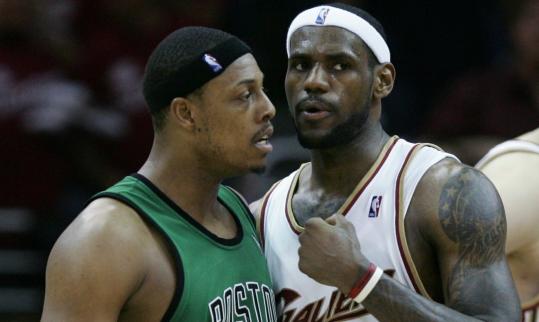
Pierce and Lebron’s Epic Battle

Paul Pierce stood at the free throw line, stoically, mentally preparing for the uncontested shot he was about to take.

The Celtics led 95-92 with seven seconds left in Game 7 against Cleveland, and after the array of jays he had dropped in a for-the-ages showdown with Lebron James, a single point from the charity stripe seemed like a mere footnote on excellence.

The referee bounced the rock to Paul. A chant started to reverberate throughout The Garden, the timing of which was–to say the least–peculiar.

“M-V-P, M-V-P!!, M-V-P!!!!!” sang out the crowd nearly in unison.

Then, as if sensing its visceral reaction was slightly misplaced and maybe premature, the stadium came to a prompt hush as Pierce was about to release the ball.

As he let it go, his face said it all. Long. Way long.

What happened next was a little mysterious, and the rest miraculous. The ball unorthodoxly bounced off the back rim, up and away … then back down again, passing through the nylon on its way.

Paul’s expression went from horror to elation in, well, a single bounce of the ball.

His 40th point gave the Celtics a 96-92 lead. Moments later, his 41st point closed out the scoring of a masterpiece seventh-game.

After a spectacle throughout which–at worst–Paul’s shots deigned to hit the rim, you had to wonder: Did the “MVP” chant momentarily strip Pierce of his focus or did he simply clank a free throw at the most inopportune and unlikely time?

In the postgame press conference, Paul didn’t articulate his thoughts behind the brick, but he seemed sure of how the ball managed to find its way into the cylinder.

“It’s the ghost of Red just looking over us,” he said. “I think he kind of tapped it in the right direction and it went through the net, and it put a smile on my face.”

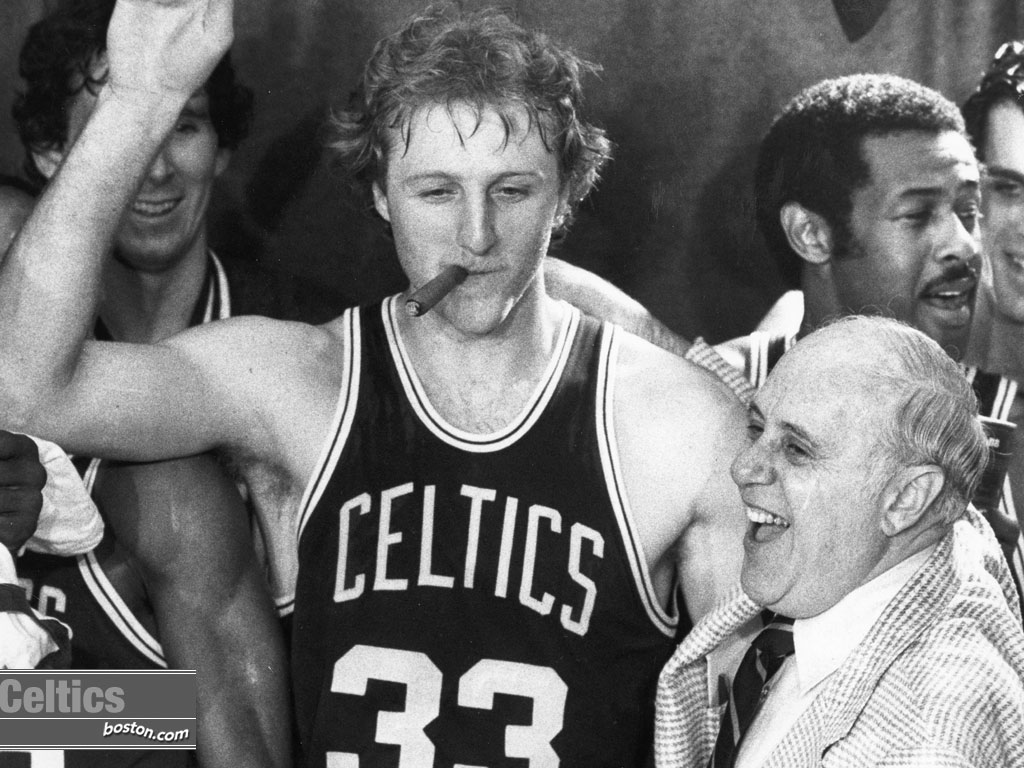
If it was indeed the restless spirit of Red Auerbach, it’s fitting that the departed Celtics patriarch found a way to make his presence felt in this epic Game 7.

It was the proverbial takes-years-off-your-life cardiac affair, rife with pulsating drama, cascades of emotion, and history in the making. The kind of game that used to take place regularly when Red’s cigar still burned on the sideline.

Staged in tandem by the league’s global icon and one of its underrated superstars, played on its most fabled hardwood beneath 16 championship banners, the underrated superstar–carrying the legacies of many men on his back–simply refused to let the global icon (45 points) write the next chapter of his own legacy.

Paul and Lebron. Lebron and Paul.

The two, playing ostensibly a surreal game of one-on-one, went blow for blow. It was Bird-‘Nique and Ali-Frazier-esque. It brought back memories that any Celtics fan under the age of 30 only has through family anecdotes, ESPN Classic and YouTube.

When it was over and the Celtics had prevailed, survived, escaped–however you want to put it–the clock read 6:31 pm. Afternoon may have turned into evening outside on Causeway Street, but inside TD Banknorth Garden for three hours on a Sunday, time stood still.

Again and again Lebron tormented better than 18,000 rowdy proponents of Celtic pride. Sometimes he exhibited brute power by forcing his way to the basket; others he deftly utilized high screens to bury threes.

Over and over Pierce responded.

“Tonight was basically ‘get the ball to Paul Pierce and get the hell out of the way’,” said a revering Kevin Garnett at the podium next to Pierce. “Ya’ll don’t have to ask any questions, that was the game plan.”

From the opening tip Paul dazzled with his jumpers, dug deep to man up Lebron in key situations defensively, and then delivered the psychological knockout blow, slipping by Lebron in pursuit of a crucial jump ball with the Celtics nursing a 91-88 lead in the last minute. He tipped the ball away from James, raced towards midcourt, dove and secured it before calling a timeout.

The house erupted as Pierce lay on the parquet with the basketball still clenched in his arms, fists pounding, exhausted, soaking in the imminence of victory. Once again, his body language spoke for itself.

Afterwards, Lebron succinctly put the pervasive feeling into words: “Obviously Game 7 in The Garden, I knew this was history. This will go down in history.”

“I look forward to seeing it on [ESPN] Classic in three or four days,” Garnett added.

“Straight up.”