Skip to content

Posts from the ‘MLB 2008’ Category

Woulda Been: The ’08 Sox

Well it stomped and it growled after rising from the dead, made a valiant last stand on wounded hind legs … but in the end the mighty beast succumbed…

Four score minus one year ago, the Philadelphia Athletics erased an eight-run deficit to best the Cubs in the fourth game of the 1929 World Series. Almost 79 years to the date, because of what went down at Fenway Park in the fifth game of the 2008 ALCS, there are now two distinct returns to the Google search, “Red Sox greatest comeback in history”.

That, folks, is something to behold.

Face it, we were all doing something else by the middle of the seventh inning of Game 5. The TV might have been on, but the Sox were trailing by seven and the Rays had been cranking balls out of Fenway in a fashion unseen since a certain 19-8 thrashing that precipitated the other distinct return to that Google search.

The champs were cooked, and after another October rife with west coast start times and extra-inning heart-pounders, bleary Red Sox Nation was exhausted.

We had accepted — albeit begrudgingly — our fate. Just wasn’t going to happen this year. Papi was some combination of confused, frustrated (though he hates the word) and hurt. Lowell was done for the season. Ellsbury had lost it. Beckett was obviously pitching through a nearly or completely torn oblique muscle. Dice-K and Lester simply couldn’t shoulder all the weight being thrust upon them by Beckett. The old war horses, Varitek and Wakefield, were guaranteed disasters any time their number was called.

With seven outs before the final bell of the ’08 season, in a seven-run — 7-0!! — game, the most promising post-title Red Sox campaign since pre-World War I was going up in smoke. Check that, was engulfed in flames. It was painful and angering to watch them go down like that, in their house, but understandable given the odds they faced.

Wasn’t our year…

Then, just as that notion was settling into the heads of Nationers far and wide, the Fenway magic found its way back. For everyone in the place, while it may have once again come out of nowhere, the disappearing act the Sox pulled was nothing new. It was the Rays who had little idea that the trick itself — the Red Sox making imminent defeat vanish — was an old habit of this team within the confines of this funky ballyard.

It began with Trot Nixon in 2003, when the Moneyball A’s couldn’t seal the deal in Game 3 of the ALDS, and Nixon made them pay with an 11th inning shot that helped prolong a season.

With that stroke and the formal reverse sweep that followed, a franchise whose losing had been nothing short of Shakespearean for 85 years established a new calling card: the Comeback card. It was a card the hardened Sox would play again in ’04, with Ortiz, Schilling and Lowe leading the way to salvation. Then it reappeared in ’07, this time in the form of Drew, Beckett, Pedroia and Papelbon.

That it happened once more was exhilarating for a city already looking ahead to the Celtics and utterly tragic for another wide-eyed and shell-shocked opponent. That Beckett channeled Schilling in a gutsy, palpably painful Game 6 (is there any other such thing for the Sox in the ALCS?) to force a winner-take-all (Red Sox translation: It’s already over) Game 7 is equal parts inspiring and unbelievable.

Let’s give credit where credit is due, though. Those upstart Rays, who likely believed the Devil had gotten back into them after Games 5 and 6, hunkered down and squared up this new incarnation of Red Sox mystique. They did what the Yankees and Indians could not. They stared down and defeated the incomprehensible force.

Wasn’t our year…

But wait. Had Game 5 gone by the wayside and the final entry in the ’08 Red Sox log had read, “Swept three straight at Fenway, out in five in ALCS”, discontent would have briefly ruled the airwaves and journals in Beantown, but rational thought would have ultimately prevailed.

That’s not what happened though. Game 5 wasn’t the final fizzle of a fatigued, broken down and fragmented contingent. It turned into an epic display of resilience and a reassertion of an otherwise farcical and cliched mentality (“Never say die”) that desperate teams adopt in their darkest hour. The Sox, on the other hand, simply breathe life into the fiction. Since Nixon’s walkoff, they are 12-3 in elimination games.

In a town like Boston, second-guessing after a major sports loss is like familial beef during the holidays: No matter what, it’s gonna happen. The question is whether or not it’s unfounded.

Sure, questions about the makeup and drive of the team would have dominated had they gone out in a five-game whimper. Slowly, however, the masses would’ve realized that the climb out of a huge hole in a league championship series is actually less challenging than attempting to win in the ruthless month of October as a team in tatters.

Yet here we are, just a few million New England heartbeats removed from almost experiencing both.

Now there’s a cause for discontent. Between 2003 and this year, the Nation knows all too well how minute the difference can be between winning and losing a decisive game. Against the Yankees in 2003, the faithful will always rightfully believe that sure triumph was snatched away by a man who never picked up a bat and rarely touched the ball, save for when he was passing it from one pitcher to the next.

Versus the Rays, victory was just as close and it was taken just as unceremoniously. Except this time it was the general manager, not the manager, who made the strategic gaffe. And this time it was during the season, not at the climax of the penultimate series, that the fatal move was executed. You know where I’m going with this.

It must be pointed out that Manny Ramirez just completed the greatest individual postseason in the history of baseball. He reached base in 24 of his 36 at-bats, slugged four homers, knocked in 10 runs and compiled a 1.747 OPS. His .520 average, .667 on-base percentage and mind-blowing OPS were all records. (By my unofficial count there were 10 teams in 2008 whose top two hitters didn’t have a combined OPS of 1.747.)

Now I hate to break the news to you, but Manny didn’t do that because he hates Boston. He didn’t do it (solely) because he desires one last monster contract. He may have morphed into the puppet of Scott Boras off the field and to the media, but between the lines Manny will always be mashing Manny. He logged the most impressive October all-time because he’s maybe the greatest October hitter in the history of baseball.
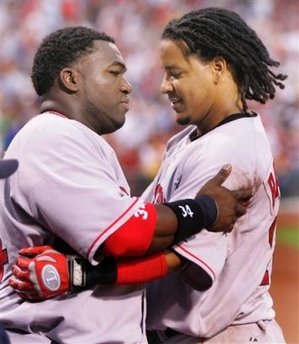
Not coincidentally, his best work has come in the seven league championship series’ he’s participated in (.340/.451/12 homers/30 RBIs in 44 games), making him undeniably the greatest LCS hitter ever. And not surprisingly, the pennant round of the playoffs has been the deciding series of every significant Sox playoff run.

Second-guessing is second nature in Boston, so chew on this. In Game 7 the Red Sox were given a glimmer of hope down 3-1 in the top of the eighth inning when Jason Bartlett booted a grounder off the bat of Alex Cora. A Coco Crisp single and Dustin Pedroia fly out had runners on first and second with one out. Papi was up.

(One quick tangent: There’s no doubt Ortiz has physically been a shell of himself this year, but it’s impossible to quantify the psychological effect Manny’s absence has had on the man we used to call Senor Octubre. Think about it. Every time he stepped to the plate for the better part of six years, he saw in his periphery one of the three best right-handed hitters in the history of the game swinging a fungo bat and stretching out his guns. It wasn’t only the opposition mulling over this dire reality. Manny’s presence unequivocally fueled Papi. The alternative argument is who’s to say what a fully healthy Ortiz would have produced down the stretch and into the playoffs — sans Manny — but let’s be real. He would’ve stood a much greater chance if his bash brother was chilling in the on-deck circle waiting to pick him up when necessary.)

So just like ’03 and ’04, the fate of the Red Sox rested on the broad shoulders of David Ortiz. He grounded out. Youkilis walked. Drew struck out. And for all intents and purposes the season was finished.

Anyone who believes that Manny wouldn’t have smoked a screamer into the gap and won the pennant, or that Ortiz, feeling wholly confident and focused, wouldn’t have again assumed the role of hero has no sense of history. Or chemistry for that matter.

The claim in July was that Manny had poisoned the clubhouse chemistry, but we’ll never know for sure. It’s pretty obvious in hindsight that the vital Papi/Manny chemistry was unilaterally removed at the trade deadline, and conspicuously absent when Theo, the trio, Tito and the Nation needed it most.

Because of that there’s about to be another offseason of pondering what coulda, shoulda been in Boston had they held onto Mr. Mercurial.

Scratch that. What woulda been.
MLB Playoff Preview ’08

Where would the Dodgers be without Manny Ramirez? Where would the Brewers be if they weren’t able to snag CC Sabathia? Would the Angels be 100-game winners with no Mark Teixeira?

And the survey says: 1) Below .500 in second place, 2) On the outside looking in at the Mets, 3) Probably not.

Indeed, if there’s a theme to this postseason, it’s those new faces in new places giving newfound hope to a trio of frustrated franchises.

But hold on, the Dodgers, Brewers and Angels aren’t the only clubs chasing realistic dreams of October glory.

With that in mind, let’s investigate each of the contenders.

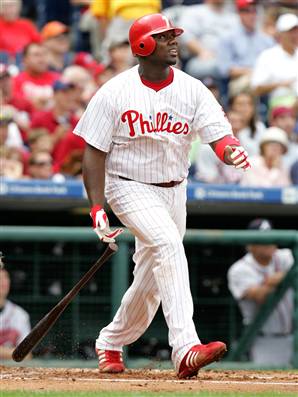
Philadelphia Phillies (92-70, NL East Champions)

Case for an early exit The Phillies aren’t exactly, for lack of a better term, clutch. They took the NL East for the first time since 1993 last year — mainly by playing second fiddle to the Mets and their mammoth collapse — then went three and out against the Rockies in the first round. The 2008 Phillies are basically the same team with basically the same record that felt no pressure down the stretch as the Mets once again faded. And they are expected to win a short series against a squad throwing CC Sabathia twice?

Case for a deep run The three things you need to win a title — an ace, a basher and a closer — the Phillies have. Cole Hamels is as nasty as they come, Ryan Howard and Chase Utley are tough outs that become even tougher in the playoffs, and Brad Lidge converted all 41 of his save chances this year. The formula is there.

Verdict Out in 4 against the Brewers. Because Sabathia threw the last game of the regular season, Hamels won’t be facing him in Game 1. This puts an excess of pressure on the Phils to take the first game. And even if they do they’re likely looking at a split going back to raucous Milwaukee.

Los Angeles Dodgers (84-78, NL West Champions)

Case for an early exit An inability to score runs. The Dodgers Achilles heel the last few years has been just that. Of course sticking Manny Ramirez in the middle of that lineup has paid enormous dividends, but the fact remains that LA scored 155 fewer runs than the Cubs this year, and even with Manny they can’t match the depth of Chicago’s lineup.

Case for a deep run The ex-Sox factor. That would be Manny and Derek Lowe. If Manny continues to smash the ball and Lowe (3.34 ERA in 18 postseason appearances) shows off his abnormally large set of stones, sky’s the limit for this team. Jonathan Broxton and Takashi Saito at the end of games is a dynamic combo.

Verdict Out in 5 vs. the Cubs. Just a tough draw for the Dodgers. If the Mets don’t fritter away another sure playoff berth, Manny and company are headed to Philly for a much easier series. I see them splitting the first two at Wrigley before returning to Chavez Ravine for a tussle with Rich Harden. He’s not the face you want to see in a swing game, no matter what the venue.

Los Angeles Angels (100-62, AL West Champions)

Case for an early exit History. The Angels simply can’t deal with the Red Sox in October. Dating back to 1986 they’ve dropped nine straight to Boston in the playoffs. Their two biggest weapons, John Lackey and Francisco Rodriguez, have been tormented by the Sox in the postseason.

Case for a deep run F— history. Lackey was 2-0 with a 2.81 ERA and .132 BAA vs. Boston this year. They took eight of nine from the Sawx in the regular season. They are a far healthier team than they were last season going into the games that count. And Mark Teixeira completely changes the tenor of that lineup.

Verdict Done in 4 vs. the Red Sox. I’m just not convinced the Angels hurlers can shut down whatever lineup Boston trots out. As good as he was against the Sox this year, Lackey was putrid down the stretch (8.14 ERA and .356 BAA in four September starts). Ervin Santana and Joe Saunders simply don’t instill fear and the Angels bullpen — always one of their strengths — does not cope well with the patient Boston hitters.

Milwaukee Brewers (90-72, NL Wild Card Champions)

Case for an early exit Inexperience. We all saw what happened when the young Brewers got into a pennant race with the Cubs last year. They found that extra finishing gear this time around but that doesn’t change the fact they haven’t been to the dance since 1982. Not to mention succeeding in October requires a shift into overdrive. Is the Brew Crew going to be able to harness all that expectation and emotion?

Case for a deep run Let’s say it together: CC Sabathia. Talk about a man with purpose. In case you missed his body of work last year (AL Cy Young winner, 15 earned runs in 15 1/3 innings in the playoffs), Sabathia has something to prove. As fantastic as he’s been since joining the Brewers, he isn’t getting that desired $200 million payday unless he alters the perception about his ability to carry over regular season dominance into October.

Verdict Beaten by the Cubs in 5 in the NLCS. Sabathia will single-handedly carry them into contention for a pennant. Their lineup should be able to pack enough punch to match the mighty Cubs. Two glaring reasons why they can’t compete with Chicago in a long series: 1) Ben Sheets has already proclaimed he has a “broke arm”. 2) The back end of the Brewers bullpen isn’t strong enough to make up for the loss of the staff’s second-most important arm.

Boston Red Sox (95-67, AL Wild Card Champions)

Case for an early exit Josh Beckett’s oblique strain. He’s already been pushed back to Game 3 of ALDS, and that’s tentative. Oblique strains are by nature nettlesome. They are known to hang around, and in the blink-of-an-eye postseason tournament that is October baseball, Beckett’s is of grave concern to the Red Sox. Oh and have I mentioned the team paid $7 million to dispose of its best hitter? Oh that’s right, I did.

Case for a deep run Pitching. Specifically Beckett getting healthy and joining Dice-K and Jon Lester to form the best starting trio in the American League. All have won at least one World Series game. Beckett (6-2, 1.73 ERA in nine postseason starts) is one of the greatest October fireballers the sport has ever seen. And don’t forget about Jonathan Papelbon. He’s never allowed a run in the playoffs. You read that correctly.

Verdict Beaten by the Rays in 7 in the ALCS. One game swung my feelings about this team. September 9 at Fenway. First place at stake. The Red Sox entered the ninth with a 4-3 lead and Papelbon gave it up. Instead of leapfrogging Tampa Bay and probably cruising to the division title, that was the closest Boston got. And that contest wasn’t the anomaly; it merely underscored what became the norm this year: the Rays coming from behind and stealing games from the Red Sox. What that game did determine, however, was home field advantage for this series. The Rays (57-24) were the best home team in baseball, while the Red Sox, as always, were a different team (39-42) away from Fenway Park.

Tampa Bay Rays (97-65, AL East Champions)

Case for an early exit The pressure that goes with traversing uncharted territory. We’re talking about a team that had never even finished second to last before shocking the world this year. Will the pressure finally catch up to the wildly talented, yet very young and inexperienced Rays? I’m as eager as any to find out.

Case for a deep run Home field throughout the playoffs. As mentioned above, no team was better than the Rays within the confines of their own ballpark. Throw in the fast turf that is ideally suited for the Rays, the circus rules that define Tropicana Field (catwalks are in play!), and the team’s one hardened veteran (Troy Percival) being the guy that will have the ball when nail-biters are on the line, and these upstarts formerly tabbed as Devil Dogs are going to be tough to take down.

Verdict A Game 7 loss to the Cubs in the World Series. (Did I really just write that?)

Chicago Cubs (97-64, NL Central Champions)

Case for an early exit 1910, 1929, 1945, 1998, 2003, 100 years, the Billy Goat, Steve Bartman and quite a bit else that I’m likely missing.

Case for a deep run Rich Harden, Ryan Dempster, Carlos Zambrano, Ted Lilly, Derrek Lee, Alfonso Soriano, Aramis Ramirez, Kerry Wood, Carlos Marmol, Jeff Samardzija and Sweet Lou Piniella.

Verdict The stock market rights itself, pigs fly, the Red Sea parts again, Paris Hilton does gratis club appearances … and … CUBS WIN!! CUBS WIN!!!! CUBS WIN!!!!!!

Deal or No Deal? Three Keys to Makin’ Deadline Moves

With another MLB trade deadline upon us and most fantasy deadlines looming soon thereafter, it’s time to start dealing. Now is it always imperative to make a move just because some predetermined date in time says you must? No, I’ve never been a proponent of dealing for the sake of dealing.

However…

Unless your team has been leading the pack from the word go (in which case it’d be wise to stick with what you’ve got) or been feeding on the sewage of the basement since April (in which case it’d be wise to bounce that overdue check to the commish), chances are you need to make a trade.

Of course, sometimes making a move can be detrimental. I swung a deadline swap with a buddy last year, sending him Gary Sheffield (at the time a Top-5 fantasy player) for Roy Oswalt and Placido Polanco. Oswalt went 6-2 with a 2.57 ERA in the second half while Polanco batted .348. Sheffield hit .203 before going on the shelf.

(Yes, the trade was only detrimental to him, and yes, our friendship was temporarily bludgeoned.)

Truthfully, I got lucky considering before that move I had an ultimately nixed proposition on the table with another friend that would’ve netted me Eric Gagne (you know, the Texas closer who saved 12 games with a 1.32 ERA before the All-Star break, remember him?). I can’t recall off the top of my head what I was going to be giving up for him, but I do know that it was more than Richie Sexson and a bag of baseballs.

Needless to say, hindsight gave way to elation when Gagne pitched his way into the recesses of the Boston bullpen and onto the waiver wire, sparing me the regret of having been party to the worst fantasy deal of all-time.

So you see? That’s the glory of swinging deals at the deadline, that element of the unknown. Because of that, there remains no fool proof method to deadline maneuvering. Though there are a few keys.

Without further ado…

Key No. 1 — Be thorough with assessments This is the most basic, yet most integral aspect of crafting the successful deadline deal. With two-thirds of the season on the back burner, the only direction you should be looking is forward. However, within this context more often than not that requires looking back to previous years. For various reasons, certain guys simply live for the twilight. You must seek them out, for these are the players who will bring home the most bread in the shortest period of time. Some don’t heat up until the pressure starts to mount (Bobby Abreu, Robinson Cano, David Ortiz) while others just don’t seem to find their stroke until they’re waist deep in the dog days of summer (Garrett Atkins, Mark Teixeira, Nick Markakis) So before locking in a proposal be sure to, you know, cover your bases. (Sorry, I couldn’t resist.)

Key No. 2 — Don’t be afraid to shake things up (aka the Theo Epstein Corollary) A mere four trade deadlines ago, Theo Epstein literally put his career on the line by trading away the iconic Nomar Garciaparra for Orlando Cabrera and Doug Mientkiewicz. The Red Sox were an underperforming .500 ballclub in need of an overhaul. So Theo pulled the trigger on one of the most controversial trades in Red Sox history, a deal that marked a watershed moment for a tortured franchise. My point being, if Theo was willing to assume the burden of seven generations of rabid and crazy Red Sox fans, don’t balk at the prospect of pulling something of a fantasy equivalent. If your team has been sitting middle of the pack, the time has come to part with a titan. Max out the value of a Josh Hamilton, Adrian Gonzalez, Carlos Quentin or Nate McLouth by packaging one of them and going in a different direction. It’s worked before. (And as opposed to Theo, if it all fails you won’t have to board up your windows.)

Key No. 3 — There’s no harm in asking (aka the Danny Ainge Corollary) When Ainge (the Celtics GM) sent to his buddy Kevin McHale (the Timberwolves GM) a pu pu platter wrapped in a green ribbon, not many believed Kevin Garnett would emerge in return. True, most fantasy commissioners would scream collusion if something similar happened between friends in fantasy baseball, but hey, if Ainge and McHale were able to pull one over David Stern, I say anything is possible. So for all you owners out there still stewing over the 11th pick you received in the draft, make your play for Hanley or Utley. Worst case scenario is a rejection. (Or put another way: A supermodel isn’t going to ask you out. You just gotta try your luck.)

Why the All-Star Break’s Not All-Fun

Look, I love the All-Star break. Watching the Howards and Brauns of the world take aim at Tim Wakefieldesque fastballs in the Home Run Derby while the Mannys and Chippers soak it all in with camcorders in one hand and tykes in the other, that’s always cool. Seeing the AL and NL band together against one another with home field in the World Series on the line is a great twist. And if you’ve ever had the opportunity to attend a FanFest, you know what I’m talking about. I mean, who wouldn’t want the virtual experience of stepping into the batters box against Pedro in his prime?

So yeah, All-Star festivities are awesome and there’s no disputing it. There’s just one small problem.

No fantasy baseball for three days. Three days! That’s 72 hours. Or about 65 hours longer than the longest I’ve gone in between checking the progress of my squads these last three months and change. Chances are if you’re reading this column you’re nodding your head right now in acknowledgment of this hobby/sickness we share.

(Take some deep breaths, they help.)

Indeed, it only took that first day to slip into a full scale fantasy withdrawal. I’m not kidding; I woke up Monday — forgetting that it was that Monday, the one like no other from April through September — and per habitude groggily opened up Yahoo Fantasy Sports. I was horrified to discover that not only was I about to embark on my annual thrice-sunset fantasy fast, but Yahoo was performing site maintenance and the entire fantasy shebang was going to be shut down for at least 24 hours.

(Paper bags, they also help.)

So there I was, totally in the dark, no idea of what the latest standings were or what new smack talk was up on the rumor mill — two of the only things that can lighten up a Monday morning. Sure, it will be better Tuesday, but there still won’t be any pitching matchups to troll through or stats from the previous night to digest. The wait will continue.

Some of the sparse contingent of fantasy haters like to point out that it’s pure folly to invest so much time and effort into something that produces no monetary return other than prize pool money. (Yes, some of these folks call Wall Street home.) That notion introduces the other tier of this fantasy withdrawal we’re experiencing.

Work. Of the estimated 19.4 million fantasy sports participants in North America (according to Ipsos), I would assume a good deal of them are among the working class. I’d also surmise that a decent proportion of them probably feel something ranging from mild discontent to outright hate for their vocation. Fantasy is figuratively and — within this context — literally their escape.

Only fantasy baseball can allow someone to indulge a daily passion and also scorn a boss — all while on the clock. In other words, the list of people who scour fantasy stats on their own time is a lot shorter than the list of those who do it on their employer’s buck.

Take two of the guys in my league. One of them is an investment banker who spends so much time making sure he’s on top of all baseball intel I wouldn’t be surprised if he knew about Edinson Volquez before the Texas Rangers. The other is a public school teacher that the kids love because of all the movies he shows during homeroom while simultaneously bootlegging Wi-Fi and meticulously adjusting his roster before the night’s games. They, like so many during this mandated fantasy catnap, are feeling the emptiness and that sense of a loss of equilibrium.

I wish I had a remedy, but I don’t. My only intention is let you know that it’s aright, you’re not alone. There are lots of others out there just like you — starving souls, breathlessly waiting for Thursday to come, for that singular pursuit to resume.

Second Half will Tell All in MLB, Fantasy

Something funny happened last weekend. The Red Sox and Yankees played a pretty darned good split four-game series, yet nobody seemed to notice. Of course the talking heads will cite how the Yankees aren’t that good (they aren’t) and how the whole Sox-Yanks thing has become totally watered down (it has).

Fact is, the rivalry hasn’t been close to what it was in the glory days of 2003-05 — when five hour, extra-inning, extra hating blood matches were the norm, and seven-game epics with pennants on the line were the closing acts. It had, however, maintained its standing as the story of the moment whenever it renewed itself — until now.
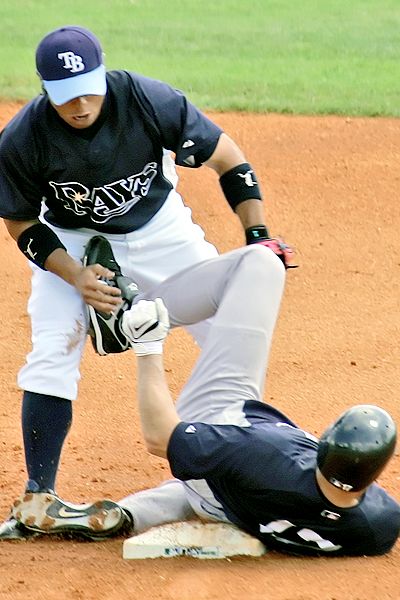
Alas, thanks to a devilish doormat promptly shedding half of its moniker and undergoing a hasty metamorphosis, Sox and Yanks are now as dated as the Devil Rays themselves.

The Rays though? Now there’s a story.

Spawned by predecessors who could never fare better than worst — and were most noteworthy for sporadic “jayvee vs. varsity” dustups with the Sawx and Bombers — this new and improved and monosyllabic contingent from Tampa has taken baseball by the jugular in ’08.

They’ve been a lap ahead of New York all year and have swept Boston twice at Tropicana Field. The most recent broom job, culminating on July 2, had those talking heads foaming at the mouth. Some waxed poetic, associating the Rays’ many weapons with the various tentacles emerging from the body of an octopus. Others boldly proclaimed that the Rays would use the thrilling series as a springboard to a championship. And all this gushing was amid constant reminders that — you might want to be sitting for this one — Rays fans somehow managed to outnumber Sox fans at the Trop! Three games in a row! Heady stuff.

Look, as a Red Sox fan with a keen interest in the Rays after what they did to my team (twice), I’m not about to dismiss the path traveled by this young and redoubtable ballclub. Though I will point out the possibly hazardous path that lies ahead.

Any team that can pull into the All-Star break improbably leading its division is automatically branded with expectation. When play begins in the second half and that bullseye is suddenly squarely on your back, that’s when things can start going awry. It should be noted that the term “second half” is a bit misleading. When the Rays begin playing again after the All-Star break, they will do so with 94 games (or 58 percent) already in the books. That leaves just over 40 percent (or 68 games) of the season to be played, which means after a handful of contests the Rays are going to find themselves in the thick of a pennant race.

It’s a pennant race that’s going to have to be waged over two months against a couple of Goliaths who have no love lost for this new flavor in the AL East (and if anything, have softened a bit on each other as they mutually acknowledge the new blood).

If the baseball season as a whole is like a marathon, the second half is more like an 800-meter race — pacing remains critical but the event feels more like a sprint. One poor road trip while your competitors are taking care of business can be fatal. The pressure mounts with each passing day.

While the Red Sox (two titles in the last four years) and Yankees (a combined 147-80 over the last three second halves) have proven themselves to be the standard-setters for finishes, the Rays have no basis for comparison because they have played the spoiler role down the stretch every year of their existence.

Am I writing the Rays off? Far from it. I’m just calling for some tempering of October predictions until the young guns have actually experienced an existence with bona fide expectations. Lest we forget, expectations have been known to weigh down even the fleetest of foot.

And now here are some players who — like the Red Sox and Yankees — are established second half destroyers, and should be accordingly protected/coveted.

Garrett Atkins One of the true all-around hitters in the game. Atkins hones his batting eye over the course of the season and by the time the All-Star break comes and goes, the third baseman is locked in. He batted .354 with a .437 on-base percentage, 18 homers and 62 RBIs after the hiatus in 2006 and followed that up with a .349/.409/12/58 second half last year. Hold onto him tight, his best is still to come.

Nick Markakis He may be one half German and the other half Greek, but the young outfielder is all about the second half. In 2006 — his first year in the bigs — Markakis batted .311 with 14 homers and 41 RBIs after the break. Last year his second half was even bigger, as he sported a .325 average with 14 homers and 61 RBIs over the last 40 percent of the season. Do what you can to secure the services of an established twilight performer.

Mark Teixeira Of all the blue-chip sluggers out there, Teixeira is the one who has made second half dominance his calling card — at least over the last two years. In the first halves of 2006 and 2007, Teixeira meandered along, doing his best Brian Daubach impression (9 homers/49 RBIs in ’06 and 12/41 in ’07). Then, after the All-Star respites, he got mad (maybe because some fool dared utter his name in the same breath as Brian Daubach), going off for 24 bombs and 61 RBIs in ’06 with an encore of 18 and 67 last year. If someone offered me Teixeira for Adrian Gonzalez today, I’d do it in a heartbeat. But that’s just me.

Johan Santana Second half surges from the rubber begin and end with Johan. Forgetting last year — when Johan was less himself than John Malkovich was in “Being John Malkovich” — Santana has been downright nasty when the margin for error becomes smaller. Please allow his second half numbers to speak for themselves: 10-1, 2.54 ERA in 2006; 9-2, 1.54 ERA in 2005; 13-0, 1.21 ERA in 2004. So… Yeah… You might want to keep the guy around for the remainder of ’08.

MLB “Cinco de Mayo” Fantasy Points

It’s Cinco de Mayo. 30 games are in the books. You know what that means.

Time to begin critically evaluating your fantasy team.

What is your injury situation? Who has underperformed? Who has exceeded expectations? Do you have good balance between offense and pitching? What’s the greater makeup of the league you are competing in? How are you feeling about your squad?

Unless your team is sitting pretty at the top of the standings, chances are you have concerns; chances are most, if not all of the above stated questions are relevant.

Let’s tackle the most cut and dry topic first: Injuries. They are often unforeseen, and are usually unavoidable. That goes for real and fantasy teams alike. Whenever a blue-chipper goes down, a ripple effect ensues. What’s interesting so far this year is that injuries to big name players (Jimmy Rollins, Alfonso Soriano, Scott Kazmir, John Lackey) have had no negative impact on their clubs.

The Phillies and Angels have withstood the losses of Rollins and Lackey; both lead their respective divisions. The Cubs are two games ahead of their pace from last year (18-13 as opposed to 16-15) despite the loss/abysmal start of Soriano. And the Rays just polished off their best April in team history without the services of their ace, Kazmir. Even predictable injuries to Rich Harden and Pedro Martinez have not slowed down their clubs. The A’s and Mets are each within a game of first place in the loss column.

Fantasy owners haven’t been so lucky. While guys like Pedro and Harden have become mid to late round “high risk/high reward picks”, Rollins and Soriano are first and second rounders; Kazmir and Lackey are frequently among the top 10 or 15 starters chosen. Their absence has been an early critical blow to fantasy teams far and wide, specifically in roto leagues.

Even though Lackey and Rollins are close to coming back (Kazmir and Soriano are already playing again) their roto value is automatically diminished because of the time they missed. Barring a supersonic final five months from these guys, you can expect about a 15 percent drop-off in their 2008 stats. Because every fantasy team is built around a few choice stars like them, that can be the difference between a top-three finish and middle of the pack.

In head to head leagues, as long as your team isn’t buried in the standings today, you’ve got nothing to worry about. Since cumulative stats don’t matter in head to head, it’s of no consequence that Lackey finishes with 14 wins instead of 18 or that Rollins scores 108 runs as opposed to 135. You will still maximize their production from here on out.

The next major issue confronting fantasy owners is trying to diagnose the poor starts of established blue-chippers. Jose Reyes, David Ortiz, Ryan Howard, Justin Verlander and Travis Hafner headline this category. With the exception of Hafner–who seems to have lost his craft–roto owners should not be sweating the paltry numbers put up by those perennial fantasy catalysts. Play them everyday; when all is said and done the numbers will be there.

This time it’s the head to head owners who must start rethinking strategy. Since stats are only accrued on a weekly basis, consistently starting a slumping-Ortiz (.216/5/24) or Howard (.167/6/14 and 45 K’s) can be detrimental. They currently carry too much baggage to warrant putting them out there everyday. Of course there’s always the chance they’ll go off for multiple home runs on any given night, but so goes the double edged sword that is head to head fantasy management.

Be it head to head or roto, it is frustrating to managers that the Howards and Verlanders have been so unproductive, but baseball is a long season. The players we have talked about are too good at what they do to fizzle for longer than what equates to a small sample size (again, with the exception of Hafner).

Looking at the other end of that spectrum is important as well. That’s right; role players who have far exceeded expectations to the point of becoming overvalued. Xavier Nady (.347/4/30). Nate McLouth (.323/7/25). Josh Willingham (.341/6/16). Ryan Church (.318/4/22).

All are on ridiculous, career defining paces at the moment, but all will come back to earth sooner or later. This can be a delicate situation in roto leagues. Ideally for each fantasy manager employing a Nady, that manager also has a Howard. That way when the sample size becomes larger (ie when Howard turns it up and Nady levels off), the players will continue to offset one another and the overall team quality will be sustained.

However, if Nady is carrying your team and you’ve suffered no major injuries or slumps, it might be time to make a move. Maximize his selling value now and see if you can’t shore up a weakness (this is a good time to address bullpen issues). Of course, making deals requires having a feel for the climate of the league — are the managers generally tight, therefore hesitant to make deals (designated NBFT: Need Based Fantasy Trader)? Or are they ready and wanting to trade at will (designated CFT: Compulsive Fantasy Trader)?

If you’re in a league with primarily CFTs, don’t hesitate and wait for the other shoe to drop. Now is the time to sell high. If there are predominately NBFTs in your league, keep an eye on the waiver wire, maintain faith in the players you drafted, and wait another month or so before pondering deals. That’s what the real GMs do.

Manny’s Still Manny

Someone needs to pass Manny the memo. You know, the one that tells him how not every long fly ball he hits is going out of the park, ending a game, and moving the Red Sox one step closer to a World Series.

Ever since his walk-off home run in Game 2 of the ALDS, Manny has found it necessary to watch the ball travel — even if it’s not traveling into four-bagger territory.

Since that bomb off Francisco Rodriguez, Manny has become Narcissus reincarnated. However, instead of falling in love with his own reflection, he falls in love with each deep drive he strikes.

Crack! goes the bat on the ball. Only then does he spring to life. His body language is as clear as the sky is blue. Oh the beauty! The power! The elegance! Oh Manny!

Manny’s eyes–with a little help from the arms usually raised over his head–say it all. He is in awe of, enamored by and totally smitten with his God-given and rediscovered stroke. He simply can’t get enough of it.

The opposition kind of already has, though.

Only four games have elapsed this season, and Manny has twice stood in the batters box to gaze at and admire not home runs. The trend began in Japan, when Manny launched a go-ahead two-run double in the top of the 10th inning against Oakland. Thing was, he thought it was destined to be a three-run homer, and stood in the batters box, watching as it … didn’t clear the fence. But hey, the hit still proved to be the game winner.

When he replicated the act in the final game of the same series back in Oakland, it wasn’t as well received. Mainly because the ball was caught. That’s right. Manny–standing proud and erect at home plate–watched a ball get caught.

Of course that finality only further fueled the ensuing comedy, as Manny trekked back to the dugout and, through giggles, tried to explain to David Ortiz et al how he really thought that one was gone. He gestured and illustrated and justified, while getting poked fun at by his teammates through it all. Anyone watching had a laugh.

You know who didn’t? The Yankees. Be assured that new Yanks skipper Joe Girardi is both aware of and not amused by Manuel’s antics.

The whole Red Sox-Yankees thing has become watered down the last few years, mainly because the intensity/hatred that festered between the teams during the 2003-04 heyday no longer exists. The relocations of Pedro Martinez and Gary Sheffield have had a lot do with that.

Remember the so called “market correction” of a few years back? Well I have a feeling that this year we may be in store for a “rivalry correction”.

Girardi has brought a new mentality to the Bronx — or brought back an old mentality perhaps. Whichever way you look at it, the Bombers are the one team that will not sit back and watch the Red Sox show them up. Joba Chamberlain proved as much last September, when he nearly shaved the beard off Kevin Youkilis’ chin with some high and inside heat. And this spring Girardi showed he was prepared to get down and dirty when he (likely) ordered Shelley Duncan to slide cleat-first into the nether-region of Rays second basemen Akinori Iwamura. The result was a classy Grapefruit League dustup.

Taking that into consideration, along with Boston beginning defense of its second title in four years, we may be looking at Sox-Yanks redux in 2008.

Plus there’s Manny. The guy’s loving life and swinging a sweet tune at the plate once again.

As for that memo? It could say a million different things, but all that really matters is Manny’s still Manny.

MLB Points: Opening Day ’08

If you watched baseball on Opening Day 2008–or caught Baseball Tonight or looked at the day’s box scores for that matter–one thing stuck out above all else: bullpen implosions. Out of 12 games, five involved bullpens blowing leads. In four of those contests, one or both offenses put up crooked numbers on opposing relievers in the late innings. Sure, it was the first day of the season and weird stuff tends to happen. Lest we forget, baseball is a sport of odd routines woven into a complex methodology.

So yeah, on day one of 162, lot’s can go wrong, and a fair amount usually does.

However, the failure of many arms late in Monday’s games was more than just a 5 a.m. wakeup call to teams only marginally sweating their bullpen situations — it was the earliest possible indicator of a bigger problem that has spread throughout the league.

Relief pitching has become a dying breed.

There are a handful of dominant closers along with an assortment of overpowering setup men in the game today, but nowhere near enough productive arms to consistently record the final six to 12 outs of ballgames.

After the first full slate of ’08, that issue couldn’t have been any more evident.

Detroit lost to Kansas City because its bullpen failed to prevent Justin Verlander’s inherited runners from scoring in the sixth inning. Then Denny Bautista gave up the winning run in the 11th. The White Sox endured three eighth-inning runs when Octavio Dotel couldn’t hold down a tie game in Cleveland. The Brewers and Pirates watched leads of three and five, respectively, washed away in the ninth inning before rebounding to win in extra innings. And the Phillies saw something of a return to normalcy — a tie game entering the final frame turned into a five-run deficit and a loss when Tom Gordon could barely record an out.

This is a theme that is going to be revisited this year more frequently than any manager –real or fantasy–is comfortable with.

Speaking of fantasy, let’s throw the fantasy spotlight on three important names who played decisive roles on Opening Day.

Fantasy Spotlight No. 1Tom Gordon Flash was nothing short of awful on Opening Day. Sent in to preserve a 6-6 tie against Washington, Gordon gave up five runs in one-third of an inning. He may be old (40) but he’s still owned in 60% of ESPN fantasy leagues. More importantly, he’s not just being counted on to fill in for Brad Lidge until Lidge gets healthy (which should be sometime in the next week or two).

He’s also going to have to be the guy to close games on an interim basis if and when Lidge starts again losing the mental battle that has plagued him since “the Pujols blast” of October 2005. If Gordon can’t answer the call, the Phillies will have no choice but to return Brett Myers to a closing role. Judging from Gordon’s opening act of ’08, the Phils better hope Lidge can keep it together. The bottom line for fantasy owners is Lidge still has great stuff. Gordon does not.

Fantasy Spotlight No. 2 – Eric Gagne How the mighty have fallen. Gagne may have a ring as a result of his service in Boston last year, but it seems to have come at the cost of his mojo. He was so bad in a Red Sox uniform that Terry Francona used him only in mop up situations last October. In his first appearance since receiving an utterly ludicrous $10 million deal from Milwaukee, Gagne picked up right where he left off in Beantown. Entrusted with a three-run lead in the ninth, he promptly gave up a hit, a walk and a game-tying homer to a rookie (Kosuke Fukudome) playing his first game in the US.

The only thing about Gagne that has been more discouraging than his performance is his body language. He hasn’t looked like he’s had any confidence in himself since last July when he was still a member of the Texas Rangers. This is a major concern for the Brewers as well as for all those fantasy owners who are counting on 25+ saves from Gagne.

Fantasy Spotlight No. 3 – Kosuke Fukudome If we’re going to talk about Gagne, Fukudome can’t be left out of the conversation. The guy crossed the globe, came to an organization that happens to be entering its 100th season without a championship, and in his first big league game went 3-for-3 with a game-tying home run in the bottom of the ninth. Forget justifying his potential with comparisons to the Ichiros and Matsuis of the world. I’m already sold.

Of course he’s not going to do that everyday, and will surely go through some understandable transitional struggles, but the makeup is clearly there. Like his countrymen, Fukudome is a professional. You don’t need more than a tiny sample size to see that the latest hacking Japanese import possesses a distinct stoicism. That in itself should do wonders for the most losing franchise in American sports.

MLB Preview 2008

The defending champs in Tokyo. Miguel Cabrera in Detroit. Johan in New York. Joe Torre in LA. Just a minor shakeup from a year ago, no? So how’s it all going down in 2008? Here are the thoughts of one scribe…

On the Outside Looking In

Arizona Diamondbacks (87-75) It’s tough to make the playoffs two years in a row, particularly when you can’t score runs. Last year the Diamondbacks scored 712 runs, fifth-fewest in MLB. They also surrendered 20 more than they scored, making them (by far) the only playoff team with a negative run differential. Good pitching and a pesky lineup one through eight got Arizona to the NLCS in ’07. Adding a second ace in Dan Haren to complement Brandon Webb would indicate the D-Backs are set to be even better in 2008, except there’s one major caveat. Jose Valverde and his 47 saves are now in Houston. The Diamondbacks won 90 games last year, but many of them were thanks to Valverde protecting one-run leads. Webb was a stud from mid-summer on last season, but Valverde was the MVP of the team. Without him, Arizona has uncertainty at the back end of their bullpen. No team wants to adopt a closer by committee. Especially one that needs to constantly protect tenuous leads late in ballgames.

Cleveland Indians (91-71) The following statement is going to make the city of Cleveland cringe (again): The Indians had their shot last year, and blew it. The optimistic outlook is the Indians have a solid and young core and will be competing for the foreseeable future. The pessimistic forecast has reigning-Cy Young winner C.C. Sabathia bolting town for a mega-deal after 2008 (he rejected a four-year, $68 million contract extension and unilaterally suspended talks until after this season). Fans of the Tribe know it was there for the taking last October. Those feelings of regret have been compounded by concern about the future. Which leaves the present. More bad news: The 2008 Detroit Tigers might boast the greatest offense of all-time. Cleveland will be good, just not good enough to return to October.

Into October…But Out

Los Angeles Dodgers (90-72/NL West Champions) The NL West will be the deepest division in the league. In the age of the unbalanced schedule, a stacked division means upwards of sixty games against quality opponents–not including interleague and interdivision play. That puts a premium on overall team balance. When good teams play one another over and over again, the team with the best balance will prevail. The Dodgers have consistent starting pitching (Brad Penny and Derek Lowe), good middle relief (Scott Proctor and Jonathan Broxton), and the best closer in the National League (Takashi Saito). With speed at the top of their lineup (Juan Pierre and Rafael Furcal) and power in the middle (an emerging-James Loney and Russell Martin), LA will avoid the scoring droughts that plagued them last year. Joe Torre’s cool and calm demeanor is also ideally suited for Southern California. The new skipper will lead the Dodgers back to the postseason, but not through it.

Atlanta Braves (91-71/NL Wild Card) Two consecutive seasons without playoff baseball at Turner Field? Are the Braves really still the third-best team in the NL East? On paper they are. But luckily they are looking up at a city and team that deal with high expectations about as well as Isiah Thomas deals with basketball contracts. The Phillies staged an impressive run last year to steal the division from the Mets, but let’s get something straight: the Mets CUH-LAPSED. The city of Philadelphia was still rubbing its eyes while the Rockies were in the process of sweeping away the Phillies in the NLDS. This is the pick I’m most ambivalent about. Both teams have good pitching, powerful lineups and closers who are suspect. I guess I’m going with the Braves because they’re still the Braves (and the Phillies are still the Phillies…)

New York Yankees (93-69/AL Wild Card) I hate sounding like a broken record but I simply refuse to pick against the Yankees in the regular season so long as Derek Jeter is taking the field everyday. Keeping an already established Joba Chamberlain in the bullpen is a wise move, because the Yankees biggest weakness will be their starting pitching. One man who hasn’t started at the big league level isn’t going to change a whole rotation. However, the one-two punch of Joba and Mariano Rivera will protect late inning leads for the Yanks when they have them. More importantly, they will help account for the inconsistencies of the New York starters. This team could find itself down big early in ballgames, but with its loaded and unrelenting offense and a couple stoppers at the end of the game, no deficit will be insurmountable for the Bombers (except the 0-2 one they’ll face against Detroit in the playoffs).

Los Angeles Angels (94-68/AL West Champions) An interesting pattern has developed the last six years. The Angels, Yankees and Red Sox have been the three most consistent franchises in the American League. Since 2002, all three have made at least four postseason appearances and averaged better than 91 wins per year. The Angels have had continued success by playing aggressive baseball; they steal bases, hit and run, squeeze. John Lackey and Kelvim Escobar are rocks at the top of their rotation; Scot Shields and Francisco Rodriguez have been as good as they come at the end of games. In October, however, that all changes. The Angels pitching staff cannot deal with the Red Sox offense, particularly David Ortiz and Manny Ramirez. The Yankees, meanwhile, can barely touch the Angels hurlers. Twice the Yankees have lost to Los Angeles in the playoffs (2002 and 2005), and twice the Angels have been defeated by Boston (2004 and 2007). What am I getting at? The Angels have established themselves as the class of the American League, right there with the Red Sox and Yankees. Seattle will push them hard, but LA will be back in October, albeit briefly.

Playing for a Pennant

Chicago Cubs (89-73/NL Central Champions) The Cubs dealt with their fair share of turmoil to begin the Lou Piniella era. Alfonso Soriano started the year in a prolonged slump and Carlos Zambrano was awful until he punched out his catcher. Once they got rid of Michael Barrett, Chicago started playing like most had expected going into the season. Still, they never seemed to click on all cylinders, and were blitzed by Arizona in the NLDS. This year, there will be stability in the clubhouse–or at least as much as there can plausibly be with Sweet Lou and Zambrano still prone to the occasional outburst.

No matter what, the Cubs won’t have to expend nearly as much energy and emotion in order to win a very bad division. If Kerry Wood can succeed as the closer, this team is built to make some noise in October. They have three horses at the top of their rotation (Zambrano, Rich Hill, Ted Lilly) and a lights-out setup man in Carlos Marmol. If they weren’t inevitably running into a team on a blood mission, I’d say the Cubbies were about to be closing in on their first pennant since 1945. Instead, 2008 will go down as another tantalizing, but ultimately unfulfilling campaign in Wrigleyville.

Detroit Tigers (101-61/AL Central Champions) Admit it. If you’re a fan of any team in the American League, you are dreading the first time your team and this team meet. The 2007 Tigers won 88 games and scored 887 runs. Then they went and added Miguel Cabrera and Edgar Renteria–who scored a combined 178 runs last year. So how many times will Tigers cross the plate in ’08? 950? 1000? More? Apologies in advance to pitching staffs in the AL Central, which will have no choice but to get abused by this sure-to-be historic offense up to 19 times a piece over the next six months. Detroit will be raking from April through September, and into October.

Why then are they not going to be representing the AL in the Fall Classic? Pitching. Specifically, their bullpen. It’s looking like Joel Zumaya will never be the pitcher he was, at least not this year. Fernando Rodney is mediocre, and he too is battling shoulder issues. That leaves the man who will be entrusted to get the final three outs, Todd Jones. His best days are far behind him. His recent past has been spotty at best (average of six blown saves and 4.10 ERA the last two seasons), and he hasn’t been able to get anybody out this spring (seven appearances, 15 hits, 11 earned runs, 14.84 ERA). Even backed by a legendary offense, that’s simply not going to cut it in a seven-game series against a team with a lockdown bullpen.

The Runner-Up

Boston Red Sox (96-66/AL East Champions) The Red Sox are in Tokyo as this column goes to publication. The trip, which will span 18 days and three countries, is great for the Red Sox brand and even better for the game itself. Theo Epstein and the Sox brass lured Dice-K and Hideki Okajima from Japan last year. They transformed the Boston Red Sox into a global enterprise. Then they won a second title for the first time in a century. As much as Hank Steinbrenner would like to deny it, Red Sox Nation is now multinational, multilingual, and carrying the torch into the next era of the sport of baseball. Assuming an ambassadorial role for MLB won’t come without consequences, however.

By the time the Red Sox finally return to Fenway–via the west coast and Toronto–on April 8, the entire organization is going to be gassed. Players have been forced to alter their diets (“lots of sushi” says a reinvigorated Manny Ramirez), sleep habits, and general routines. Terry Francona and his staff have basically assumed responsibilities of foreign dignitaries in addition to their daily duties as managers and coaches. And then there’s the simple fact of being on the road for an extended period of time to kick off the season. It’s not easy. The defending champs will be buoyed by the sustained reception they receive upon their return home, but it’s just not reasonable to expect them to come flying out of the gates in April like their calling card would indicate.

They will win the AL East, because they are better than the Yankees, but if anyone thinks they’re going wire to wire, think again. It will take time to shake off the Tokyo-jet lag, and come October, after the Sox have played the most grueling 162 games imaginable, in addition to another run through the American League playoffs, it will all catch up. The Sox won’t repeat as champions, but they will come damn close.

The Pick

New York Mets (98-64/NL East Champions) I thought that with a healthy Pedro Martinez in 2008, the Mets would be good enough to get back to where they were last year: on the brink of the NL East title and home-field throughout the playoffs. Frankly, though, I wasn’t convinced that even Pedro’s elephant-sized ego would be sufficient enough to pull the team out of the total malaise it was stuck in since early September. Then Omar Minaya saved the day, the season, and quite possibly the franchise, by working a deal for Johan Santana. So in comes the best pitcher of today, joining the best hurler of yesterday.

For those who have little faith in Pedro, chew on this: when the walls were crashing down around the Mets last September, Pedro, with all 88 miles per hour of his fastball, started five games, went 3-1 with a 2.57 ERA, and struck out 32 in 28 innings. After the collapse was complete, with the Mets dreadfully looking ahead to 2008, Pedro was the beacon of light at the end of a long and otherwise pitch black tunnel. Trust me, the guy was prepared to lift that big blue toilet bowl also known as Shea Stadium–along with his team and what was left of its fan base–onto his modest shoulders, and start chugging.

Petey was ready to assume the entire burden of (another) hopeless franchise. And you know something? I would have bought in. I believe he could have done it — until his right arm detached itself from the rest of his body, that is. Well now he won’t have to take that risk. The Mets, and their fans, have been reborn. Johan has, in a word, simplified things. Willie Randolph’s boys will be the undisputed best in the league, Johan will win the NL Cy Young, Pedro will prove all the haters wrong, and the New York Mets will become your 2008 world champions.

Third Time’s the Charm for the Amazins

To say the Mets fan base has been struggling the last two seasons is like saying it hurts breaking your collar bone. Both are ridiculous understatements.

If Game 7 of the 2006 NLCS forced Mets faithful into a transitory comatose state, the last three weeks of the 2007 season turned them permanently despondent. In the weeks and months following The Collapse, I had one friend who may or may not have burned all of his Mets attire (I was too scared to inquire whether or not he had followed through on his pledge). I had another buddy who quit on sports all together, assuming a “f— baseball, f— sports, f— it all” state of mind for longer than I care to remember. And one more still who would literally lose the color in his face when any Mets-related topic was raised.

It was that bad.

It was as if in October of ’06, Metropolitan nation had collectively proposed to the woman they loved, only to be rejected in the most heart wrenching of fashions. Then, the next April she changed her mind, said yes, spent five and a half months making wedding preparations only to bail from the altar on the big day. That’s despondent. That was the state of the Mets.

That was all before Johan.

Before Johan, Mets fans were dreading the 2008 season more than a root canal. There’s the difference between 2007 and pre-Johan 2008. In ’07 the Mets–while still wounded from Game 7–began spring training with a cold sense of determination; a purpose of finishing what they had started the October before. After establishing themselves as the team to beat in the National League, that silent confidence slowly started to turn into a careless swagger. And yadda yadda yadda. Seven games up with 17 to play became dust, and just like that 2007, the year of Mets redemption, was bygones.

It was the proverbial knockout blow, and no one–not even Pedro–could pull the Mets off the mat. For once, the offseason couldn’t be long enough. To add insult to injury, when the Twins made it known they were trying to trade Johan Santana, the Yankees-Red Sox arms race reconstituted itself, which to the rest of baseball meant either the Yankees or Red Sox would land the best pitcher on the planet, if they so chose.

Then came a play even more implausible than Yadier Molina’s mind-boggling home run in Game 7: both superpowers abstained from pulling the trigger on Johan. That opened the door for the Mets to enter stage left and steal Santana from a Twins organization beginning to fear that in a year they would lose Johan and have nothing to show for him except an empty locker.

And poof! For the world according to Flushing, tempestuous night had at last given way to sunny day.

Suddenly Mets gear was popping up around New York again. Many shirts read “Santana” on the backs, but that was as much a slap in the face to hated-Yankees fans as it was a revival of Mets-fandom. The real indicator of the awakening was in each “Reyes”, “Wright” and “Beltran” jersey that started to reappear. They had all been on long hiatus in the back of the closet.

Now the jerseys are back in rotation, and the players whose names grace the fabric have been given new life as well. Wright is ready to assume more of a vocal leadership role. Reyes has vowed to be more disciplined and mature on the base paths. Pedro says he feels better than he has in years. And that guy named Johan should be able to pitch in his two cents.

Needless to say, apprehension remains a product of Mets-syndrome, newfound confidence or not. Santana started his first game as a Met on February 29, and promptly gave up a first inning three-run blast to Juan Gonzalez (yes, the same former MVP, “Juan Gone”, who has been long gone from baseball the last half decade). Simultaneously, Metsblog.com, the haven for Met-chatter, started filling up with ominous postings:

“Ah Spring!! Where the dreams of all Mets fans go to die!” (Sheahey81)

“Some start…did the Wilpons ask for their money back yet?” (jtcuse44)

“We can trade him to the Yankees with the contract for Hughes and Kennedy.” (FBones24)

“The sky is clearly falling.” (ginsengbomb)

Humor can be a remedy for pain. It can also serve as a mechanism to prevent serious attachment to something. Mets fans are dealing with elements of both. However, there’s a reason they’re even able to joke about their team again without wincing. It’s because they know in the back of their heads that they already had a good team before it self-destructed last year. Now they have the best pitcher of the generation paired with one of the greatest of all-time. Whether Pedro starts 18 games or 30, he will bring out the best in Johan, and he will bring out the best in the Mets. The guy does know a thing or two about saving lost franchises in the last year of his contract.

Pedro could be back next year, but Shea Stadium will not. The final bell will toll on the hideous hunk of steel at the end of this season, and the Mets will move to newly-constructed Citi Field in 2009. With Johan now aboard, the team and its fans can finally stop looking at the move as an escape from misery, and instead concentrate on making Shea’s swan song a tune to remember.