It’s the Steelers … Here’s Why
Something interesting happened this year. I stopped writing about my team. Because the Patriots’ season (of redemption) was derailed — by Bernard Pollard or Kevin Faulk or karma itself — before it had a chance to get rolling, I simply couldn’t bring myself to reprise my role as a de facto Pats beat writer/columnist. It was that role that sprung me to the early success I had in this business (way back when I was chronicling a dynasty for the Fordham University  publication, The Observer) and made me believe sportswriting was what I wanted to do.
So I tried something different. For the first time in a decade I watched football free of bias, hubris and emotion. I watched and rooted for the Patriots every week, but with nothing personal at stake. Merely as a fan of the game. At a Steelers bar no less.
It’s well documented how much animosity Pittsburgh fans harbor towards the Patriots. New England did twice blow through Heinz Field and thwart Steelers outfits (in 2001 and 2004) from reaching the Super Bowl.
As much as they may despise anyone associated with the Pats, I’ve always liked Pittsburgh. Envy its history and blue collar, hard-nosed style. Respect how its fan base embodies the grit and steel will of the franchise and city. And those Terrible Towels are pretty cool.
Naturally it was difficult — to say the least — to coexist with a crew that had undying hate for my team, that somehow knew and responded appropriately every time something bad happened in a Patriots game — even though the Pats were relegated to five or so TVs in an establishment boasting well over a hundred flat screens.
(For a bit of clarification, this bar is no ordinary sports bar, and I’m talking about the clientele. The average gentleman at “200 Fifth” is about two hundred and a fifth of another hundred pounds. You could field an NFL practice squad with the dudes who frequent this spot. I wouldn’t be surprised if there were a handful of Pro Bowls among these guys. And the funny/scary thing is only the latter statement is hyperbole. But I digress.)
Since Patriots and Steelers games rarely coincided, I tended to get to the bar early, catch the Pats game and gravitate to the HD projection screen in the back that always played the Pittsburgh contests. Aside from a small clique of friendlies who knew and were relatively cool with my affiliations — yet still talked lots of smack — I acted largely as an impostor to the majority of the heads. Gotta look out for numero uno.
So there I was, just another tacit Pittsburgh supporter, plain clothes clad. A veritable Steeler Nation operative, rocking my fist when the good guys scored and shaking my head when they erred.
As much of an outsider as I was, over time I started to realize that the team I was faux following actually bore strong resemblance to the one I used to follow, back in The Observer days.
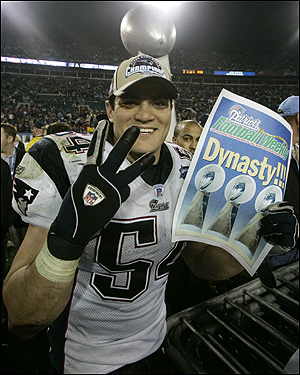 On a few occasions I have made reference to the fact that the 18-0 (and 18-1) Patriots simply weren’t comparable to the three-time champion Patriots. Were they prolific and dominant? Absolutely. But therein lay the problem. Their offensive supremacy covered up what was an aging defense that had seen its best days pass. More importantly, Brady and the offense rendered the defense a subsidiary part of the team for the majority of the season, and when it came time for the unit to step up, it was as if it suddenly couldn’t handle the pressure and stage it had once lived for.
Way back when, the Patriots defense anchored nine consecutive wins in January and February by exhibiting superior schemes, greater intellect, unrelenting toughness over sixty minutes and a knack for always making the handful of big plays and the one monstrous play necessary to move on and/or win a title. Brady, Brown and Vinatieri handled the rest.
I’ve got news for you, but no team — including the Patriots, who have gone a redoubtable 54-18 since their last title — has resembled those Patriots like this year’s Steelers.
The formula for their success has been eerily similar to New England’s circa 2003-04: ups and downs from an offense committed to the run, a defense that consistently keeps the team in games and forces momentum-changing turnovers in crunch time. A quarterback who always makes the most of a drive when he knows it’s his last. A team that finishes.
I’ve seen it happen too many times this year to be chalked up as coincidental. Against San Diego in Week 11. Versus Dallas in Week 14. In Baltimore the following week. And again in the AFC Championship two Sundays ago.
The defense has guys like Casey Hampton in the trenches, James Harrison and LaMarr Woodley on the outside, and Troy Polamalu in center field; guys that have shown time and again that in physical, taxing affairs they will not blink first. And when they hand the ball to their offense late and a drive must be executed, Ben Roethlisberger will lead it with calmness and precision, looking to Hines Ward when the going gets tough.
Simply put, the Steelers never panic. On occasion they don’t come out of the tunnel with their A-game, but their mental resolve is unwavering and their collective patience is a virtue, the reasons why they’ve come from behind multiple times against quality teams.
It was the “sixty minutes mantra” that typified New England during its run, and it’s the same primary tenet that has carried the Steelers to within sixty minutes of a record-breaking sixth Super Bowl title.
Just as the the Panthers and Eagles were exceptional and worthy opponents of the Patriots, so too are the Cardinals for Pittsburgh. One thing Arizona has benefited from this postseason is playing from ahead. Against Atlanta they were  up 14-3 and 28-17. They thrashed Carolina. And in the NFC Championship it was 24-6 before the Eagles knew what hit them.
Kurt Warner-to-Larry Fitzgerald is the explanation for all those crooked scores before halftime. But the enabler was actually Edgerrin James, whose rushing outputs — while a modest 203 yards in three games — had opposing defenses thinking “run” in the back of their minds, which was all the old war horse and stud receiver needed.
The Steelers front seven is the best in football and allowed just 73 yards on the ground to Baltimore, the league’s second-ranked rushing offense. Arizona won’t reach 50 yards, meaning Polamalu will not be needed at the line of scrimmage, meaning under no circumstances will he allow any Cardinals receiver to get behind him for a quick-hit score. Arizona will find the end zone a few times but the Pittsburgh D will make them earn it. Nothing will come easy.
On the other side of the ball, Pittsburgh will use its rushing attack to dictate the pace of the game. Willie Parker is fresher and healthier than any back the revived Cardinals defense has faced this postseason, and is no stranger to running wild in the Super Bowl (who can forget his electrifying 75-yard touchdown sprint in Super Bowl XL?).
The Steelers will win the game because they can run the ball and stop the run. They’ll win the game because Ken Whisenhunt vs. Dick LeBeau is a wash. They’ll win the game because they don’t get down big. They’ll win the game because Roethlisberger has something to prove. They’ll win the game because they’ll see the Terrible Towels.
Above all, the Pittsburgh Steelers will win Super Bowl XLIII because their defense will not lose it.
Steelers 26 Cardinals 21
Last Week: 1-1
Playoffs: 8-2
 Super Bowl. The Panthers were 10-point favorites, and even more striking, had moneylines ranging up to minus-500 (meaning a bettor had to lay $500 to win $100).
 3. We didn’t realize that Carolina’s finish was not as impressive at it seemed. The Panthers went 3-1 in December, starting with the “bandwagon” Monday night game against Tampa Bay. You know, the game they ran all over a 9-3 Bucs team on a national stage, and everyone (including yours truly) hopped on the bandwagon, unaware that Tampa was terrible. That was followed by a 30-10 spanking of a Denver team we found out was in the midst of the worst collapse in league history. After that was the flexed Sunday night showdown with the Giants, a contest in which the Panthers blew an 11-point lead and lost in overtime. In their season finale against the Saints they watched a 23-3 lead evaporate and had to scramble in the final minute to pull out a 33-31 victory that preserved the NFC’s second seed. That’s what you call writing on the wall.
 An argument could be made that the Cardinals were actually peaking going into that contest (they were 5-2 over their last seven, losing only to Carolina and the Giants). The Eagles sprung out to 21-0 lead and never looked back. Donovan McNabb threw for 260 yards and four touchdowns and Brian Westbrook scored four times (twice on the ground).
 The Ravens defense, traditionally stout, did a lot of bending against Kerry Collins, giving up 391 total yards. It made up for it by inducing three Tennessee turnovers in the red zone. The Baltimore D knows that if it allows the Steelers to move the ball like it did the Titans, Pittsburgh will turn those possessions into points.
 With their 23-17 overtime win over the Colts, the Chargers joined the Patriots as the only team to down Peyton Manning twice in the playoffs. It’s no secret that San Diego has taken a page from New England’s 2003-04 defensive schematic. By masking coverages and blitz packages through constant movement and interchanging parts at the line of scrimmage, the Chargers have been able to flummox Manning to the degree that he loses his rhythm and starts making mistakes. That’s why they’ve had success against Indy.
 The circumstances are different this time around. If the Chargers are to have any hope of opening up their passing game it’s imperative that they get something from their ground attack. Even in a perfect world that’s already the tallest of orders against Pittsburgh’s second-ranked run defense.
 that manage the game and minimize mistakes (Kerry Collins threw only seven interceptions all year; Joe Flacco tossed 12), and defenses that live for winning time.
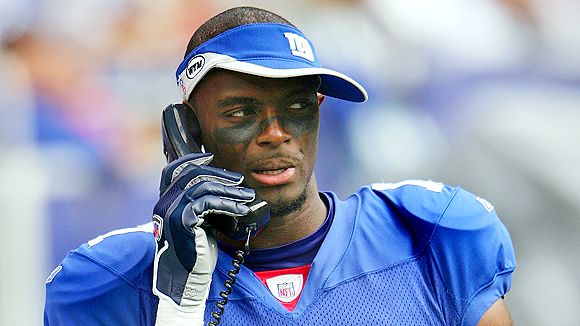 Eagles beat the Giants in a 2006 wild-card game, 23-20).
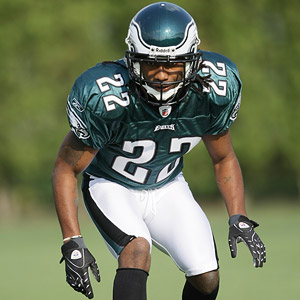 yards on the ground and frustrated Eli Manning, who was just 13-for-27 with 123 yards.
 Everything is so up in the air that even the big boys out west are tentative. Considering every road team is between a one and three point favorite, Vegas sportsbooks — as opposed to last year
  and helped Atlanta shed the moniker of “suspect road team”. However, it must be pointed out that Ryan was just 13-for-24 with 134 yards and a touchdown in that game. Turner finished with a decent day’s work: 19 carries, 70 yards, one touchdown. It was really the Vikings who beat themselves, losing four fumbles.
 pieces around him. Tony Dungy is an exceptional coach with a ring. Done and done, right? Not so fast. The Chargers are peaking at the right time for the second year in a row. Their offense has averaged over 37 points per game during a four-game winning streak to close the season. The defense allowed just 18.5 points per game since Ron Rivera was inserted in place of Ted Cottrell. And bear in mind that if Jake Delhomme doesn’t complete a miraculous touchdown pass with no time on the clock in Week 1 and Ed Hochuli doesn’t blow the call vs. Denver in Week 2, the Chargers are a much more appealing 10-6.
 The Chargers were 4-8 and three games behind Denver with four to play and somehow managed to steal the AFC West at 8-8.
 Chad Pennington returning to beat the team that jettisoned him was fitting.
 Let’s begin with the Carolina-New York game. Both teams have identical 11-3 records, so the winner will take the top overall seed and home field throughout the NFC playoffs. While they have gone in divergent directions the last two weeks — Carolina has mowed down the Bucs and Broncos; the Giants have dropped a pair to the Eagles and Cowboys — this game is actually more important to the Panthers. They have proven to be unbeatable at home this season (8-0) but are a pedestrian 3-3 on the road. If they can’t go into the Meadowlands and knock off the banged-up Giants (Brandon Jacobs should play, but will be limited) Sunday night, it’s highly unlikely they’ll do it next month with a Super Bowl on the line against a presumably healthier New York team. The defending champs, on the other hand, proved last year — in Dallas and Green Bay among other places — that they can win on the road in the playoffs. There’s a good chance that the winner of this game will represent the NFC in Super Bowl XLIII.
 scoreboard-watch situation next week. The Ravens (9-5) are still livid at what they believed to be an erroneous touchdown call that cost them the game vs. Pittsburgh last week, and will look to take it out on Tony Romo and the Cowboys. Dallas (9-5) has begun to put it all together of late. The defense is playing as well as any unit in the league, having recorded 20 sacks over the last three games. Of all the wild card hopefuls, the Cowboys are undoubtedly the scariest.
 postseason. Out west, the Broncos have a three-game advantage over San Diego and a manageable final slate (KC, at CAR, BUF, at SD). Denver will be the fourth seed and host a wild card game. The Jets are lined up to wrestle the AFC East away from the Patriots for the first time since 2002. They could conceivably run the table (at SF, BUF, at SEA, MIA) and steal the second bye from Pittsburgh. While the Steelers are the most complete team in the conference, they must deal with unquestionably the most difficult final four games (DAL, at BAL, at TEN, CLE) of any AFC contender.
 Atlanta Falcons: 8-4 (at NO, TB, at MIN, STL)
 victories over the Eagles and Bengals. Considering the opponents they’ll have to face this month, a split of their last four games is the most likely scenario for the Ravens. Like Dallas, the pressure will be on Baltimore in their two remaining conference games, as three of their four losses have come against AFC teams. Even at 10-6, if the Ravens end up with five conferences losses they’ll probably be on the outside looking in come playoff time.
 there to upgrade their cable to the silver package for the next couple of months. (Showtime, you can thank me later.)
 effect Tony Romo’s return had on the Dallas defense, how upon seeing their leader back the unit played with renewed inspiration and passion. Simms pointed to the fact that Romo put only 14 points on the board and threw two picks. He wanted to know why a defense with eight first-rounders couldn’t have found that next gear when Romo was out. Sapp built on it all by agreeing that in the absence of the starting quarterback, a defense must take the burden away from the offense and dictate games — which the Cowboys D didn’t when Romo was down. Sapp talked about the 1999 season, when his Bucs’ lost Trent Dilfer and were forced to do more in order to make life easier for rookie Shaun King.