Skip to content

Posts from the ‘Strictly Ballgame’ Category

Boston Ramblings

Heady times in Boston once again.

The Red Sox and Yankees are set to tango at Fenway in their inaugural ’09 series beginning Friday. The Patriots will be on the clock Saturday, as the 2009 NFL Draft fires up. And once the Celtics take care of the Bulls, both the Green and Bruins will be appearing in their respective conference semifinals for the first time since 1992.

A few thoughts about each…

AM I THE only one yearning for an infusion of hate into Sox-Yanks? Isn’t that what made this whole thing the preeminent ongoing sports drama, way back when?

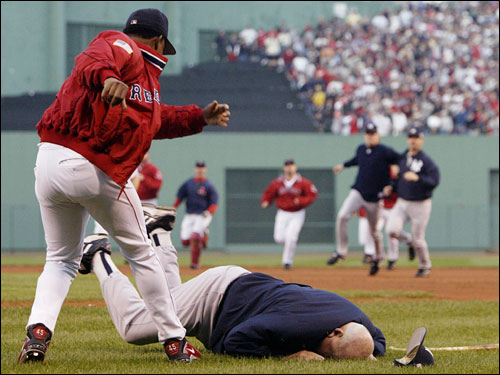
You ask any Red Sox or Yankees fan what they remember most clearly about the rivalry in recent past — apart from The Comeback — and a Boston fan will say Varitek’s Glove in A-Rod’s Face, while a New York fan will recount Pedro’s Body Slam of Zimmer.  These enduring images characterized and defined the rivalry, made it drop-everything, must-see television 19 or 26 times annually.  ESPN and Fox salivated all over it.  Passionate followers cleared their schedules and did everything they could to score the hottest ticket in town.  Casual fans tuned in because, hell, anything could happen.  No matter who you were, Red Sox-Yankees always found a way to find you.

Nowadays?  The media outlets aren’t nearly as enthralled, which is largely a reflection of popular sentiment.  And quite frankly, it’s because they have barely anything to hype.  The big storyline going into this weekend surrounds Joba Chamberlain and David Ortiz.  Joba, who has thrown at Kevin Youkilis on a few occasions, was called out by Big Papi, if you can even classify it as such.  Ortiz basically said that since Joba has shown head-hunting proclivities, he’s going to find it difficult to gain respect throughout the league.  (His comments contained almost as much vitriol as a certain drive-by argument…)

Would it be that out of line if Big Papi had said something just a tad more incendiary, to you know, send a message? I for one would love to see Joba hurl some chin music at Ortiz, watch Papi step out of the box and tell Joba to watch his corn-fed behind, then blast one into the center field bleachers.

IT’S PRETTY MUCH impossible to predict what the Patriots will do come draft day, which is why it’s so much fun tossing around various conspiracy theories.  Using the last two drafts as indicators, there’s truly no telling what Bill Belichick is up to.

Two years ago, the Randy Moss-to-New England rumors had come and gone before the draft, yet Belichick pulled a cat of out a hat in New York and in came Moss for (even at the time) a laughable fourth-round pick.  And a year ago, clearly deviating from his track record of only selecting linemen high in the first round, Belichick traded down from the seventh to tenth overall pick and selected linebacker Jerod Mayo.

While the possibility of Julius Peppers becoming a Patriot has been declared dead for all intents and purposes, it is for that very reason that it could still be alive.  When Peter King reports that New England is looking to trade its first-round and a second-round pick to move into the low top 10, but professes to have little idea as to why, the theories are free to fly.

All that’s for sure are the following facts: 1) New England was initially offering a second-round pick for Peppers, which was not enough, 2) Having shored up their secondary (signing Shawn Springs and Leigh Bodden) and running game (Fred Taylor), the outside linebacker position is the Patriots’ only glaring weakness, 3) A low top 10 pick is an excellent bargaining chip, given the caliber of talent available there, as well as the slightly smaller financial obligation necessary to sign the player.

If Peter King doesn’t have a bead on what the Patriots will do, it’s legitimately anyone’s guess.  But that’s what makes following Belichick’s moves on draft day so intriguing.

THE CELTICS WERE the champs again on Thursday night in Chicago.  After a pair of scintillating games at the Garden that could have gone either way, Paul Pierce took command of Game 3 from the outset and the Celtics defense suffocated the suddenly overmatched Bulls all night.

Even with Kevin Garnett on the bench in a suit, it was a vintage performance from the Green on the defensive end, as they held Chicago to under 41 percent shooting and forced 22 turnovers.  For the first time in the series, Pierce played like the best player on the court.  And Rajon Rondo, who battled to a stalemate with Derrick Rose in Boston, took decisive control of the point guard showdown, racking up 20 points, 11 rebounds, 6 assists and 5 steals.

This series may still be extended — Chicago was 28-13 at home before Thursday — but for the Bulls, there’s ultimately no recovering from such a colossal beatdown in their own building.  Especially against the champs.

I HAVE NEVER written about the Bruins, because 1) I don’t know enough about hockey to throw my weight around, and 2) the Bruins have done nothing but disappoint for a very long time.  They infamously blew a 3-1 series lead against Montreal as the No. 1 seed in 2004, then attempted to reverse the script last year as the underdog, before falling to the Habs in seven.

All I remember from last year’s playoffs was how a few choice Boston crackpots decided to beat up visiting Montreal fans leaving the Garden.  It was an unnecessary and classless thing to do, though it paled in comparison to the disgraceful act staged by Canadiens fans before Game 3 Monday in Montreal: booing the American national anthem.

It was fitting that the Bruins proceeded to snuff out Montreal’s season with a pair of systematic thrashings, while formalizing a tidy four-game sweep in which Boston outscored the Habs 17-6.   I can officially say I’m back on the bandwagon, and am eagerly anticipating the Bruins’ projected second-round matchup with the New York Rangers.

To bring this rambling column full circle:  Maybe a little Bruins-Rangers is just what the doctored ordered for a suffering Boston-New York rivalry.

(Unless of course Joba decides to throw one behind Big Papi Friday night.)

In March, Guards Wear the Slipper

Teams that win national championships are talented, well-coached, deep, resilient … and exceptionally lucky somewhere along the way.

Alas, no would-be champion navigates the madness of March without the aid of a rabbit’s foot stashed somewhere precious.

What this tournament has taught us is that it’s folly to try and predict bounces of the ball.  Once the games begin, Cinderellas will rise.  Favorites will fall.   The only sure thing is that one of the top five or so teams in the nation will be left standing.  Other than that, anything goes.

There is, however, one factor that can transcend the Dance, and that’s guard play (which is to say, shooting).

Shooting is the essence of basketball.  It’s neither an art nor a science, yet there are elements of each within it.  And as much as any statistician will fight the notion, shooters are prone to hot and cold streaks that follow no logical pattern.  Anyone who has ever toed a basketball court is aware of the phenomenon that is shooting: Sometimes, inexplicably, the cylinder seems to expand and you suddenly can’t miss.

Nine times out of ten, when you hear news of a mammoth upset or Cinderella run, there is a shooting guard who caught fire behind the story.

So if you’re looking for a lower seed capable of a deep run in the tournament, it’s wise to start your search with the shooters.

With that said, pay attention to these teams and the gunners who are capable of carrying them far.

Team:  Boston College (22-11, No. 7 in Midwest)

Gunner: Tyrese Rice (G, Sr.)

Explanation: Rice is one of the more peculiar players on one of the more peculiar teams in the land.  After a junior campaign in which he averaged 21 points per game, many thought he would be among the nation’s scoring leaders this season.  Instead, he has mainly deferred to some of the younger talent around him, putting up almost a hundred fewer shots and averaging nearly four fewer points (17.1).  He has been dominant in big spots though, as evidenced by the combined 46 points he dropped in wins over North Carolina and Duke.  Rice is one of a handful of guards in the country who can spot up from anywhere and get to the bucket at will.  If he finds the zone, all bets are off for any team in his path.

Team: Texas (22-11, No. 7 in East)

Gunner: A.J. Abrams (G, Sr.)

Explanation: The Longhorns fizzled down the stretch, losing three of their last six, mainly because Abrams went cold.  The senior averaged 16.3 points and was a 38.9 percent 3-point shooter for the season.  Yet he made just 11 of 33 attempts from long range and scored only 11.5 points per game down the stretch.  If he can regain the form that saw him torch UCLA and Villanova in consecutive games early in the season, Texas could run through Duke in the second round and possibly find itself challenging Pittsburgh for a trip to the Final Four.  Abrams is that explosive.

Team: Temple (22-11, No. 11 in South)

Gunner: Dionte Christmas (G, Sr.)

Explanation: If you haven’t heard of him by now, you probably don’t watch Sportscenter too often.  The Owls, led by a man whose name is conducive to clichés, blitzed the Atlantic-10 tournament last week to earn an automatic bid to the Dance.  Eyes started opening in the semifinal game, when “Christmas came early” for Temple against perennial conference power Xavier.  The senior guard dropped 20 on the Musketeers before following that with a 29-point encore in the championship vs. Duquesne.  He hit a combined 10 threes in those contests.  Now the Owls find themselves matched up against Arizona State.  If Christmas goes off again, Syracuse (Temple’s likely second-round opponent) may have to up the threat level from “Orange” to red.

Team: Marquette (24-9, No. 6 in West)

Gunner(s): Jerel McNeal (G, Sr.) and Wesley Matthews (G, Sr.)

Explanation: The Golden Eagles were drastically altered when point guard Dominic James broke his foot against Connecticut on Feb. 25.  Including that game, Marquette dropped five of six to end the season.  In all five of those losses they battled, but fell to nationally-ranked Big East foes.  The good news is backup point guard Maurice Acker was able to get some significant playing time against big-time opponents.  If he can take care of the ball in the tournament, that will enable McNeal (19.7 ppg, .402 3-point shooter) and Matthews (18.4 ppg, .377 3-point shooter) to do what they do best: light up the scoreboard from outside and keep the pressure on the opposition.  The two have a combined eight years of experience.  Even without James, they are capable of shooting their way to the Sweet 16.

UConn-‘Cuse: Just Wow

I remember being at the semifinals of the 2003 Big East Championship.  Sitting about 20 rows back of where the baseline meets the sideline at Madison Square Garden, I watched Connecticut and Syracuse go at it.

Carmelo Anthony had been the story of the year but on that March night it was Ben Gordon who put the Huskies on his back to take down ‘Cuse and its freshman titan.  After the teams exchanged postgame handshakes — Anthony with Gordon and Emeka Okafor among others, pantheon coaches Jim Boeheim and Jim Calhoun with one another — I tracked Anthony as he exited the court and walked toward the tunnel.

I inched closer to floor level, getting to within shouting distance of him.  Intending to give him a piece of my mind (it’s a habit I have), I suddenly had no words (a rarity).  He had this steely and resolute look in his eyes, yet at the same time seemed to be fighting back a grin.  The contradiction froze me. 

The look, which could have been construed as a defiant acceptance of defeat, I interpreted differently.  It was almost as if he knew something nobody else did, and the moment of clarity just happened to come after a tournament loss in the world’s most famous arena.  To me he looked like a kid who knew the stage was about to be his, and to hell with anyone who dared stand in his way.

Can I be positive about this?  Of course not.  But I will say I left MSG that night knowing which team I’d have going the distance once the brackets were announced.  I left the Garden with the sneaking suspicion that I had witnessed some history wrapped in an otherwise ho-hum 80-67 final.

Three and a half weeks later I had won my first (and only) March Madness pool and was about to pen the first (of a few) “Respect Carmelo” columns for my school newspaper.

So why am I writing about that contest now?  Why give two hoots about some game that happened six years ago when the same teams just ran six overtimes less than 24 hours ago??  SIX!!!!!!  That’s three full halves PLUS two overtimes!!!

I’ll tell you why: Because it’s special to feel like you’re a part of history.  I witnessed one of the greatest college players lose for the final time, and am pretty sure I pegged the moment when he decided as much.  That moment still resonates.

I wasn’t even at MSG Thursday night but can say unequivocally that Connecticut-Syracuse on March 12, 2009 was a game I’ll be talking about when I’m an old-timer.  I may not have been as privileged as the 19,375 inside the Garden, but I still feel like I was a part of history.

This one was so epic you didn’t even have to be there, you just had to see it with your own eyes.

Had to see Eric Devendorf’s miracle three with 1.1 seconds left in regulation, a shot that would have Deven-dwarfed every buzzer-beater since Christian Laettner’s had there been 1.2 seconds remaining instead.

Had to see 7-foot-3 Hasheem Thabeet — disregarding the fact that his cranium is situated somewhere in the stratosphere — dive earthward for a loose ball to secure a possession in overtime.

Had to see UConn jump out to leads in each of the first FIVE extra sessions, only to watch Syracuse claw back and tie the game — but never take the lead — every time.

Had to see Paul Harris miss not one but two layups in the closing seconds of the fourth overtime that would have won the game for the Orange.

Had to see Jonny Flynn put a tad too much english on a reverse layup just moments before Harris.

Had to see, one by one, star players foul out and give way to walk-ons and benchwarmers.

Had to see those same walk-ons and benchwarmers make HUGE plays in the biggest moments of their lives.

Had to see all the drives, jays, blocks, acrobatic saves, bodies flying, near-daggers, rugby scrums for loose balls, volleyball battles for boards, clutch free throws, diabolic bounces off the tin, jumping jacks, and-ones…

Had to see Sean McDonough, Jay Bilas and Bill Raftery lose a few marbles.

Had to see the fans — who were as exhausted as the players — yelp like dogs with muted barks once it was all over.

Had to see Boeheim — no sucker for hyperbole — proclaim he had “never been prouder of any team”.

Had to see………hell you just HAD to see it.

If you’ve been reading this column up until now and feel like the last half has been one convoluted, impossible-to-follow run-on, that’s good because that’s exactly what I intended it to be.  I essentially just cut and pasted my notes into the piece.

Truth is, I can’t do justice to what transpired in midtown Manhattan Thursday night.  You gotta see it for yourself.

So check out ESPN Classic when you have a moment. Chances are they’re heading into overtime right now…

Defining “Dynasty”

With the Pittsburgh Steelers having just captured their second Super Bowl in four years and sixth overall, it seems like a good time to tackle one of the most subjective and contested concepts in sport, “the dynasty”.

How does one define a sports dynasty? Who has rightly deserved the title of dynasty throughout sports history? What does “dynasty” actually mean?

The last question is the easiest to answer. The origin of the word is from the Greek dunasteia, meaning “lordship”.  According to the Merriam-Webster Dictionary, a dynasty is defined as:

1) a succession of rulers of the same line of descent.

2) a powerful group or family that maintains its position for a considerable time.

Not too much help there, although it’s evident why the notion of a sports dynasty is so debated.  There just isn’t a tangible or relevant definition of the term.  It has been up to the professional leagues, teams, writers and fans to determine what has constituted a dynasty over the years.

When exactly the term entered the vernacular is difficult to pinpoint, but two of the original teams to garner the designation — the Boston Celtics of the late 50s and 60s and the UCLA Bruins of the 60s and early 70s — still come the closest to fulfilling the second definition of the word, “a powerful group or family that maintains its position for a considerable time.”

Red Auerbach’s Celtics won 11 of 13 NBA titles from 1957 to 1969, including eight straight.  John Wooden’s Bruins took down 10 of 12 NCAA championships from 1964 to 1975, highlighted by a run of seven in a row.  Those teams — particularly the Celtics — were dynastic in the truest sense of the word, in that they were sports families headed by powerful patriarchs that held their standing over an extended period of time.

Mergers, expansion and free agency have drastically altered the landscape of professional sports since the old school UCLA and Celtics dynasties.  Understanding that, let’s dissect the dynasties of the (semi) modern era. We’ll use the mid-1970s as a jumping off point, considering the ABA-NBA merger took place in 1976, MLB introduced mainstay franchises such as the Mariners and Blue Jays in 1977, and the Super Bowl era was well under way.

In my opinion, there are two parameters that must be met if a team wants to enter the dynasty debate.

1) the team must win back-to-back to titles.

2) the team must win or have won another title within a few years of the successive championships.

In the three major sports there are a handful of squads that have gone back-to-back over the last 40 years, but that was it.  They didn’t win another one before or after the consecutive titles within a reasonable amount of time.  Among these teams are the New York Yankees (’77 and ’78), Detroit Pistons (’89 and ’90), Toronto Blue Jays (’92 and ’93), Houston Rockets (’94 and ’95), and Denver Broncos (’98 and ’99).

It’s an admirable accomplishment to go back-to-back, but there’s an aspect of sustained excellence inherent to the idea of a sports dynasty that those teams didn’t have.  Two in a row without another can still fall in “flash in the pan” territory.  At least in the context of this argument.

As for the teams that are in the running, let’s um, run through them…

The Pittsburgh Steelers of the 70s — the original “Steel Curtain” — set the the standard for Super Bowl dominance.  Led by Terry Bradshaw, Lynn Swann and “Mean Joe” Greene, Pittsburgh won four out of six titles between 1975 and 1980, a mark that is still yet to be met.  Dynasty.

In the 80s, the San Francisco 49ers gave a solid encore performance to the Steel Curtain.  Behind the innovative and groundbreaking West coast offense instituted by Bill Walsh, Joe Montana and Jerry Rice’s 49ers snagged four Super Bowls in a nine-year span (1982-1990).  Included in that run was a back-to-back in ’89 and ’90, which solidified the Niner dynasty.

No other NFL franchise has won four titles in one era, but the Dallas Cowboys (’92, ’93 and ’95) and New England Patriots (’01, ’03 and ’04) have each gone three out of four.  Given the parity that started to take shape in the mid-90s and the establishment of a salary cap in 1994, it could be argued that the Cowboys and Patriots were actually the two most dominant teams in league history.  We’ll keep that on the back burner for now.

Jumping to MLB — which saw 14 different champions between 1975 and 1995 — the only dynasty of the last 35 years is undisputed: the New York Yankees of the late 90s.  With great pitching and a young superstar named Derek Jeter, the Yankees won four out of five World Series between 1996 and 2000.  That seven different teams have won titles in the eight years since New York’s run only underscores how remarkable it was.

Finally to the NBA, which has been the most conducive to dynasties throughout the time period in question.  Let’s begin with the present, and a peculiar team that has heard the term thrown around in reference to it on more than one occasion.  That would be the San Antonio Spurs.

Since Tim Duncan’s sophomore campaign in 1998, the Spurs have won four of the 10 NBA titles to be contested.  They’ve won three of the last six, but all in odd years (’03, ’05 and ’07).

Duncan will probably go down as the greatest power forward of all time, but his lumbering style and passive attitude are generally cited as the chief reasons why the Spurs have yet to repeat as champs.  The guy has simply never exhibited the fire and drive needed to go after it, year after year.  It takes a cold-blooded leader to repeat, and Duncan — while many things — is not that.  Spurs proponents would argue that a miracle three by Derek Fisher in 2004 and Dirk Nowitzki’s historic three-point play in 2006 are the only things standing between San Antonio and five straight titles.  And they would have a point, except there’s no room for “coulda, woulda, shoulda” when talking dynasty.

I’ll argue that San Antonio’s three titles combined with those plays merit them the moniker of “team of the decade”, but a dynasty?  No.

This is where it gets interesting, because at the beginning of the decade we saw a bona fide dynasty in the Shaq/Kobe Lakers.  Three straight crowns starting with the 1999-00 season.  A loss in the 2004 Finals to the chippy Detroit Pistons — with the additions of Gary Payton and Karl Malone no less — cost the Lakers their shot at being the team of the decade.  That is unless they grab another one in ’09…

Now let’s trek back to the 80s, a magnificent era that featured what I must deem a “co-dynasty”.  Magic’s Lakers and Bird’s Celtics won eight of nine NBA titles beginning with the 1979-80 season.  While LA had the upper hand (winning five rings to Boston’s three and two of the three head-to-head showdowns), there’s no doubt that Magic isn’t Magic without Bird and vice versa.  Same goes for their teams.  The iconic franchises fed off one another, spawned a fervent bicoastal fan base and permanently embedded the sport in American culture.  For that reason the 80s Celtics are the only team to warrant the dynasty tag despite a failure to repeat (they won three of six from ’81 to ’86 and appeared in five Finals during that span).

If we’re talking dynasties and iconic players, the argument begins and ends with one man.  Michael Jordan.  The greatest, most prolific champion of the modern era.  His Bulls three-peated from ’91 to ’93, and again from ’96 to ’98.

He took a break (for reasons still not completely determined) and played baseball for a year and half in between, and his team became mortal without him.  After a truncated return in ’95 and a second straight loss in the Eastern Conference playoffs for the Bulls, MJ made it clear that the glory days were again on the horizon, and he lived up to his word.  When it was over Jordan had essentially gone six-for-six in his prime, a surreal stretch of individual dominance in what was historically believed to be a team game.

The dynasty debate is one of the great ongoing discussions in sport.  While it will continue to live on — in locker rooms, through the media, around the dinner table — the 90s Bulls are the greatest dynasty in recent American sports history.

Any beef?

BG’s Showtime Pitch and Week 12 Picks

Anyone who doesn’t pay for Showtime is sleeping on — hands down — the best football show out there: Inside the NFL. Each week James Brown hosts (and mediates) a forum of Phil Simms, Chris Collinsworth and the inimitable Warren Sapp. The show, formerly of HBO, accomplishes everything NFL fans are looking for on a program. It’s insightful, edgy and laugh-out-loud funny.

You see, football fans are quite simple in their needs. If you make them laugh, succinctly interpret the game and say a few borderline inappropriate things, they will be happy. Which is precisely why it baffles me that so few are tuning into JB, Phil, Chris and Warren. Oh right, the whole Showtime thing. Well here’s my pitch to every football enthusiast out there to upgrade their cable to the silver package for the next couple of months. (Showtime, you can thank me later.)

Seriously though, these four are the perfect pigskin quartet. Simms and Collinsworth understand and can relate the game as well as anyone in the business. Simms, a former quarterback, is adept at giving us the perspective of the field general. Collinsworth, who spends inordinate amounts of time in the tape room, is always pointing out things the average fan simply isn’t equipped to notice. The two also happen to loathe one another, and that mutual contempt fuels their frequently divergent opinions.

Sapp, meanwhile, is a one-of-a-kind personality. His knowledge — which equates to raw intelligence from the trenches — is invaluable considering the voice of the lineman is generally the least heard (save for Fox’s Tony Siragusa and his live reports from the end zone) but arguably the most vital to grasping the game. With Warren, the mood is always light because he’s in a perpetual state of giddiness and is unrelenting in his shameless pleas for votes on Dancing With The Stars (DWTS has been a great running subplot on the show).

Then there’s Brown, the mercenary moderator of NFL roundtables. He was the point man on Fox for over a decade, feeding the likes of Terry Bradshaw, before jumping ship to CBS in 2006, where he now tosses to Shannon Sharpe. I tell you, the man has seen it all.

JB’s true genius is always revealed when the feuds between Simms and Collinsworth reach a boiling point, at which time he’ll cut in with some sarcastic patchwork comment (“These guys really do get along well off-camera”) just as they’re about to start giving each other backhanders. He’ll then seamlessly segway to Sapp for his take on the topic that previously had both white fellas sporting loony ear-to-ear grins as they traded personal insults.

The big fella always has something to say, and it’s often so outlandish that viewers quickly forget that Simms and Collinsworth are arm wrestling off-camera. A few highlights: His reaction to hearing about ex-teammate Keyshawn Johnson’s pending interior design show on A&E (“Keyshawn, I knew you were a [rhymes with snitch]”); his response after Ray Lewis told him the Ravens were playing the pass against the Giants last week (“I dropped the phone, I dropped the phone”); and most recently, his take on Donovan McNabb not knowing there are ties in the NFL (“When I heard him say it I almost passed out”). It should be noted that Sapp has since apologized to Johnson for stepping out of line, but in my opinion that’s just another reason to watch the show.

What’s most important — and what ultimately makes the show a success — is their collective ability to get beyond the jokes and jabs and give the viewer bona fide insight and analysis. Take for instance their handling of Dallas‘s huge win in Washington on Sunday night, a victory that essentially saved the Cowboys’ season. Collinsworth was enamored with the effect Tony Romo’s return had on the Dallas defense, how upon seeing their leader back the unit played with renewed inspiration and passion. Simms pointed to the fact that Romo put only 14 points on the board and threw two picks. He wanted to know why a defense with eight first-rounders couldn’t have found that next gear when Romo was out. Sapp built on it all by agreeing that in the absence of the starting quarterback, a defense must take the burden away from the offense and dictate games — which the Cowboys D didn’t when Romo was down. Sapp talked about the 1999 season, when his Bucs’ lost Trent Dilfer and were forced to do more in order to make life easier for rookie Shaun King.

They all might have had varied takes on the game, but their contributions were individually and collectively valuable, and flowed well together in spite of any personal issues between them. That’s all it takes to create a successful product.

To sum it up: For ten bucks a month you get a guaranteed 12 rounds of Simms-Collinsworth, countless sound bytes from Sapp and lots of sardonic wit from JB. You get a show about football, rife with humor, tension and drama, yet complemented by an abundance of substance. And don’t forget about the unparalleled game footage provided by NFL Films.

It’s all there waiting for you. So grab the phone and dial up Showtime. You won’t regret it. I promise.

Just tell them Ballgame sent you.

Here are the Week 12 picks (Home teams in CAPS).

CLEVELAND over Houston

DALLAS over San Francisco

TENNESSEE over NY Jets

Tampa Bay over DETROIT

Buffalo over KANSAS CITY

Chicago over ST. LOUIS

New England over MIAMI

JACKSONVILLE over Minnesota

DENVER over Oakland

BALTIMORE over Philadelphia

ATLANTA over Carolina

NY Giants over ARIZONA

Washington over SEATTLE

Indianapolis over SAN DIEGO

Green Bay over NEW ORLEANS

Last Week/Thursday: 11-5-1

Overall: 103-56-1

Finally, I have to shout out my high school alma mater, BB&N, where the football team’s kicker just set a state-record by booting a 58-yard field goal. Pretty ridiculous, eh? The accomplishment got him a feature story on the ABC affiliate in Boston. In case you were wondering, we didn’t set any state records during my two seasons on the squad.

Redeem Team Does US Proud

Anyone who watched Kobe Bryant get thoroughly handled by Paul Pierce and the Boston Celtics in the 2008 NBA Finals knew the other shoe would drop soon enough.

The guy has never been able to stomach losing — from growing up in Italy challenging his dad’s teammates to games of one-on-one as a tyke to rounding into the force that has competed for five NBA championships, it’s always been win or bust for the Black Mamba.

That said, the spanking his Lakers took in June at the hands of an old rival registered a full 11 on the Kobe revenge-o-meter. If there hadn’t been a certain hardwood redemption project in the works, you could’ve probably found him busting guys up on the Venice Beach courts all summer. A reassertion of the MVP’s supremacy was not only necessary, it was imminent. The only question was who would draw the short straw.

To describe the Beijing Olympics as timely would be to understate the urgency of Kobe’s desire to restore the basketball order.

Thus it was fitting that Spain — and not a wannabe And One Mixtape contingent from Inglewood — fell victim to the Mamba’s wrath. It was also revealing — considering that until the waning minutes of the final game the (no longer “so-called”) Redeem Team was able to thrive with the world’s best player serving as an auxiliary.

Kobe the role player? On this team he was, they all were. Which is why it was downright inspiring to see a group of the game’s greatest check their egos at customs, band together as a unit and take back what has always been rightfully America’s: title of best balling nation on the planet.

It was a spectacle to behold from the beginning of the eight-game run to redemption. Assembled by Jerry Colangelo and spurred on by Mike Krzyzewski, Team USA played suffocating defense, exhibited sincere unselfishness, finished quarters strong, refused to respond to the pugnacious ploys of other countries, and visibly relished representing their homeland.

Fluid and flawless as their performance was on the court (average margin of victory: 27.9 points), so too was their work as ambassadors off it. As opposed to the bad taste USA Basketball left in the mouths of most everyone associated with the 2004 Athens Games, the players this time around embraced their status as representatives of their nation.

In a country where Kobe Bryant and Lebron James are as popular as Yao Ming, 12 tall gentlemen were crucial to shaping the American image in China. If accessibility and amiability were tallied in points, the score would’ve been in the thousands for the Redeem Team.

Again, with the reclusive and moody Athens squad as the most recent basis for comparison, the 2008 team registered a PR blowout. They kicked it in the Olympic Village, dined out, signed countless autographs, attended other events in different venues, soaked up the vast cultural and touristic offerings of the host country — all the while living a kind of existence only the Beatles could relate to. Which is to say the experience was equal parts thrilling and daunting.

Overwhelming as the reception may have been at times, they were in it together, a team united as much off the court as on, which not only bolstered the image of their sport and country but demonstrated how they’ve all caught up to the game the world has caught up to. A team game.

From Carmelo Anthony’s rugged international style to smooth Chris Paul’s million dollar smile, from Lebron’s vocal leadership to Jason Kidd’s experience, Dwyane Wade’s panache and Kobe’s competitiveness, these 12 men came to embody everything we as Americans could’ve hoped for: charming, witty, classy winners.

So I found myself nodding my head when Kobe took over the gold-medal game late, having a hand in 18 of Team USA’s final 27 points in a thrilling fourth quarter that tested the resolve of Team Redeem. His time had come after all, the time to reaffirm his place as the best player in the world. He hadn’t forced it though, hadn’t once unleashed the revenge-seeking Black Mamba just because he could. There was something far greater at stake, and he knew it. They all did.

That was the spirit of this squad. All for one.

For that reason USA Basketball has respectfully regained it’s throne atop the basketball world. And they did it on the world’s terms, not their own. They did it the right way.

Olympic Points

National pride is a sensation that — for most of us — rarely manifests itself in a profound way. As Americans, the concept of nationalism is more or less implicit. We’re intrinsically proud to be American (with caveats) but rarely wake up with a burning desire to be closer to Uncle Sam.

It’s for this reason that you don’t commonly observe reverent citizens gathered around American flags in the streets of US cities or see 50,000 people breaking down in tears before sporting events when the Star Spangled Banner is performed.

Indeed, the two most tangible representations of American nationalism — the flag and the national anthem — are so omnipresent that more often than not they evoke a sense of formality rather than one of visceral emotion. In my lifetime there have only been two recurring instances where I’ve felt an instinctive and deep-seated connection to my flag and national anthem.

First is when I’m traveling abroad. Exploring the culture and examining the history of foreign lands has always piqued my interest. It’s also summoned my frequently dormant patriotism.

(Case in point: A vacation I was on in Normandy, France. A friend of mine owns a seaside house on Omaha Beach, site of the American invasion into German-occupied France during World War II. Situated a mere half-mile or so from my friend’s property is the Normandy American Cemetery, a magnificent and powerful memorial that contains the remains of the thousands of American military that perished in the D-Day battle. On a balmy June morning a few years back, I led 15 excited French kids up the hill that adjoins to the Cimetiere Americain while belting out the Star Spangled Banner. It was a goofy and endearing sequence that was also one of most prideful moments I’ve ever had as an American. Chances are it shall remain such.)

The only other happening that can arouse my inner patriotism is the Olympics. I enjoy the clash of countries and cultures through the competition of sport. Frequently I will casually tune into some coverage knowing it’s only a matter of time before I’m totally swept up: as a sports fan, as a journalist, as an American.

This happened on Sunday night, or day three of the 2008 Beijing Games. Work had precluded me from watching any of the Opening Ceremonies or early events, so I was already psyched to get my first dose of the summer games since Athens.

Political and idealogical implications of these Olympics notwithstanding, Michael Phelps’ quest for Olympic immortality (eight gold medals) has been top news thus far. He took home his first gold in the 400 meter individual medley, which preceded what was said to be his toughest event, the 4 x 100m freestyle relay. It was purported to be his sole “long shot” because he would need to rely on three other guys to have a chance.

I don’t know a whole lot about the event, but I do know that the Americans owned it from 1964 through 1996. They relinquished their stranglehold on gold in the 2000 Sydney Games at the hands of the host Aussies before slipping to bronze medal status in Athens four years ago.

Leading up to Beijing, gold in the men’s relay became synonymous with the French. They were the presumptive favorites. Quite presumptive in fact. The French anchor and world-record holder in the 100m freestyle, Alain Bernard, took it up a notch, saying, “The Americans? We’re going to smash them. That’s what we came here for.”

And so French — again — became synonymous with tactless arrogance.

Since I’ve spent so much time in France, love the language and may very well reside there one day, I’ve always had the back of the French when unknowing folks take unfounded shots at them. Which only serves to underscore the wave of patriotism and French antipathy I suddenly harbored upon seeing those comments.

Wait, you’re talkin about my boys? Faux real?! I stewed. Oh it’s on now Frenchy!

As the race began — with Phelps swimming the lead-off leg — I was locked in. Sure enough, the Americans fell behind during the middle legs. By the time the American anchor, Jason Lezak, hit the water, he was more than a half-second behind the world-record holding Bernard (which I’m pretty sure is a hell of a lot).

He made up no eau in the first 50 meters and needed a miraculous push in the home stretch to have any shot at thwarting the brash Frenchman. With a little more than 30 meters to go he started to make his move. The crowd felt it. At 20 meters he had gained more ground, at 10 slightly more.

With one final dominating stroke, Lezak pulled into the end wall a fraction of a second ahead of Bernard — eight-hundredths of a second to be exact. It was so close that Phelps and the rest of the team — along with the announcers — had to look at the official scoreboard to affirm their rapturous delight.

What followed was a state of euphoria experienced communally by the improbable gold medalists, the delirious announcers, the awestruck crowd and every proud American following it all half a world away.

Phelps struck a muscle pose that could grace the cover of any fitness magazine. The broadcaster’s voice cracked. I jumped up and nearly hit the ceiling.

The quest for unprecedented gold continued.

And to think, ten minutes before that piece of history I was mindlessly channel surfing my way through an otherwise mundane Sunday night.

That’s the glory of the Olympics.

See Ya Manny, So Long Dynasty

I received a text from a friend the night before the trade deadline when it looked like Manny Ramirez was headed to South Florida to join the Marlins. The text read: “Worried yet?”

My response: “They won’t do it. Not with a dynasty on the line.”

(One of the great sports debates is what constitutes a dynasty. It’s clearly a subjective interpretation of greatness. In this scribe’s opinion a team must win back-to-back titles plus another one within a few years, which is to say any franchise that wins three out of five championships is worthy of some manifestation of the term “dynasty”. A banner in 2008 would mean three out of five for the Sox.)

So my rationale was the Red Sox brass would not threaten what is at least arguably a potential dynasty in the making, particularly given that David Ortiz spent a significant period of time on the shelf and the team didn’t fade.

Given that Josh Beckett is fixing to turn it up, that Dice-K has been far from the liability most believed he would be this year and Jon Lester is the second-best lefty in the American League.

Given that Jonathan Papelbon is still the surest thing this side of Mariano Rivera when it comes to closing games in October.

Given that the most prolific offensive tandem since Babe Ruth and Lou Gehrig was intact again for the first time since it co-slugged its way to a second World Series in four years.

Given that cumulatively this team was unequivocally gearing up for another title run.

I didn’t think it would happen because I’ve come to understand the whims of this ownership. John Henry, Tom Werner and Larry Lucchino have personalized the experience of being a Red Sox fan because they themselves are Red Sox fans — ones who happen to be ridiculously wealthy businessmen who assumed control of the enterprise.

Too often in sports business and figures detract from what is ultimately best for a team. With Manny’s eight-year, $160 million deal, it was at times a wise business move for the ownership to remove all those dollars from its weighty payroll. Hence irrevocable waivers in 2003, a busted trade for Alex Rodriguez in 2004, and annual deadline talks with the Mets’ Omar Minaya about a Manny move to Flushing.

In all instances, getting rid of Manny was the smart business move, the best for the bottom line. But Theo Epstein — acting on behalf of the trio — abstained from ever pulling the string because of one prevailing reason: The guy was too damned good and too vital to the most important end of winning. Winning superseded personal relationships. Winning supplanted smart business.

To this ownership, winning mattered most. And in pennant races and pursuits of October glory, Ramirez behind Ortiz gave the Red Sox a decisive inside track to victory.

I’ll be frank: Manny has always been a pain in the rear (to put it gently) through the eyes of ownership and his colleagues. It was just always kept more or less under wraps, in that Manny for the most part squawked privately and off the record, which meant only bits and pieces were divulged.

I’m sorry, but it’s no coincidence that the historically publicly soft-spoken Manny signed with Scott Boras before (essentially) a contract year — the Red Sox held two $20 million club options for 2009 and 2010 on Ramirez — then proceeded to start voicing all the displeasures he’s traditionally voiced behind the scenes directly to the media.

Boras, who’s likely still peeved at the Red Sox for holding him hostage two summers ago over the Dice-K contract, saw the perfect opportunity to turn the tables on the only contingent to have gotten the better of him at the negotiating table.

He knew that unleashing the Manny circus on the public would force the hand of the club, force them to 1) pay monetarily to get rid of Manny (which they have, $7 million), 2) dispose of him for seventy cents on the dollar (which they did, for Jason Bay), and 3) line Manny up to get shown the money come this offseason (which if I were a betting man…).

Done and done. And just like that the Manny Ramirez era came to a prompt conclusion in Boston.

What truly perplexes me is the fact that lots of fans and writers are on board with the move. Proponents of the trade would point to the fact that Manny’s bullheadedness was tearing the team apart from the inside, that his antics have been far worse this year than in the past.

Not true.

Manny has always been Manny. To the fans and outside world he was frequently endearing, quirky and warm, while behind closed doors he was consistently self-centered, obstinate and vexing. Bottom line is he has forever lived in Manny World, in spite of everyone around him — be it media, teammates or bosses.

(If you’re not convinced, pick up Seth Mnookin’s Feeding the Monster. It is the single most illuminating piece of writing about Manny and the organization.)

Due to that longstanding discord it was obvious that Manny and Boston would part ways after this season. After finishing what unofficially kicked off in 2003, the most prosperous era in Red Sox history. Like it or not, like him or not, the Red Sox with Manny Ramirez were most sufficiently primed to defend a World Series crown for the first time in nearly a century.

Debating team chemistry, managing motives and money is moot. Through everything that has gone down in the last week, only two facts have emerged: 1) The Red Sox are a decidedly worse team today than they were on the morning of July 31, 2008, and 2) If they should get there, the Red Sox will be a far less intimidating force in October than they were in ’04 or ’07.

Don’t believe me?

Just ask any Angels or Yankees fan.

Deal or No Deal? Three Keys to Makin’ Deadline Moves

With another MLB trade deadline upon us and most fantasy deadlines looming soon thereafter, it’s time to start dealing. Now is it always imperative to make a move just because some predetermined date in time says you must? No, I’ve never been a proponent of dealing for the sake of dealing.

However…

Unless your team has been leading the pack from the word go (in which case it’d be wise to stick with what you’ve got) or been feeding on the sewage of the basement since April (in which case it’d be wise to bounce that overdue check to the commish), chances are you need to make a trade.

Of course, sometimes making a move can be detrimental. I swung a deadline swap with a buddy last year, sending him Gary Sheffield (at the time a Top-5 fantasy player) for Roy Oswalt and Placido Polanco. Oswalt went 6-2 with a 2.57 ERA in the second half while Polanco batted .348. Sheffield hit .203 before going on the shelf.

(Yes, the trade was only detrimental to him, and yes, our friendship was temporarily bludgeoned.)

Truthfully, I got lucky considering before that move I had an ultimately nixed proposition on the table with another friend that would’ve netted me Eric Gagne (you know, the Texas closer who saved 12 games with a 1.32 ERA before the All-Star break, remember him?). I can’t recall off the top of my head what I was going to be giving up for him, but I do know that it was more than Richie Sexson and a bag of baseballs.

Needless to say, hindsight gave way to elation when Gagne pitched his way into the recesses of the Boston bullpen and onto the waiver wire, sparing me the regret of having been party to the worst fantasy deal of all-time.

So you see? That’s the glory of swinging deals at the deadline, that element of the unknown. Because of that, there remains no fool proof method to deadline maneuvering. Though there are a few keys.

Without further ado…

Key No. 1 — Be thorough with assessments This is the most basic, yet most integral aspect of crafting the successful deadline deal. With two-thirds of the season on the back burner, the only direction you should be looking is forward. However, within this context more often than not that requires looking back to previous years. For various reasons, certain guys simply live for the twilight. You must seek them out, for these are the players who will bring home the most bread in the shortest period of time. Some don’t heat up until the pressure starts to mount (Bobby Abreu, Robinson Cano, David Ortiz) while others just don’t seem to find their stroke until they’re waist deep in the dog days of summer (Garrett Atkins, Mark Teixeira, Nick Markakis) So before locking in a proposal be sure to, you know, cover your bases. (Sorry, I couldn’t resist.)

Key No. 2 — Don’t be afraid to shake things up (aka the Theo Epstein Corollary) A mere four trade deadlines ago, Theo Epstein literally put his career on the line by trading away the iconic Nomar Garciaparra for Orlando Cabrera and Doug Mientkiewicz. The Red Sox were an underperforming .500 ballclub in need of an overhaul. So Theo pulled the trigger on one of the most controversial trades in Red Sox history, a deal that marked a watershed moment for a tortured franchise. My point being, if Theo was willing to assume the burden of seven generations of rabid and crazy Red Sox fans, don’t balk at the prospect of pulling something of a fantasy equivalent. If your team has been sitting middle of the pack, the time has come to part with a titan. Max out the value of a Josh Hamilton, Adrian Gonzalez, Carlos Quentin or Nate McLouth by packaging one of them and going in a different direction. It’s worked before. (And as opposed to Theo, if it all fails you won’t have to board up your windows.)

Key No. 3 — There’s no harm in asking (aka the Danny Ainge Corollary) When Ainge (the Celtics GM) sent to his buddy Kevin McHale (the Timberwolves GM) a pu pu platter wrapped in a green ribbon, not many believed Kevin Garnett would emerge in return. True, most fantasy commissioners would scream collusion if something similar happened between friends in fantasy baseball, but hey, if Ainge and McHale were able to pull one over David Stern, I say anything is possible. So for all you owners out there still stewing over the 11th pick you received in the draft, make your play for Hanley or Utley. Worst case scenario is a rejection. (Or put another way: A supermodel isn’t going to ask you out. You just gotta try your luck.)

Why the All-Star Break’s Not All-Fun

Look, I love the All-Star break. Watching the Howards and Brauns of the world take aim at Tim Wakefieldesque fastballs in the Home Run Derby while the Mannys and Chippers soak it all in with camcorders in one hand and tykes in the other, that’s always cool. Seeing the AL and NL band together against one another with home field in the World Series on the line is a great twist. And if you’ve ever had the opportunity to attend a FanFest, you know what I’m talking about. I mean, who wouldn’t want the virtual experience of stepping into the batters box against Pedro in his prime?

So yeah, All-Star festivities are awesome and there’s no disputing it. There’s just one small problem.

No fantasy baseball for three days. Three days! That’s 72 hours. Or about 65 hours longer than the longest I’ve gone in between checking the progress of my squads these last three months and change. Chances are if you’re reading this column you’re nodding your head right now in acknowledgment of this hobby/sickness we share.

(Take some deep breaths, they help.)

Indeed, it only took that first day to slip into a full scale fantasy withdrawal. I’m not kidding; I woke up Monday — forgetting that it was that Monday, the one like no other from April through September — and per habitude groggily opened up Yahoo Fantasy Sports. I was horrified to discover that not only was I about to embark on my annual thrice-sunset fantasy fast, but Yahoo was performing site maintenance and the entire fantasy shebang was going to be shut down for at least 24 hours.

(Paper bags, they also help.)

So there I was, totally in the dark, no idea of what the latest standings were or what new smack talk was up on the rumor mill — two of the only things that can lighten up a Monday morning. Sure, it will be better Tuesday, but there still won’t be any pitching matchups to troll through or stats from the previous night to digest. The wait will continue.

Some of the sparse contingent of fantasy haters like to point out that it’s pure folly to invest so much time and effort into something that produces no monetary return other than prize pool money. (Yes, some of these folks call Wall Street home.) That notion introduces the other tier of this fantasy withdrawal we’re experiencing.

Work. Of the estimated 19.4 million fantasy sports participants in North America (according to Ipsos), I would assume a good deal of them are among the working class. I’d also surmise that a decent proportion of them probably feel something ranging from mild discontent to outright hate for their vocation. Fantasy is figuratively and — within this context — literally their escape.

Only fantasy baseball can allow someone to indulge a daily passion and also scorn a boss — all while on the clock. In other words, the list of people who scour fantasy stats on their own time is a lot shorter than the list of those who do it on their employer’s buck.

Take two of the guys in my league. One of them is an investment banker who spends so much time making sure he’s on top of all baseball intel I wouldn’t be surprised if he knew about Edinson Volquez before the Texas Rangers. The other is a public school teacher that the kids love because of all the movies he shows during homeroom while simultaneously bootlegging Wi-Fi and meticulously adjusting his roster before the night’s games. They, like so many during this mandated fantasy catnap, are feeling the emptiness and that sense of a loss of equilibrium.

I wish I had a remedy, but I don’t. My only intention is let you know that it’s aright, you’re not alone. There are lots of others out there just like you — starving souls, breathlessly waiting for Thursday to come, for that singular pursuit to resume.