Skip to content

Posts from the ‘Strictly Ballgame’ Category

Second Half will Tell All in MLB, Fantasy

Something funny happened last weekend. The Red Sox and Yankees played a pretty darned good split four-game series, yet nobody seemed to notice. Of course the talking heads will cite how the Yankees aren’t that good (they aren’t) and how the whole Sox-Yanks thing has become totally watered down (it has).

Fact is, the rivalry hasn’t been close to what it was in the glory days of 2003-05 — when five hour, extra-inning, extra hating blood matches were the norm, and seven-game epics with pennants on the line were the closing acts. It had, however, maintained its standing as the story of the moment whenever it renewed itself — until now.

Alas, thanks to a devilish doormat promptly shedding half of its moniker and undergoing a hasty metamorphosis, Sox and Yanks are now as dated as the Devil Rays themselves.

The Rays though? Now there’s a story.

Spawned by predecessors who could never fare better than worst — and were most noteworthy for sporadic “jayvee vs. varsity” dustups with the Sawx and Bombers — this new and improved and monosyllabic contingent from Tampa has taken baseball by the jugular in ’08.

They’ve been a lap ahead of New York all year and have swept Boston twice at Tropicana Field. The most recent broom job, culminating on July 2, had those talking heads foaming at the mouth. Some waxed poetic, associating the Rays’ many weapons with the various tentacles emerging from the body of an octopus. Others boldly proclaimed that the Rays would use the thrilling series as a springboard to a championship. And all this gushing was amid constant reminders that — you might want to be sitting for this one — Rays fans somehow managed to outnumber Sox fans at the Trop! Three games in a row! Heady stuff.

Look, as a Red Sox fan with a keen interest in the Rays after what they did to my team (twice), I’m not about to dismiss the path traveled by this young and redoubtable ballclub. Though I will point out the possibly hazardous path that lies ahead.

Any team that can pull into the All-Star break improbably leading its division is automatically branded with expectation. When play begins in the second half and that bullseye is suddenly squarely on your back, that’s when things can start going awry. It should be noted that the term “second half” is a bit misleading. When the Rays begin playing again after the All-Star break, they will do so with 94 games (or 58 percent) already in the books. That leaves just over 40 percent (or 68 games) of the season to be played, which means after a handful of contests the Rays are going to find themselves in the thick of a pennant race.
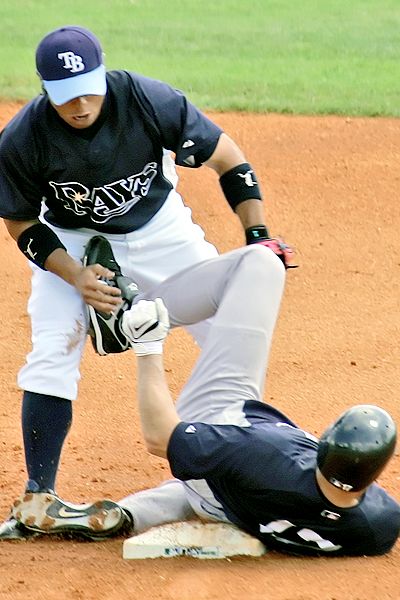
It’s a pennant race that’s going to have to be waged over two months against a couple of Goliaths who have no love lost for this new flavor in the AL East (and if anything, have softened a bit on each other as they mutually acknowledge the new blood).

If the baseball season as a whole is like a marathon, the second half is more like an 800-meter race — pacing remains critical but the event feels more like a sprint. One poor road trip while your competitors are taking care of business can be fatal. The pressure mounts with each passing day.

While the Red Sox (two titles in the last four years) and Yankees (a combined 147-80 over the last three second halves) have proven themselves to be the standard-setters for finishes, the Rays have no basis for comparison because they have played the spoiler role down the stretch every year of their existence.

Am I writing the Rays off? Far from it. I’m just calling for some tempering of October predictions until the young guns have actually experienced an existence with bona fide expectations. Lest we forget, expectations have been known to weigh down even the fleetest of foot.

And now here are some players who — like the Red Sox and Yankees — are established second half destroyers, and should be accordingly protected/coveted.

Garrett Atkins One of the true all-around hitters in the game. Atkins hones his batting eye over the course of the season and by the time the All-Star break comes and goes, the third baseman is locked in. He batted .354 with a .437 on-base percentage, 18 homers and 62 RBIs after the hiatus in 2006 and followed that up with a .349/.409/12/58 second half last year. Hold onto him tight, his best is still to come.

Nick Markakis He may be one half German and the other half Greek, but the young outfielder is all about the second half. In 2006 — his first year in the bigs — Markakis batted .311 with 14 homers and 41 RBIs after the break. Last year his second half was even bigger, as he sported a .325 average with 14 homers and 61 RBIs over the last 40 percent of the season. Do what you can to secure the services of an established twilight performer.
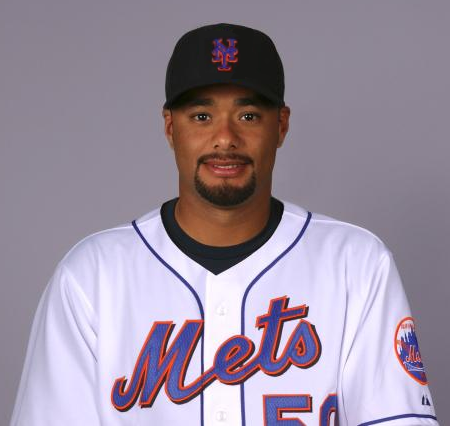
Mark Teixeira Of all the blue-chip sluggers out there, Teixeira is the one who has made second half dominance his calling card — at least over the last two years. In the first halves of 2006 and 2007, Teixeira meandered along, doing his best Brian Daubach impression (9 homers/49 RBIs in ’06 and 12/41 in ’07). Then, after the All-Star respites, he got mad (maybe because some fool dared utter his name in the same breath as Brian Daubach), going off for 24 bombs and 61 RBIs in ’06 with an encore of 18 and 67 last year. If someone offered me Teixeira for Adrian Gonzalez today, I’d do it in a heartbeat. But that’s just me.

Johan Santana Second half surges from the rubber begin and end with Johan. Forgetting last year — when Johan was less himself than John Malkovich was in “Being John Malkovich” — Santana has been downright nasty when the margin for error becomes smaller. Please allow his second half numbers to speak for themselves: 10-1, 2.54 ERA in 2006; 9-2, 1.54 ERA in 2005; 13-0, 1.21 ERA in 2004. So… Yeah… You might want to keep the guy around for the remainder of ’08.

MLB “Cinco de Mayo” Fantasy Points

It’s Cinco de Mayo. 30 games are in the books. You know what that means.

Time to begin critically evaluating your fantasy team.

What is your injury situation? Who has underperformed? Who has exceeded expectations? Do you have good balance between offense and pitching? What’s the greater makeup of the league you are competing in? How are you feeling about your squad?

Unless your team is sitting pretty at the top of the standings, chances are you have concerns; chances are most, if not all of the above stated questions are relevant.

Let’s tackle the most cut and dry topic first: Injuries. They are often unforeseen, and are usually unavoidable. That goes for real and fantasy teams alike. Whenever a blue-chipper goes down, a ripple effect ensues. What’s interesting so far this year is that injuries to big name players (Jimmy Rollins, Alfonso Soriano, Scott Kazmir, John Lackey) have had no negative impact on their clubs.

The Phillies and Angels have withstood the losses of Rollins and Lackey; both lead their respective divisions. The Cubs are two games ahead of their pace from last year (18-13 as opposed to 16-15) despite the loss/abysmal start of Soriano. And the Rays just polished off their best April in team history without the services of their ace, Kazmir. Even predictable injuries to Rich Harden and Pedro Martinez have not slowed down their clubs. The A’s and Mets are each within a game of first place in the loss column.

Fantasy owners haven’t been so lucky. While guys like Pedro and Harden have become mid to late round “high risk/high reward picks”, Rollins and Soriano are first and second rounders; Kazmir and Lackey are frequently among the top 10 or 15 starters chosen. Their absence has been an early critical blow to fantasy teams far and wide, specifically in roto leagues.

Even though Lackey and Rollins are close to coming back (Kazmir and Soriano are already playing again) their roto value is automatically diminished because of the time they missed. Barring a supersonic final five months from these guys, you can expect about a 15 percent drop-off in their 2008 stats. Because every fantasy team is built around a few choice stars like them, that can be the difference between a top-three finish and middle of the pack.

In head to head leagues, as long as your team isn’t buried in the standings today, you’ve got nothing to worry about. Since cumulative stats don’t matter in head to head, it’s of no consequence that Lackey finishes with 14 wins instead of 18 or that Rollins scores 108 runs as opposed to 135. You will still maximize their production from here on out.

The next major issue confronting fantasy owners is trying to diagnose the poor starts of established blue-chippers. Jose Reyes, David Ortiz, Ryan Howard, Justin Verlander and Travis Hafner headline this category. With the exception of Hafner–who seems to have lost his craft–roto owners should not be sweating the paltry numbers put up by those perennial fantasy catalysts. Play them everyday; when all is said and done the numbers will be there.

This time it’s the head to head owners who must start rethinking strategy. Since stats are only accrued on a weekly basis, consistently starting a slumping-Ortiz (.216/5/24) or Howard (.167/6/14 and 45 K’s) can be detrimental. They currently carry too much baggage to warrant putting them out there everyday. Of course there’s always the chance they’ll go off for multiple home runs on any given night, but so goes the double edged sword that is head to head fantasy management.

Be it head to head or roto, it is frustrating to managers that the Howards and Verlanders have been so unproductive, but baseball is a long season. The players we have talked about are too good at what they do to fizzle for longer than what equates to a small sample size (again, with the exception of Hafner).

Looking at the other end of that spectrum is important as well. That’s right; role players who have far exceeded expectations to the point of becoming overvalued. Xavier Nady (.347/4/30). Nate McLouth (.323/7/25). Josh Willingham (.341/6/16). Ryan Church (.318/4/22).

All are on ridiculous, career defining paces at the moment, but all will come back to earth sooner or later. This can be a delicate situation in roto leagues. Ideally for each fantasy manager employing a Nady, that manager also has a Howard. That way when the sample size becomes larger (ie when Howard turns it up and Nady levels off), the players will continue to offset one another and the overall team quality will be sustained.

However, if Nady is carrying your team and you’ve suffered no major injuries or slumps, it might be time to make a move. Maximize his selling value now and see if you can’t shore up a weakness (this is a good time to address bullpen issues). Of course, making deals requires having a feel for the climate of the league — are the managers generally tight, therefore hesitant to make deals (designated NBFT: Need Based Fantasy Trader)? Or are they ready and wanting to trade at will (designated CFT: Compulsive Fantasy Trader)?

If you’re in a league with primarily CFTs, don’t hesitate and wait for the other shoe to drop. Now is the time to sell high. If there are predominately NBFTs in your league, keep an eye on the waiver wire, maintain faith in the players you drafted, and wait another month or so before pondering deals. That’s what the real GMs do.

Portrait of Portsmouth

The journey begins at an upscale condominium complex in North Jersey. Dick Kaner is already standing outside, ready to roll, ready to embark on his 37th consecutive trek down the Atlantic coast for the Portsmouth Invitational Tournament (PIT).

Like many in his profession of professional basketball scouting and representation, Kaner has just returned from the Final Four. Throughout the basketball spectrum, Portsmouth, Virginia is the next (and most out of the way) stop on the flexuous road that will end in New York for the NBA Draft on June 26.

Each year, 64 elite seniors from around the country are invited to partake in a four day tournament and showcase, which is attended by representatives from every NBA team, as well as scores of hungry, competing agents. Only a few players will be drafted, but all will be ostensibly coveted. “It’s a feeding frenzy down there,” says Stephen Percudani, an up and coming agent who is letting me accompany him. “The first time you get there, you feel it.”

I’m already feeling it—the sensation in your legs as they fall asleep, that is–laid out in the backseat of Percudani’s Volvo, listening as Kaner makes preliminary contacts and “Perc” further details the swarm of basketball bees simultaneously converging on the southernmost point of the Chesapeake Bay.

As we head down the New Jersey Turnpike and into Delaware, Kaner has only one thing on his mind — surprisingly, it’s not basketball. “Chick-fil-A,” he states with purpose. “Best chicken sandwich you just can’t get up north.”

After we locate the notorious poultry stop and chow on tasty chicken and seasoned waffle fries smothered in honey roasted barbeque sauce, it’s back to the road. The last leg of the trip entails shooting down the Eastern Shore of Virginia and over/through the Chesapeake Bay Bridge-Tunnel.

Kaner touches base with the European clubs he is scouting for at the tournament. Perc, meanwhile, opines on the pilgrimage-like nature of the trip. Portsmouth holds sentimental value to him, as it was the last place his father, Dick Percudani—a revered basketball mind and director of scouting for the Phoenix Suns—watched a game.

———————-

Marty Blake, director of NBA scouting, steps to center court of the Churchland High School basketball court. “Will Richard Percudani please report to the scorers’ table?” he asks over the public address system. Stephen Percudani knows that’s his cue and heads down to the floor to hand out the award for excellence in basketball scouting that is given in his father’s name each year.

With that, the 56th annual Portsmouth Invitational Tournament signs on.

Churchland is easily the only venue you’ll ever see containing as many familiar faces as fans. On one baseline sits scouts row, a three-tiered hub of operations for all the major representatives of NBA teams.

Larry Bird, general manager of the Pacers, arrives in a cream colored button up shirt and takes his seat in the second row. He’s flanking his old partner in hardwood crime and fellow GM, Kevin McHale.

Moments after the opening tip of the first game, in walks Danny Ainge. Wearing a backpack and attired in a white long sleeved T-shirt with a green vest, Ainge spots McHale. Lighting up like a kid on the street court who sees his superstar friend arrive to join the team (We got Kevin!!!!), the Celtics GM does a beeline to his former teammate and recent trading partner.

He gives the Timberwolves’ general manager a playful pat on the back and the two exchange fraternal pleasantries. I wasn’t close enough to hear their conversation, but given Ainge’s animation (and the Celtics’ 66 wins), I would imagine it went something like this:

Ainge: (patting McHale on the shoulders) Who’s the man??

McHale: I am, Danny. I’m the man.

Ainge: You are THEEE man!!

McHale: You were right, Danny. Jefferson’s dropping 21 and 11. And Gomes is pretty good too.

Ainge: Told you it would look fair!!

The two buddies continue to mirthfully shoot the breeze, but they are the exception. Save for a bit of idle chit chat amongst evaluators, most of the scouts show they have long ago mastered the art of the poker face. Good play or bad, they exhibit no discernible change in demeanor or mood. Their most identifiable actions are the intermittent relocating of pen hands from underneath their chins to their notebooks in order to record an observation.

The vibe in the stands is quite different. The way Percudani had forecast it (“a feeding frenzy”) is apt. After a few jump shots and fast breaks, the intermingling of agents—engaging in a discourse that can best be characterized as hawkish—commences.

American agents (of which there are roughly 400) are scoping each other out; identifying and targeting the big shots (of which there are roughly 15-20), who may or may not also be their competition.

European representatives are numerous as well; their mission at Portsmouth is often times more important than the Birds and McHales. Since the PIT traditionally produces a handful of second round picks, NBA guys are evaluating everyone, but seeking out few. European agents, on the other hand, look at the PIT and see dozens of players ready to compete professionally overseas.

From Spain, France and other parts of Western Europe to Eastern European countries like Serbia and Montenegro and Bulgaria, scouts and agents from abroad are trying to strike deals with their American counterparts to increase the flow of ballplayers overseas. The growth of the sport in Europe has opened avenues for many ex-college athletes to make a living playing the game they love.

Walt Szczerbiak, father to Wally of the Cleveland Cavaliers, is plopped down in the bleachers, balancing an evaluation sheet on his right leg. He takes the time to shake hands with acquaintances during timeouts while telling me about his expansive basketball background.

As one of the earlier pioneers in bringing the sport to Europe, Szczerbiak played in the PIT in 1971 before going to Spain and winning three Euroleague titles with Real Madrid (1974, 1978 and 1980) in the country’s highest league, the ACB. He is now the official US representative of the ACB, and has been scouting talent at Portsmouth since he undertook the position in 1986.

He has seen things change over the years.

“In the old days you had a lot of guys that got to their senior year, but now since so many guys are leaving, you’re not getting that level [of talent],” says Szczerbiak. “They’re either in the NBA or they have potential to be a lot better than the kids that are here.”

Taking into consideration that trend, a lot of the time Szczerbiak’s task is to monitor the throng of agents and make sure the teams he is representing are getting a fair shake. “You know, agents are selling one thing,” he says. “My job is to utilize my contacts and put things in better perspective.”

Szczerbiak’s Portsmouth roots–like his array of contacts–run deep. In fact, when he participated in the PIT, there was only one person from the NBA there to evaluate him; a guy who opened the flood gates and helped turn Portsmouth into an annual destination for anyone associated with the league.

———————-

“If you’re with Dick Kaner, I don’t wanna talk to you,” Bob Ferry informs me. He pauses before looking up from his spot in the first row of the bleachers at center court. “I’m just kidding,” he says through a blank stare.

“But I’m not telling you anything.”

Ferry, twice the NBA Executive of the Year (1979 and 1982), was also the architect of the 1978 NBA Champion Washington Bullets. When he discovers I’m only probing his knowledge on the history of the PIT—and not trying to finagle sensitive player info out of him—he opens up.

“I came down here, I think it was about 1971. I heard about the tournament. I drove in from Baltimore. Then I drafted Kevin Porter, a very good player, and kept it secret. Then a couple of years later I drafted a kid by the name of Chuck Robinson, who was really a good player. And then the word got out that I was coming down here, and word went out to all these scouts.”

“It gradually just got bigger and bigger, more people found out about it and more scouts came, and a better quality of players started coming in and before you knew it, it basically worked its way to what it is today.”

While Ferry enjoyed having his own “pickins” for a period of time when the tournament was still a niche, he speaks with a justifiable sense of pride when detailing the evolution of the event. His one time diamond in the rough ultimately served as one of the launch pads to greatness for the likes of Rick Barry, Earl Monroe, Dave Cowens, Scottie Pippen and John Stockton.

As we watch one of the consolation games– this one pitting former Tennessee teammates Chris Lofton and JaJuan Smith against one another—Ferry talks about how the tournament has turned into a “job fair” of sorts. Watching the two ex-Volunteers go at it, matching threes while playing tight, aggressive defense, you can tell they are teammates no longer; only competitors vying and competing for the same looks.

Ferry sums it up: “These kinds of tournaments are it. These tournaments leave a strong impression on people. And for some of [the players], it’s the last one they got.”

———————-

The final buzzer sounds. A team led by Jamar Butler of Ohio State has just won the championship by a breezy 23 points. However, Butler, the tournament’s Most Valuable Player, is not even one of the three athletes from Portsmouth that NBADraft.net projects to have their name called by David Stern in New York.

There are whispers that this year’s tournament is collectively one of the weaker fields in recent past. For many—even those who excelled over four days—the dream may be fading. There are only so many jobs to be had in the NBA, after all (450 to be exact). But for those kids willing to take a chance and head overseas, a career is waiting for them.

As I’m wrapping up, the European agents are desperately trying to make some final lasting impressions with the athletes. I find Percudani, and just as we are preparing to exit Churchland one more time and hit the road back to the Tri-State area, I see someone familiar walking toward us.

After breathing all things basketball for four days, it feels like we picked up Dick Kaner from his condo a month ago. We talk briefly about Lofton and Smith, and the upcoming Orlando Pre-Draft camp. Kaner’s taking off with a friend later on, so won’t be riding north with us, but he does have some parting advice.

“Chick-fil-A,” he reminds us.

“You won’t get it in New York!”

NCAA Tournament Preview

The NCAA tournament field begins with 65 teams, and in the span of four days, is whittled down to 16. Transpiring more like a continuous strike of lightning than 48 separate basketball games, the first two rounds of the Big Dance make it impossible to do anything else for the better part of 80 hours. Once the first ball goes up on Thursday at noon, you won’t see a blink throughout college basketball until Sunday evening.

By then, the real picture will have started to come into focus.

A few teams whose lower seeds indicate they should have fallen but remain standing will be given the Cinderella treatment, but chances are they won’t fit into the slipper. In reality, only a handful of schools each year have a viable shot at the whole shebang, and no champion has ever been called Cinderella. To win six consecutive elimination games requires lots of talent, a considerable amount of depth, and outstanding coaching.

Plus, of course, more than a little luck.

Following is a region by region breakdown of key games, possible sleepers, and the schools that will find their way to San Antonio.

East Region

Game to watch (5) Notre Dame vs. (12) George Mason– It was two years ago that George Mason turned the college hoops universe inside out, winning a regional final against a UConn team stacked with future NBA players. The Patriots instantly became the most improbable Final Four team (an 11th seed) in tournament history. After missing the Dance last year, Mason is back, and so is the mystique associated with the name. Notre Dame, on the other hand, is looking to settle some unfinished business after getting upset by Winthrop in last year’s tournament. The Irish have the inside/outside combo with Luke Harangody and Kyle McAlarney, but the Patriots won’t back down.

Possible sleeper (7) Butler– The Bulldogs have the resume of a top-five seed: 28 wins–Texas Tech, Virginia Tech, Ohio State and Florida State among them–and only three losses (by an average of four points). They are led by a great point guard (Mike Green) and a cold-blooded shooter (A.J. Graves). Graves was the catalyst of their run to the Sweet 16 last year. And like it did against Florida last March, Butler has the ability to slow down a high-flying offense like Tennessee, the team it will be facing in the second round.

Advances to San Antonio (1) North Carolina– The Tobacco Road to the Alamo is paved for the Tar Heels. The number one overall seed in the tournament is always rewarded with the most favorable travel schedule. Two games in Raleigh followed by a regional in Charlotte (where the Heels just won the ACC tournament championship) should make up for what could be a few roadblocks (Notre Dame/Louisville/Tennessee). Tar Heel faithful are about as faithful as they come, and with UNC primed to make another run at the title, it’s just not possible to envision them getting bumped in their home state. And don’t forget about that Tyler Hansbrough character…

Midwest Region

Game to watch (6) USC vs. (11) Kansas State– Is there really any debate? Is it really a coincidence that the two most iconic freshmen in the country (O.J. Mayo and Michael Beasley) find themselves matched up against one another on college basketball’s grandest stage? I think not. While Beasley is pretty much the consensus number one pick in next years draft, as Kevin Durant was at this time last season, can Beasley pen a different conclusion to his brief collegiate career? Many thought Durant was going to replicate Carmelo Anthony’s performance of a few years before but that journey never even began as Texas was manhandled in the second round by…you guessed it, USC! Once again, in this matchup I don’t see a coincidence. I do see a heck of a basketball game though.

Possible sleeper (6) USC– The Trojans are toeing that line between sleeper and under-the-radar favorite. Most teams would prefer the former. Let’s put it this way: if USC can get past Kansas State, with Mayo and Taj Gibson representing a formidable and confident inside/outside presence, I see them running through Wisconsin and Georgetown en route to the Midwest Regional Final. They’re that scary.

Advances to San Antonio (1) Kansas– I won’t mince words. The Jayhawks, while maintaining a consistently elite recruiting class since the departure of Roy Williams, have drastically underperformed in March since Bill Self took over. That said, this is undoubtedly the most versatile Kansas team since the likes of Kirk Hinrich and Drew Gooden had them in three out of four regional finals. Brandon Rush, Mario Chalmers and Sherron Collins are probably the best guard-trio in the country, and as anyone who follows the madness knows, guard play wins in March. This is the year Kansas gets back to the Final Four.

South Region

Game to watch (6) Marquette vs. (11) Kentucky– Big programs with experienced leaders traditionally make for entertaining tournament games. You’ll be hard-pressed to find an opening round matchup boasting two bigger powerhouses. As for tenured-leaders, look no further than Dominic James of Marquette and Kentucky’s Joe Crawford. With a combined seven years between them, both have played in a lot of important games. Add to that the rivalry that began when the Golden Eagles, carried by a phenom (one Dwyane Wade), stunned the top-seeded Wildcats in a 2003 regional final, and you have a recipe for a first round heart-pounder.

Possible sleeper (12) Temple– Under legendary coach Jon Chaney, no one really took note of how Temple got into the tournament when it did. All that mattered to opposing coaches and teams was the fact that the Owls were always a dark horse to make a deep run. Since Chaney’s departure, Temple has taken a few steps back, but the parallels between the 2008 Owls and past Temple teams are quickly becoming apparent: slow start, strong finish, unlikely Atlantic 10 tournament champion. The blueprint is there.

Advances to San Antonio (2) Texas– I think Memphis is the meanest, toughest and best overall team in the country. The problem is, they can’t shoot free throws! It doesn’t matter how good you are, because any team that has plans of winning it all will have to finish multiple games at the free throw line. The Tigers barely shoot 60% as a team, and their best free throw shooter, Derrick Rose, is a shade under 70%. That’s not going to cut it against a team like Texas. D.J. Augustin and A.J. Abrams are arguably the top guard-tandem in the country, and both are better than 79% shooters at the charity stripe. The Longhorns will advance because their guards can close out games.

West Region

Game to watch (7) West Virginia vs. (10) Arizona– There is always one team that has something to prove after gaining what many believe to be a bogus tourney bid. Last year it was Stanford. This year it’s Arizona. The Wildcats lost twice to Arizona State and finished with a worse conference record than their in-state rival, which had much of the college basketball world up in arms about ASU’s snub. The only way to justify its 24th straight tournament berth (the nation’s longest active streak) would be for the Wildcats to beat a traditionally solid tournament team in the Mountaineers.
Possible sleeper (5) Drake– It’s tough to deem a fifth seed a “sleeper” but Drake is certainly not a household name. They just finished annihilating the Missouri Valley Conference–which has shed the “mid-major” label with its quality and depth the last few years–and sport a 28-4 record overall. It looks like they’ll be meeting a suddenly-stumbling Connecticut team in the second round. A Sweet 16 appearance looks increasingly likely for the Bulldogs.

Advances to San Antonio (1) UCLA– Of all the top seeds, the Bruins have the fewest obstacles standing between them and another Final Four, as the West is the only region without multiple title contenders. The nucleus of this team–Darren Collison, Josh Shipp, Alfred Aboya, Lorenzo Mata–has been sniffing a national title the last two years, only to be thwarted by Florida both times (first in the National Championship, and last year in a National Semifinal). The Gator dynasty has been dismantled and Kevin Love is on the scene, which bode well for UCLA. This should be their easiest passage to the Final Four. The real question is will they be able to finish the job they began in 2006?

LSU’s Wild Ride to the Big Game

As soon as LSU conquered the land’s toughest football conference last Saturday, the Tigers and their loyal pack were resigned to the hard truth that a possible BCS crown had already been lost. SEC champions for the first time since its last national championship in 2003, LSU knew it wouldn’t be enough. A computer–in conjunction with writers and coaches–had decided that a couple of one loss teams, West Virginia and Missouri, were superior to the twice-downed-in-triple-overtime Tigers. And that was that.

Only a miracle could save the Tigers. Actually two.

Check that, two and a half.

Miracle number one came in the form of the formidable Oklahoma Sooners. Oklahoma too had seen its title hopes crushed after a loss at Texas Tech. Oklahoma still found its way to the Big 12 championship game, where the perennial conference power-Sooners faced Missouri, a team it had already beaten by ten points earlier in the season. Accordingly Oklahoma was favored entering the rematch with the top-ranked Tigers. They pummeled Missouri for a second time, this bout by three touchdowns, which ultimately raised the question: which occurrence was more miraculous–Oklahoma beating the number one team in the country or the number one team in the country being Missouri? Subjectivity aside, Missouri was out but all that meant was Ohio State was in.

LSU needed miracle number two, the true miracle, to have a realistic shot of leapfrogging the five teams necessary for securing second place in the final BCS standings. The game in question was #2 West Virginia hosting unranked Pittsburgh. Also known as “The Backyard Brawl”, WVU-Pitt is traditionally adequately summed up by its joint-nickname. The key word being “traditionally”. This season West Virginia, led by quarterback and Heisman-candidate Pat White, had staked its claim as a national contender while Pitt had languished as Big East bottom-feeders. With the line Las Vegas had set, West Virginia by 29 points, it appeared that a backyard beat-down was in the cards. Didn’t happen. The Panthers shocked the mortified Mountaineers and their rugged fans, 13-9. By the time LSU’s charter flight from Atlanta had landed in Baton Rouge, the table was set.

What needed to happen next was for the Tigers to get the official invitation to dinner–a summons that would only be proposed at the behest of a computer.

Due to the convoluted nature of the BCS mathematical formula and the fact that the entire system was being tested by a handful of teams all vying for the desired permutation that would spit them out in the top two, the human element was going to be crucial. Since the polls (Harris and Coaches) represent two-thirds of the BCS compilation, the six computer rankings used as the other third of the BCS formula were going to hold far less weight. As long as there was a consensus between polls on the number two team in the country, the BCS do-dad would likely concur.

So LSU had to wait for one more small miracle by putting its fate in the hands of the voters, who as we all know can be fickle at times. One of four teams–LSU, Georgia, Oklahoma or Virginia Tech–would have to be number two. Voters tend to stick by the guiding principle of “it’s not about losing, but rather when you lose”. In respect to the teams LSU was contending with the Tigers couldn’t feel very confident considering they were the most recent of the four to be defeated, and at home no less on the day after Thanksgiving. Oklahoma last lost on November 17; Virginia Tech on October 25; and Georgia way back on October 6. However, with a little deeper digging you could toss aside all conventional wisdom.

Oklahoma lost its two games to unranked teams (Colorado and Texas Tech) and only beat three ranked teams (Texas and twice Missouri). Virginia Tech lost to LSU by 41 points at Tiger Stadium. And Georgia, although beating four ranked opponents (including Kentucky, who beat LSU), couldn’t get by Tennessee, which was precisely what prevented them from gaining a head to head shot against the Tigers for the SEC championship.

The resume of LSU dwarfed those of its three competitors. Of the Tigers’ 11 wins, six were against ranked teams (Virginia Tech, South Carolina, Florida, Auburn, Alabama and Tennessee). Each of their two losses came in triple-overtime in true SEC-blood games against Kentucky and Arkansas. And to compound the drama, in the hours leading up to the SEC championship against the Volunteers, LSU was thrust into pondering life in the near future without its head coach Les Miles (who had been granted permission to speak with his alma mater, Michigan, about its coaching vacancy) and its defensive coordinator Bo Pellini (who appears headed to Nebraska). Then the Tigers had to play the game itself without their starting quarterback. The injured-Matt Flynn was replaced by sophomore Ryan Perrilloux, who in an MVP-performance, won the game despite playing through an injury on his throwing hand sustained during the contest.

LSU’s immediate reward for reclaiming the SEC? A birth in the Sugar Bowl in New Orleans. Any other year an LSU appearance in the Sugar Bowl would have the state of Louisiana thumping. After Saturday’s game though, the sugar wasn’t tasting so sweet. While the Tigers were assured of playing a BCS game in the Superdome, it wasn’t the one they had envisioned throughout the ’07 season. This year, so it happened, was New Orleans’ turn to host the BCS National Championship and it sure seemed like the Tigers were going to miss the party.

Not until the finishing touches were put on one predictable and one epic choke, and not until those chokes were assessed by the voting powers-that-be were Tiger fans finally rewarded with that invitation they’d been expecting since two-a-days began last summer. An invitation to travel into their backyard and compete for a national title.

While the reality is LSU will likely win the national championship in a de facto home game, the simplicity of one winner-take-all game that has evolved from the chaos of an unprecedented and enthralling SEC campaign is almost an anticlimax for LSU fans. Between two triple-overtime losses and three other games in which the Tigers rose from the ashes (against Florida, Auburn and Alabama, all games in which the Tigers came from behind in the waning minutes or seconds) Tiger fans must feel as if they’ve been stuck in a centrifuge since the beginning of October; they may no longer be plastered against the wall but their heads are still spinning.

Once they regain their collective equilibrium they’re going to realize that no one game could compare to the five heart-stopping battles they waged within their own conference. I chronicled one of those struggles, the Auburn game, which I attended while the Red Sox were simultaneously making a fierce ALCS comeback against the Indians. Much like LSU after the Arkansas game, the Red Sox were all but written off after falling behind three games to one against Cleveland. When the seemingly impossible finally happened and the Sox clinched the pennant after three straight wins, Red Sox Nation gleefully looked ahead to the grandest stage in baseball, the World Series. But deep down we all knew the true trials of willpower were behind us. All that laid ahead was business. The business of winning a championship.

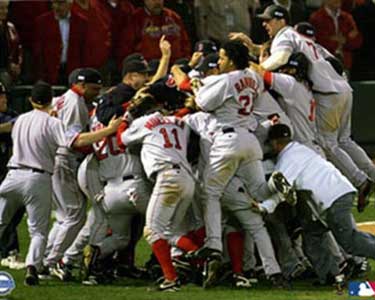
LSU ran the gauntlet that was the SEC this year. Like the Red Sox in the ALCS, the Tigers escaped battered and bruised if not preciously close to knocked out, but they escaped nonetheless. Boston, after finally putting away the Indians in Game 7 at Fenway Park, took four straight from the Colorado Rockies to win its second World Series in four years.

Expect the Tigers to follow in kind with their second in five.

It’ll all take place on January 7 in N’Awlins, in a Dome inhabited by Saints but at times destined for Tigers. And even if the game doesn’t end up shaving additional years off the lives of LSU fans, only when the purple and gold confetti starts flying will the path traveled be fully appreciated.

Cheers and Jeers: NFL Week 12

Here are some cheers and jeers following a bizarre Week 12 in the NFL…

Cheers to Chad Johnson for bringing back some of that Ocho Cinco zest and revealing he still has a knack for the theatric. Against the Titans Johnson caught a season-high 12 passes for 103 yards and three touchdowns. After his first score, which doubled as the first time he’d seen the end zone since Week 2, #85 took control of a sideline camera and filmed his fans in happy mode. Other than a classic (yet seemingly under-the-radar) ESPN interview between Keyshawn Johnson and Chad, the entertaining Ocho Cinco has not been heard from nearly enough this year. The NFL put its foot down on excessive touchdown celebrations, which is one reason for the generally toned-down merriment following scores. As for Chad’s fall from grace, the Bengals played poorly all season, which should explain why until Sunday we’d seen very little of one of the more vocal and dramatic personalities in the league. If Chad can lead Cincinnati back to relevance that’s a good thing for the NFL (considering this season it hasn’t repeatedly had to send representatives to courtrooms on behalf of Bengal players).

Now, to go from the uplifting to the unfair…

Jeers to Peyton Manning for showing up to “root” for his brother when the Giants hosted the Vikings. Like Eli doesn’t know Peyton has been better than him at every level of football since Pop Warner. Not only did Eli have to contend with Minnesota’s formidable pass rush, he had to do so with his big bro dissecting every play from his perch in a Giants Stadium luxury box. How did Eli respond to the sibling pressure? By throwing four interceptions (three for touchdowns) to the woeful Vikings secondary. Sibling rivalries are always intense, especially when they wind their way to the pinnacle of a sport (just ask Venus and Serena Williams). Thing is with Peyton and Eli, only one of them is at the pinnacle of football. The other one is a serviceable quarterback who just happened to throw three touchdowns to the other team Sunday. Look, this may have been destined to be one of those “Eli games” but his brother certainly didn’t help the cause. Shouldn’t Peyton have been buried in a tape room somewhere preparing for Jacksonville?

Speaking of two guys who will be spending some time in the tape room…

Jeers to Gus Frerotte and Kurt Warner for fumbling the ball on the last the play of the game. All Frerotte had to do was take the snap on fourth-and-goal from the Seattle 1-yard line, hand the ball to Steven Jackson and walk off the turf that formerly housed “The Greatest Show”. Instead he botched the snap, dropped the ball and lost the game. Warner’s gaffe was almost as egregious and equally decisive. In overtime against the 49ers, Warner’s Cardinals were backed up at their own 3-yard line. On first down Warner dropped back into the end zone, couldn’t find an open receiver, and was stripped of the football. Tully Banta-Cain recovered the freebie for the game-winning touchdown. For two quarterbacks with a combined 23 years of NFL experience, the fashion in which Frerotte and Warner exited the field Sunday was embarrassing to say the least.

On a more positive note…

Cheers to the Eagles for displaying their disgust at being on the short end of a 24-point spread by nearly taking down the Patriots in Foxborough. If New England has been the ruthless model of efficiency this season the Eagles have been the total opposite model of chaos. Donovan McNabb and the city of Philadelphia are approaching the end of a bitter relationship. Eagles coach Andy Reid has dealt with domestic issues of monumental proportions. No one would have blinked twice if the Patriots dropped the Eagles by four touchdowns. Yet led by A.J. Feeley and a fearless, unrelenting pass rush Philly hung with the Patriots for four quarters, something no team (even the Colts) has accomplished against the Pats this year. While the term “blueprint” may be a little exaggerated, the Eagles clearly showed the rest of the league that any defense with the stones to consistently rush five and six guys can disrupt Tom Brady. If an NFL team ever deserved a pat on the back in defeat, it was the Eagles on Sunday night.

Speaking of pats on the back…

Cheers to NBC for pumping up the volume on the sideline microphones at Gillette Stadium, which enabled viewers to literally hear how Tom Brady was dealing with the Eagles’ various defensive alignments and pass rushes. Time after time Brady took the play clock down to the final seconds, letting out a hail of adjustments to his receivers and linemen in an attempt to warn them of impending defensive movement. More than once he called out a hot route or refined blocking assignment to a receiver by name (“Gaf..” “Randy..”). We also heard Brady use the audible “Omaha” on more than one occasion, and given the tranquil atmosphere he even took to whispering something in the ear of Kevin Faulk before taking a snap out of the shotgun. NBC’s first two broadcasts of Patriots games were filled with a lot gushing on the parts of Al Michaels and John Madden. In Week 2 against San Diego it was all about CameraGate and last week in Buffalo they took turns tossing the “perfect season” salad. Last night NBC simply broadcast a football game and let the players do most of the talking.

Finally…

Jeers to Todd Sauerbrun for pretty much single-footedly losing the game for Denver in Chicago. As a kicker I believe Sauerbrun should have gotten the memo about Devin Hester. You know, the one that outlines how Hester is the most electric return man ever to play the game of football!!!!! How’s this for a bad day: first Sauerbrun booms a punt to Hester in the third quarter, which the lightning returner takes to the house; then after the offense has given the Broncos a 20-13 lead, Sauerbrun’s kick off sails straight down the field to Hester, who snatches it and torches another Denver coverage unit for six more; then with a 34-20 lead late in the game and Denver forced to punt, Sauerbrun, so concerned with keeping his boot away from Hester, instead doesn’t even get the kick away and has it blocked. 17 unanswered points later and the Broncos had ample reason to leave the Windy City feeling pretty Sauer.

Here’s the updated power poll…

NFL Top Five Power Poll: Week 12

1. Patriots (11-0)

2. Cowboys (10-1)

3. Packers (10-1)

4. Colts (9-2)

5. Jaguars (8-3)

NBA Preview 2008: A Glimpse into the Future

With all the NBA Previews floating around, here’s an uncompromising vision of the 2008 NBA Playoffs…

Mid-April 2008: the NBA Playoffs are set

East

1. Celtics (58-24) versus 8. Knicks (41-41)

2. Pistons (52-30) versus 7. Cavs (43-39)

3. Magic (47-35) versus 6. Heat (45-37)

4. Bulls (47-35) versus 5. Nets (46-36)

West

1. Suns (61-21) versus 8. Kings (43-39)

2. Spurs (59-23) versus 7. Hornets (46-36)

3. Nuggets (54-28) versus 6. Rockets (51-31)

4. Mavs (54-28) versus 5. Jazz (52-30)

Late-April 2008

The first round of the 2008 NBA Playoffs featured a few laughers, some unforgettable subplots and one epic series. In the East, the Celtics beat the Knicks in four. In Game 1 Isiah Thomas (who just before the postseason signed himself to a 10-day $40 million contract to prevent Stephon Marbury from running point) took the opening tip and drove to the basket. The ensuing swat by Kevin Garnett was so severe that player-coach-GM Isiah opted to forfeit the series and all three of his job titles, and move to a country where it wasn’t frowned upon for a male boss to make sexually insinuating remarks to a female subordinate. The next day Marbury led the Knicks in a parade down Broadway.

The Nets/Bulls series was a first round joke, as Vince Carter dropped 45 in Jersey’s Game 1 victory. His agents then informed him on a conference call that the 2008-09 season wasn’t a contract year, and the Nets lost the next four straight. In the 3-6 matchup Dwight Howard and the Magic knew something was awry when Shaq rolled up to Amway Arena in a 22-wheeler emitting pungent diesel fumes. In the Heat’s 4-1 series win, Shaq went for at least 18 and 12 each night.

The best series was a rematch from last year’s Eastern Conference Finals, between the Pistons and Cavs, won by King James. The Pistons made the necessary adjustments and were in position to eliminate the Cavs in Game 6 before Lebron iced Rasheed Wallace at the free throw line, if you can call it that. As he did to Gilbert Arenas two years ago, Lebron walked up to Sheed and whispered something in his ear. Sheed then removed his head band, threw it around the neck of Lebron, pulled him close and whispered something back through a loony smirk. For that he received his fourth technical of the series, allowing the Cavs to force a Game 7, which the Pistons won in double overtime.

Out west the Kings battled the top-seeded Suns to a split in Phoenix. In Game 3 back in Sacramento, the Maloof brothers, evidently too close to the action, inadvertently tripped Ron Artest as he was running back up the court after a dunk. An incensed-Artest chased the petrified owners into the stands, making him the first player to leave the court both on the road and at home. There were no injuries, but the remainder of the series didn’t go too well for the Kings, and their owners, the Queens.

In other first round action, the second-seeded Spurs dismantled the Hornets, sweeping four straight. The series was so one-sided Tim Duncan only protested every other call against him. Meanwhile, in the 3-6 set, the Nuggets (who owned the best record in the league over the last six weeks) maintained their high level of play against Tracy McGrady’s Rockets. Allen Iverson and Carmelo Anthony hit many, many jays and Marcus Camby’s lanky, shot-blocking frame consistently frustrated Yao in the Nuggets’ 4-2 series win.

That left the Mavericks and Jazz, a series which Mark Cuban assured everyone who was willing to listen that his Mavs would not lose. Too bad they didn’t have an answer for Deron Williams, who methodically picked apart the Dallas defense with a dizzying array of fast break dishes, no-look bounce passes and smooth jumpers. Dirk Nowitzki didn’t replicate his dud performance of a year ago against Golden State, but in the end the Mavs fell in an anti-climatic Game 7, very similar to their Game 6 elimination at the hands of the Warriors. After his team’s second consecutive first round exit, Cuban was so enraged he vowed never to speak to the team or media again. In their pieces the next day the Dallas beat writers declared the season a success.

May 2008

After the Celtics smoked the Heat in Game 1 of the Eastern Conference Semifinals, Dwyane Wade held a players-only meeting in the locker room. He told his teammates that the Celtics were very beatable, given how “freaking old” they all were. By the end of his tirade he realized that the cold stares of Shaq, Alonzo Mourning and Penny Hardaway were burning holes through his jersey. The Celtics coasted in five. In the other second round matchup, the Pistons and Bulls squared off for the second year in a row. Chauncey Billups (aka Mr. Big Shot) was neutralized by Ben Gordon’s protruding chest. Due to this, Pistons coach Flip Saunders was rendered completely useless since he had only one play on his clipboard (“Chauncey create offense”). Da Bulls advanced in six.

In the second round of the west, Phoenix started looking like a team ready to handle business. The Jazz, who had looked so workmanlike in the first round, simply couldn’t run with Steve Nash and the Suns. After Utah lost the first three games of the series by a combined 42 points, Carlos Boozer tracked down Phoenix GM Steve Kerr and told him he had a hidden “screw over my team” clause worked into his contract and he’d be willing to exercise it for an immediate trade. Sans Boozer, Utah was swept the next night. Meanwhile, the Nuggets and Spurs clashed for the third time in the past four postseasons. In a startling reversal of roles, it was the Spurs who captured Game 1 before losing four of the next five to a Nuggets team clicking on all cylinders. For the third time in five years, the Spurs again could not defend their title. When Tim Duncan was asked if he felt his team didn’t have the necessary fire and drive to repeat as champions, he responded by saying that Dirk Nowitzki’s game-tying three point play in Game 7 of the 2006 Playoffs was “bulls–t”.

That left four teams standing in the ’08 Playoffs: the Celtics, Bulls, Nuggets and Suns. The Eastern Conference Finals was a backyard brawl. The teams split the first six games, all hotly contested affairs. Ray Allen, Paul Pierce, and Ben Gordon each hit a game-winner. What was an up and down, guard-oriented affair throughout the first eighty percent of the series turned into the KG show in Game 7 at the Garden. Garnett went for 37 with 24 rebounds in the decisive contest, and entered select company when he shattered the backboard glass on a tremendous two-handed throw-down. He then ate the remnants of the defunct apparatus. The Western Finals was equally entertaining. While the Suns took care of the Nuggets in six, Denver won the first game against a suddenly lackadaisical-Suns team. The series became an instant classic when Iverson arrived unannounced at Mike D’Antoni’s press conference after Game 1, during which the coach was questioning if his Suns had practiced hard enough to adequately prepare for the tough-minded Nuggets. A.I. looked up at the snarling coach, and asked him if he was really talking about “practice?!?”.

June 2008

The Celtics and Suns, after waiting a combined 34 years (the Celtics since 1986 and the Suns since 1993) to return to the Finals, waged hardwood war in the championship round. The hype going into the series revolved around an ongoing debate of which franchise and its players was hungrier. Was it the Suns? who had only appeared in two Finals in their history, the ’93 loss to Michael Jordan’s Bulls and a 1976 loss to their father’s Celtics. Or was it the Green? who had suffered through two decades of total futility after three decades of systemic dominance.

Each side claimed it was hungrier than the other. In the first shocker of the series, Steve Nash beat KG in a hot dog eating contest prior to Game 1. For the first time all season the omnipotent and omnivorous Garnett was upstaged, which set the tone for the series. Nash was simply too much for the slower-Celtics and their epically overwhelmed point guard, Rajon Rondo. The Suns notched the first two games in Phoenix plus the second game in Boston, pushing Boston to the cusp of elimination going into Game 5. In that affair the Green looked done with just under a minute remaining, trailing by eight points. It was then that Danny Ainge pulled the string on an incredible transaction, securing Reggie Miller’s services for 38 seconds. The baller who had redefined “clutch” entered the game and ripped off three treys in a row, sending the Garden into oblivion and implausibly jettisoning the Celtics back to Phoenix for Game 6. Returning to the arena formerly known as America West, Nash ended any hopes of a Boston-comeback. The Suns won a track meet, 123-119, and Phoenix clinched its first basketball title behind Nash’s 24 points and 16 dimes.

And just like that 2008 was in the books.

Believing on the Bayou: a Sox/Tigers Narrative

The whys and hows associated with extraordinary happenings in sports can only be thoroughly assessed with the assistance of hindsight. That’s the beauty of The Moment: it rips you from reality, sweeps you up, and spits you out in a state of euphoria. Reflection is not possible when living The Moment. Only realization. Realization that wherever you are and whatever the circumstances, The Moment will always be with you.

—————————————————————————————————————————

It was Saturday morning, October 20. Curt Schilling was approximately eight hours from throwing the first pitch of Game 6 of the ALCS at Fenway. I was in Baton Rouge, Louisiana, priming myself for what I knew could end up being the most intense sports experience of my life. Not only was I preparing for another Game 6 with the Sox in the midst of another furious ALCS comeback, I was preparing to miss it.

Friends of mine had come through with dynamite tickets to the completely sold out LSU-Auburn game. A game, for LSU-faithful, that was equally as important to the Tigers as Game 6 was to the Sox. One loss for either squad meant no championship in ’07. Of course, the predicament these two odds-on favorites had to contend with was a result of their own doing. The Red Sox played uninspired baseball for three straight games against Cleveland, pushing them to the brink of elimination. LSU, meanwhile, a week after pulling a cat out of a hat against the defending-national champs, Florida, lost a back-breaker in triple overtime to Kentucky. Just like that, two teams that had visions of perfection were left with the disturbing actuality that seasons so full of haughty expectation were improbably teetering on the brink.

By mid-afternoon outside Tiger Stadium all you could see were purple tents; all you could hear was classic rock and all you could feel were Tiger-fans zoning themselves in for a showdown with…the Tigers (of Auburn). Then there was me. I was, you might say, a fish out of water. But not to most of the tens of thousands milling around me. Garbed in a yellow-LSU t-shirt and Red Sox cap, I tacitly fit in. No matter how much I appeared to belong, the ritual I was engulfed in was like nothing I had ever been a part of. Baking under the scorching southern-sun, I drank beer, ate gumbo and jambalaya, and did my best to engage the Fighting Tiger-faithful.

However, as the hours passed and the bodies multiplied, the angst started to take form. As I wrote before, a Sox-Indians ALCS was nowhere near as angst-inducing as another Sox-Yankees would have been. That said, with the way my heart was palpitating around 7:00 pm, my future cardiologist thanks Cleveland for ousting the Yankees. Because I literally could no longer sit still, I decided to make some rounds.

I crossed the street outside the stadium, and as I was peering through a steel fence into one of the cavernous tunnels that marks a point of entry, I heard a voice that seemed to be addressing me. I was already toasty enough to not really care about acknowledging the belligerence around me, but next thing I knew a guy was in front of me, asking if I knew how to traverse the fence and get to the tunnel. Before my synapses had a chance to fire, I was doused with an affront that made me see New York.

“AWWWWWW,” the guy said. “You’re a Red Sox fan!?”

“Abso-(expletive)-lutely,” I retorted.

Typical of a Yankees fan, he threw a few more barbs about my allegiances before again asking me for directions. I wish I had known where he was trying to get, so I could have then sent him in the exact opposite direction. As we were parting, I on my own and he with another couple, he turned.

“Later bro,” he said. “I’m going to meet my ex-girl and her new guy so I can beat his ass.”

“Sounds good pal,” I returned. “Maybe he’s a Red Sox fan. At least it’ll be worth it.”

Chuckling at the fact that Sox-Yanks beef really does invade all environments, I decided to test out my new headphones and old-school AM/FM walk-man, which beginning in about thirty minutes, was going to be my lifeline to Schil and the Sox. I had already researched the ESPN Radio affiliate in Baton Rouge, which was AM 1300. Tuning into the station expecting to hear some ALCS pregame, I instead heard LSU pregame. I wasn’t worried, since I knew that the LSU games were broadcast on FM. I received a call from my friends, who said they were heading into the stadium. I told them I was going to try and catch the beginning of the baseball game on TV and I’d meet them for kickoff.

I began gravitating in and out of various tailgates, accepting beers and talking to different people while waiting for some piece of Red Sox bait that I could gobble up and parlay into a first-inning viewing. Opportunity presented itself when I found myself inside a tent the size of a tractor trailer. I got talking to a guy who quickly noticed my hat, and conveyed his support for my team. He had given his tickets to his sons, so he would be sedentary for the duration, which made him one of few not attempting to imminently enter the stadium. I asked him if, by chance, I could take in the first forty minutes of the Sox game. He obliged, told me to take a seat, handed me a 22 ounce can of Natural Light, and we exchanged formal greetings. SCORE.

The game began, and still a bit wary about the lack of any pregame coverage on the radio, I decided once and for all to locate the broadcast. For the entire first half inning, during which Schilling set down the Indians, and throughout the bulk of the Red Sox half of the first, I desperately tried to find the right station, to no avail. When Manny came up with nobody out and the bases loaded, I resolved to the fact that the first inning would be it for me because this game definitely wasn’t being broadcast in Baton Rouge. An early score had never been so imperative.My palms were drenched as Manny pin wheeled the bat, while my host (whose name I had long forgot) popped open another Natty Light. Strikeout. You’ve got to be kidding me. Mike Lowell the run producer was next up. Pop out.

Kill me now.

J.D. Drew was up with two outs and the bases loaded. I was about to see a microcosm of his entire Red Sox season as my final send off into Tiger Stadium. Then, without me even knowing it, the seeds of The Moment were planted.

“Now that J.D. Drew is a ballplayer,” said the guy.

I cringed. Luckily I was too frozen in place to produce any identifiable reaction, because had I been able to, it would not have been a very polite reciprocation of my new friend’s hospitality. Drew worked the count to 3-1, which helped me temporarily emerge from my comatose state.

Just a walk, J.D. Puhhhhh-leeeease, J.D.!!! Do the one thing we’ve paid you $14 million to do this year. Just take ball fou—

—CRACK!!!!!!

“There it goes,” said the guy.

No way.

No EFFING WAY.

GRAND SLAM!!!!!! J.D. DREW!!!!!!!!!

I don’t know what I did next; that’s usually how it goes when you encounter The Moment. I think I ran around a few tents screaming at the top of my lungs before returning to my new best friend.

“THAT J.D. DREW IS A BALLPLAYER!!!!!!” I bellowed. “HE PLAYS BASEBALL!!!!!!!!”

All I needed to do before jigging my way into Tiger Stadium was solidify one piece of information for my official recollection of The Moment.

“What’s your name again, sir?” I asked the guy.

“Bobby,” he said. “Bobby Sage.”

“Thank you, Bobby Sage!” I said. “I will never forget you, Bobby Sage!!”

On that ecstatic note I headed into the stadium, visions of Drew rounding the bases consuming my mind and prickly chills stinging my spine. What greeted me was an abyss of purple and gold, over 92,000 strong, packed into an imposing structure, aptly deemed “Death Valley”. The noise level was so high even my thoughts were deafened. Our seats were in the North endzone, next to the student section. Mayhem.
Unfortunately, the ensuing Tiger-performance bore no resemblance to what inhabitants of Death Valley know to be the norm; namely dominant football. Auburn moved the ball on a seemingly-porous LSU-defense. The Tigers offense turned the ball over; receivers dropped passes. By halftime, the deficit was 17-7, and LSU fans started resembling Red Sox fans after Game 4. Specifically, there was a pervasive sense of frustration bordering on incredulity. Never, however, was there a sense of defeat among the fans, which made me feel right at home as a Sox fan.

Sure enough, the Tigers battled back, and led in the fourth quarter, 23-17, until Auburn scored a touchdown with 3:21 remaining. With the extra point, it was a 24-23 deficit for LSU. As was the case in the game against Florida (when LSU converted five out of five fourth downs), the Tigers played their best with their backs against the wall. An authoritative drive led by quarterback Matt Flynn culminated with the closest a regulation-football game can come to a walkoff victory: Flynn threw a touchdown pass to Demetrius Byrd with one second remaining to end the game.

And in the dwelling of Baton Rouge, a place that feels its heartbeat determined by the play of its Tigers, The Moment took over.

—————————————————————————————————————————

Only after the campus of LSU stopped shaking sometime Sunday morning, and after the Red Sox formally clinched their 12th pennant later Sunday night, was I able to start to reflect on the weekend that was. The Moment, which had officially spanned more than 24 hours, three historic games and two sports, ultimately subsided. In its place came the whys and hows. Why is it that the Red Sox become unbeatable only when they’re at their most beaten? How is it that the Tigers never say die in Death Valley?

The latter is an easier question to answer: teams get scared when darkness descends on Tiger Stadium. In their last 25 Saturday night home games, the LSU Tigers are a perfect 25-0. While the Tigers have been a force in college football for the last five years (a cumulative 51-9 record and national champions in 2003), the home-field advantage on a Saturday night in Death Valley goes way back and is unparalleled in college football. Whenever 92,000 people flow into Tiger Stadium on a Saturday night, they are determined to emerge victorious; so too are the players and team they support. Many times the games are laughers. A handful of nights turn magical. What stays unchanged is a collective assertion of will over the adversary and the constancy of winning under the Louisiana stars.

As for the Red Sox, the transformation this team has undergone since 1999, from uncanny chokers to torchbearers of comebacks, is both glorious and amazing. It’s also completely impossible to diagnose. As you’ve probably read or heard somewhere by now, the Red Sox are 14-3 in their last 17 elimination games, and have seemingly instilled trepidation in the opposition to such a degree that in the future teams are actually going to dread getting up in a series against this team. Beginning in ’99, continuing in ’03, culminating in ’04, and returning in ’07, the Red Sox have changed the face of playoff baseball. Since ’99, they’ve played .823 baseball when each game could be their last, and .438 baseball (14-18) when it’s just another meaningless, non-life-or-death battle in October. Wow.

Now it’s time to look ahead. With triumph again born from tribulation, the Sox and Tigers are each ready to resume pursuit of all that matters in the eyes of their faithful: hanging a banner in ’07. Great moments are often the impetus of and the driving force behind what ultimately become great teams. On the weekend of October 20, the towns of Boston and Baton Rouge officially started believing; believing that for their teams, greatness was indeed again on the horizon.

NFL Power Points (and Jack)

I had to catch last Sunday’s Patriots-Bills game at the bar because the Jets-Dolphins game was being televised in the New York market. I met one of my buddies outside of a subway station at Fifth Avenue and 9th street in Brooklyn. We had a ways to walk to get to the spot I usually frequent but ended up stumbling on a hole in the wall that I noticed was playing the Pats game. Since the place was relatively empty we decided it was as good as any. It ended up being better. Mugs of Budweiser were a dollar fifty, served by a barkeep who probably remembered life during the Prohibition. There was also no kitchen, which earned this particular bar the designation of “only bar open at noon on Sunday just for drinkers” (or so I would surmise).

The clientèle fell in line with the venue; guys on the solo, sipping brew, uttering profanities at the particular television where their gaze was directed. There were two women in the bar; the token football-bar cute girl (who’s ratcheted up a few notches on the “cute scale” simply because she’s drinking beer and watching football on Sunday) and the bartender’s lady friend (who took intermittent breaks to share a Newport with her man). Since there were no greasy burgers or dry eggs benedict to be had, food deliveries were rampant. I kid you not; I’ve never been to a place where one guy was inhaling a cheesesteak with fries next to a guy chowing on lo mein and egg rolls out of a box. The experience was perfected when a gentleman arrived with a bag of pirated movies, proclaiming “best DVD from Chinatown”. Good times. Now let me unveil the first installment of my NFL top five power poll.

1. Patriots (3-0) Usually the defending champs have to drop a game before relinquishing the top spot. Except this year. In 2007 the Patriots have outscored their opponents, 114-35, and have won each game by at least 24 points. Tom Brady has thrown for 887 yards, 10 touchdowns and one interception; his completion percentage is 79.5% and his quarterback rating is 141.8. All are numbers I can’t even fathom projecting. Randy Moss has been the best receiver in football and the Patriots defense is simply nasty (and missing its two best players). Add that all up and you know why the Patriots are number one until they fall.

2. Colts (3-0) After smoking the Saints at home on opening night the Colts have struggled in victory against Vince Young and the Titans (one of four teams to beat Indy last season) and the emerging-Texans. Wins are wins in the NFL, don’t get me wrong, but the Indy defense remains suspect, especially with the losses of Nick Harper and Cato June. Offensively (per usual) the Colts need not worry. Joseph Addai looks like he’s about to bust out a 1400 yard/15 touchdown sophomore campaign, which will makes things much easier for Peyton Manning as the Colts pursue a (futile?) defense of their title.

3. Steelers (3-0) So far the knock has been that they haven’t beat anyone that good just yet. But three decisive victories (Browns/Bills/49ers) with an average margin of three touchdowns has me believing the Steelers are once again for real. In terms of “Steel City Football”, Mike Tomlin has picked up right where Bill Cowher left off. By pounding the ball with Willie Parker (who leads the NFL with 368 rushing yards) and playing hard-nosed defense (the Steelers D ranks second in the league), Pittsburgh looks likes it’s ready to take back the AFC North.

4. Packers (3-0) The only thing more surprising than the Packers’ 3-0 start was when Ben Stiller’s character in “There’s Something About Mary” thought its quarterback was named “Brett Faaahvraaaah”. Indeed, the man and legend who’s time and again teased us with notions of retirement is guiding a team that has “NFC contender” written all over it. Wins over Philly, the Giants, and most recently San Diego, mean the cheeseheads have returned in full force, and with reason. Green Bay now has a young and vibrant defense complementing the old war horse, and in a division/conference where anything is possible, I say the Pack is back.

5. Cowboys (3-0) I’m not sold on this team yet. The talent is there, no doubt. In fact, top to bottom the Cowboys are probably the most talented team in the NFC. But the NFC East is also the toughest division in the conference and I’ve never thought a whole lot of Wade Phillips (especially in comparison to Bill Parcells) . Because the Eagles are notorious slow-starters I’m far from anointing the Cowboys NFC East champs. Although I will say their second half thrashing of the Bears at Soldier Field on Sunday night was a big statement. I felt they were going to win the football game; I just didn’t know they were going to become “the team” that forced a major shakeup in Chicago.

On a different note, I felt I had to address Jack Bauer errr Kiefer Sutherland’s recent DUI arrest. In case you missed it, Jack was cited for driving under the influence after he was pulled over for making an illegal U-turn Tuesday morning in West LA. While TMZ.com caught Jack lethargically signing autographs at the Fox function he was attending before the incident, I can only imagine how the actual apprehension went down. I’m guessing it was something like this:

Officer: Do you know why I pulled you over, Mr. Sutherland?

Jack: Who the f–k are you talking about?!?!!? I’m Jack Bauer!!!!!

Officer: You made an illegal U-turn, sir.
Jack: I used to run CTU you sonavabitch!!!!

Officer: Have you been drinking, sir?

Jack: There is a terrorist threatening to detonate a nuclear warhead in Los Angeles!! Millions of lives are stake!!!! I implore you to let me go!!!!!!!

Officer: Will you step out of the car please, sir?

Jack: Millions of lives!!!!!!

Officer: Sir, I’m going to have to ask you again.

Jack: Do the names Glen Livet and Jack Daniels mean nothing to you!!!!?!?!?!?

Officer: Mr. Sutherland, I’m placing you under arrest.

Jack: Habib Marwan!!!!!!!!

Cally-Sox-Pats Points

I just spent 10 days in Los Angeles, which should explain the recent void in posting. For that I apologize. However the time I passed in Southern California was more or less a marathon of sports and gaming, culminating with a mega-sports weekend back in Boston. Before I get into the Red Sox and Patriots let me catch you up on the highlights of my wacky sports voyage out on the left coast.

LA is a city that couldn’t be any further removed from New York (and I’m not speaking continentally). In the City of Angels it’s 82 and sunny everyday, and woe to he who spots a cloud. Tans and radiance in LA are as common as suits and scowls in New York. Cars are either classy and ostentatious or average and unnoticed. That’s Southern California in a nutshell: an endless struggle to be seen. Sports act merely as another manifestation of the Hollywood-driven, image-conscious SoCal culture. So yes, sports fans exist in abundance, but their level of interest and passion is dwarfed by their East Coast fan-counterparts. But then again, when everyone is so smoking hot and the sun perpetually shines, I guess sports really don’t need to be so all-consuming.

Case in point was the Dodgers-Padres game I attended last Wednesday. In a do or die ballgame for the Dodgers, the Stadium at Chavez Ravine (a beautiful ballpark situated in the hills above LA) was at least 15,000 short of sold out. The only buzz generated before the late innings was in reaction to the timeless-Tommy Lasorda as he posed for a photo with a pair of cute coeds at his post behind the Dodgers on-deck circle. And the one time the crowd appeared genuinely united in celebration was during the “kiss cam” between innings. This is a ritual where some seedy guy with a camera prowls through the stadium looking to goad older couples and first dates into awkward embraces, all with the crowd peeping gleefully on the jumbotron. (Although I definitely got the best show because it turned out the couple in front of me were actually cousins, forced to sweat out that particular half-inning dreading the scenario in which they were compelled to become incestuous kiss cam-culprits).

The other infusion of energy came when the ever-chipper Vin Scully led the house in his token-double rendition of “Take me out to the ballgame”. While we’re here let me tell you how truly dumbfounded I was when a buddy of mine told me that Scully calls both the radio and television broadcasts, on his own, simultaneously. That’s like trying to recount a Vegas story for your grandmother and best friend on a conference call. Which reminds me…

Smack in the middle of the trip I had my first foray with the mercurial beast that is Las Vegas. Three friends made the trek with me. We got there at 1 am on a Monday night and proceeded to run the gauntlet for the next ten hours. We hit the MGM Grand, Paris, Bellagio, Caesars Palace and the Monte Carlo before calling it a day (or whatever you call unorthodox hours in succession spent in Vegas). Other than some ups and downs, a hooker sweet talking my buddy, and me riling up a blackjack dealer at the Grand, there was astonishingly little to report from Sin City. I was expecting Times Square on speed without the cops. I was ready to be baffled!! I ended up being befuddled. This sensation was later validated when I learned that Britney Spears had made a wrenching comeback at the MTV Video Music Awards the night before at the Palms. What eventually hit me like a sack of bricks was the realization that we unknowingly became those guys who decided to roll through the night after the biggest cooler in the history of Vegas. Excellent.

If you want to laugh or feel my pain watch the “performance” for yourself.

The good news was that a monstrous sports weekend was on the horizon 3,000 miles away in Beantown. The Yankees were visiting the Red Sox for their last regular season tilt beginning on Friday while the Patriots were absorbing a cheating scandal and trying to prepare for a playoff rematch with the San Diego Chargers on Sunday.

Friday’s Sox-Yanks game was spent on the couch at my buddy’s place. A few mornings at the beach combined with the still-present Vegas-hangover was sufficient enough to keep us out of the bar. With the three-game sweep statement the Yankees made at the Stadium two weeks before, it was vital for the Sox to come out and reciprocate that statement. Everything looked nice, as Dice-K submitted his first good start in a month and the Sox carried a 7-2 lead into the eighth inning. It was then that the Yankees decided to reciprocate what the Sox did to Mariano Rivera in the clubs first meeting of the season, way back on April 20th. Namely score a lot of runs in a very short period of time. They battered Hideki Okajima and Jonathan Papelbon for six lightning-quick scores, turning a sure “W” into a ringing “L”. The Sox saved face behind their ace on Saturday, as Josh Beckett proved once again he’s the stopper. But the empty feeling was back on Sunday night as the Nation watched Big Papi fly out with the bases loaded and the game on the line against Mo. The Sox will now enter October having dropped five of six to the Bombers.

So the obvious question is how worried should we be? Seeing Dice-K throw well, albeit laboriously, was about the best thing we could’ve seen minus Manny making a triumphant and healthy return last weekend. The Sox need Dice-K in the playoffs. As for Manny, his oblique muscle strain is absolutely a cause for concern, because the soreness affects both his swing and mobility. It looks like he’s going to end up having a whole month to rehab and strengthen the muscle, which should be enough time. If Manny comes back healthy the lineup is not a concern entering the postseason. The bullpen evidently is. Okajima hasn’t been able to get anybody out the last month and Eric Gagne has cost the team four wins since he came on board six weeks ago. Mike Timlin seems to have finally gotten old. Papelbon has sputtered of late but will be lights out come October because he scares people.

Don’t be fooled, if the Red Sox keep playing the way they’ve been playing they’ll surely surrender the AL East. At 90-63 it’s realistic that they could go 5-4 over their last nine, finish with 95 wins, and (like 2005) lose the division to the Yanks with identical 95-67 records because they dropped the season series 10-8. For this scenario to come to fruition, the Yankees would only have to win seven of their last 10. Shivering yet?

I’ll give you reason for optimism. First, the Red Sox are ambassadors of the wild card, and have their habitual meal ticket to October already punched if need be. While these Sox may not douse themselves in champagne, donning “Wild Card Champion” T-shirts like the Cowboys or Idiots, there’s always comfort in knowing they’re “in” on September 20th. Second, look at the recent past. Last year the Tigers pushed the self-destruct button in September and allowed the Twins to erase a late-August double digit lead and take the division on the last day of the season. The wild card Tigers then chomped their way to the AL pennant before losing a bizarre World Series marred by rainouts and the Cardinals. Then there are the 2000 Yankees, who lost 15 of their last 17 and almost let the in-shambles-Red Sox steal the division, before abruptly steamrolling their way to a third-straight championship. So rest (relatively) easy for the time being and let me talk about the reason why I barely watched the last Sox-Yankees game.

It was very difficult to turn away from NBC on Sunday night, even if the network refused to acknowledge the existence of one of the most thorough NFL thrashings in some time. ESPN.com’s Sportsguy tackled that in his latest column, detailing in form everything Al Michaels and John Madden chose not cover (like, for instance, the Pats-Chargers game that took place in Foxborough). Assuming you’ve read Sportsguy or one of the other gazillion pieces written about the Patriots lately, I’ll abstain from dropping stats, except this one: Roosevelt Colvin finished the game with 5 tackles, 2 sacks, an interception and two forced fumbles. That’s next level. Collectively that’s where the Patriots appear to be residing on a perch of their own these days. Yet, like NBC, the football world and national media currently know only two words to associate with the Patriots: CameraGate. Or maybe that’s one word. Whatever.

In any event what strikes me is that most people I’ve talked to (on both coasts) are in agreement on two fronts about this Patriots team. First is the common belief that, injuries notwithstanding, the ’07 Patriots have a better than 50% chance of vanquishing the ’72 Dolphins by becoming the first team in league history to go 19-0. Second is the fairly unified and time-honored notion that the rat is dirty too. While Bill Belichick decided to interpret NFL rules in his own way (read: cheat), it was Eric Mangini who had no qualms about blowing the whistle on Belichick and assuming the role of “the rat”. Why Belichick was being so brazen in defiance of NFL mandates, in the presence of the one guy in the league who knows more about his skeletons in the closet than anybody else is beyond me.

That definitely doesn’t clean up what Mangini did, however. Football is not like other sports. If anything football represents the closest a game can come to combat. It’s the one sport where the boundary between “gamesmanship” and “cheating” cannot be clearly defined. In football, it shouldn’t be. Teams play once a week, 16 times a year. Preparation for a football game involves much more than scripting the first drive for your offense or honing your special teams unit. Preparation for a football game involves gathering sensitive information about your opponent; identifying and learning how to expose its weaknesses; discovering new ways to confuse and exploit it. You might as well liken being an NFL coach to being a CIA field office chief overseas (within context of course). The goal is to target a system (be it a mark or a team) and infiltrate that system, all towards the greater goal of gaining intelligence about your adversary that you can later use when the time warrants. By nature the work is devious and manipulative. Some work, as they say, is not for the faint of heart. Whereas the CIA develops human assets as its principle means of gathering intelligence, NFL coaches employ the use of video cameras.

Again, I’m not condoning Belichick’s actions; the videotaping of the Jets signals he authorized was a shady and underhanded tactic aimed at gaining inside info about the Jets defensive calls so as to better prepare for the teams second meeting later this season. It was also a means he used to more thoroughly prepare for the teams second meeting later this season. (No, I’m not being redundant.) Fact is, scheming and illegal as it was, it’s pretty commonly held throughout the league that all teams and all coaches do exactly what Belichick was doing, just not as arrogantly. The terms “squeaky clean” and “football” have no business being uttered in the same breath. Rules and violations aside, anyone who sits down and watches football on Sundays knows implicitly that the game is raucous and dirty, defined by battles in the trenches and chess-like maneuvers by coaches. Players don’t hesitate in classifying it as “war”.

What I find interesting in everything that’s happened is the fact that Eric Mangini presented the entire league and its franchises with a golden opportunity to permanently relegate Belichick and the Patriots to the fringes of NFL-society. Yet last Sunday it was Mangini himself who drew the ire of Ravens head coach, Brian Billick. Ater the Jets dropped a hard-fought 20-13 game to the Ravens, Billick said the Jets defense “did a very, very effective job of illegally simulating the snap count” to thwart the Ravens’ offensive line. Coaches are rarely impulsive in press conferences, especially those with the stature and tenure of Billick. While he later backed off what he said, pointing the finger instead at the officials for not properly harnessing the Jets’ maneuvers, Billick’s postgame comments should assuredly not be taken with a grain of salt. In modifying his statement from after the game, Billick later said, “I was more upset that [the Jets] were doing it better than we were. We all do it.”

Very crafty on Billick’s part in my opinion. He succeeded both in blowing the whistle on the whistle blower and subtly conveying that in a word, s–t goes down in the NFL. So you know what? Let’s leave it at that and get back to some football because I’ve lost all feeling in my fingers.