Skip to content

Posts from the ‘Patriots’ Category

Pats ’07 Preview and Picks

Turmoil amid new faces. New faces amid turmoil. The 2007 New England Patriots.

For the last week that palindromic diagnosis of the three-time ex-champs has been eaten up and regurgitated by much of the nation’s sports, news and entertainment media. The fodder has been abundant: Randy Moss just began practicing; Richard Seymour was just placed on the PUP (Physically Unable to Perform) list; Rodney Harrison was just flagged and suspended for using HGH (Human Growth Hormone). And Tom Brady just had a child out of wedlock.

Caught up yet? I know what you’re thinking. The only way you couldn’t be caught up with the recent goings on of the Pats is if you fail to acknowledge the existence of ESPN, Sports Illustrated, People, the New York Times, CNN, and of course, TMZ.com. (Check out the piranhas at work on Brady’s tail). So in the interest of preventing further regurgitation, pay attention to the following, fully-integrated, piece by piece, Patriots preview.

Randy Moss Since his arrival Moss has been a model Patriot. Okay, he barely made an appearance in training camp (although regulated his competition during his brief stint), and sat out the entire preseason. In total, a pulled hamstring afforded him a nice month-long rest with which to prepare for his first year in red, white and blue. So, given that we’ve barely seen or heard from Moss, how then could he possibly constitute a model Patriot? Because, well, we’ve barely seen or heard from Randy Moss. He’s spoken to the media, but when he’s done so it was if he was eerily channeling his coach and quarterback. Far cry from the verbal loose cannon that inhabited Minnesota and Oakland. He’s also had no brushes with the law; no funky smells seeping through the tinted windows of his Escalade. So you see? He’s been a perfect superstar, and has been given his due leeway from the masters of player management running the organization. So far it looks like the “meet you halfway” agreement between Belichick/Brady and Moss has worked out pretty well.

Richard Seymour There is no disputing that Seymour is the second best player on the Patriots, and probably the most skilled and versatile defensive lineman in the NFL. When you play six seasons in the league, notch five Pro Bowls and win three rings, “the best” is generally the category you fall into. That’s a Hall of Fame resume in less than half of a career. Because Seymour is only now entering his “prime”, and also happens to be recovering from offseason knee surgery, it is wise to sideline him now. While six games may mathematically represent nearly 40% of the season, I believe it is the Patriot-platitude that states: it’s not how you start, it’s how you finish. In the case of Seymour, he need not play the first six games, because the only bearing those games will have is on where the Pats stand in terms of the home-field advantage picture in the AFC. Trust me, that picture doesn’t even start to come into viable focus until week 10. Seymour now has the opportunity to extend his training/rehab camp into October and return when he’s comfortable on that knee.

Rodney Harrison Before all the preposterous comparisons to Barry Bonds start flying, let’s get something straight: Rodney Harrison was not using HGH with devious intentions. In other words, as opposed to Bonds, he’s not a cheater. Of course this is a matter of opinion, and since he did break the law, you have every right to label him a cheater. But I believe him when he says he was using HGH to try and recover faster from a shoulder injury and ligament tears in his knee. The guy has been both an iron man and an enforcer throughout his career (before the 2005-06 seasons he had only one injury-marred campaign in his 11-years as a professional). But that’s also a double-edged sword. Because Harrison has maintained the reputation as one of the most fearsome and dirty players in the league, once the injuries started coming, opposing teams (see: 2006 Tennessee Titans) started turning the tables on the Pats safety. Loosely interpreted as a “put him out when he’s down” policy, it’s clear that there’s been no love lost between the recently-ailing Harrison and his (literally) sore competitors throughout the league. Judging from the forthcoming and sincere way in which he’s dealt with this situation (as opposed to his MLB counterpart, Gary Matthews), and the fact that it doesn’t look like prosecutors are going to charge him, I say let him serve his suspension (four games) and forget about it.
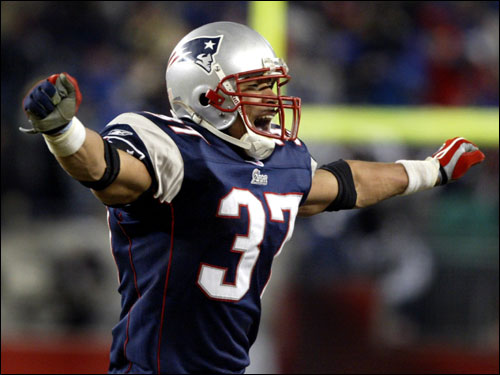
Tom Brady Wow, how times have changed. It wasn’t even six years ago that Brady unbelievably found himself standing smack in the middle of the football universe, hoisting the Lombardi trophy and Super Bowl MVP, ecstatic and stupefied, hands on his cheeks, staring wide-eyed at Drew Bledsoe, like the little boy who had just been told he received a lifetime pass to Disney World. Five seasons and two titles later, the kid who brought a legacy to New England has helped bring a boatload of drama to Hollywood and the fashion world. After his long relationship with actress Bridget Moynahan ended in the middle of last season, and before he started dating supermodel Gisele Bundchen, Brady learned he was going to become a father. Fast forward to the week before last, when Moynahan had Brady’s son, while Tom was balancing the Patriots preseason regimen in Foxborough, with Gisele in New York and the mother of his child in Los Angeles. Quite precarious, considering by nature, such balancing acts traditionally involve stabilizing two entities, one on each side of the center. Unfortunately, even for the mega-man, the laws of gravity still apply. Three’s still a crowd last time I checked. Crazy as it may sound, the time for parting with the hottest woman in the world may soon be upon Tom.

Prediction As we have already (many times over) established, the Patriots are dealing with more than a handful of issues, the reverberations of which are being felt from Boston to Hollywood; from New York to Milan. Just a tiny deviation from the crew of unknowns that chose to be introduced as a team before Super Bowl XXXVI in New Orleans. Like the Red Sox, the Patriots no longer fall within the greater classification of “little guys”. To the absolute contrary, they are the giants. They remain the hunted, even if they haven’t hung a banner in two years. So how are they planning to navigate through the trenches of overblown injuries, overstated sanctions and glamorous personal and familial affairs? I’ll tell you why. Because the one person who can truly and earnestly say that the CNNs, ESPNs and TMZs mean squat; the one guy who can operate blissfully oblivious to the outside world; the one coach who can stand at the podium and address everything without divulging anything, well he happens to be the man in charge of the 2007 New England Patriots. For years Bill Belichick has been using his unparalleled knowledge and esoteric schemes to win football games. He’s done it with fringe talent; he’s done it with stars. He’s done it with fringe talent turned into stars. This year he has the nucleus. It may not be intact today, but if Belichick will tell you anything it’s that the road to a Super Bowl is a voyage. The beginning may be rocky, but it’s not about where you begin. For the 2007 New England Patriots, the road will end in Phoenix, and a dynasty will be reborn.

Picks

AFC East: Patriots

AFC North: Ravens

AFC South: Colts

AFC West: Chargers

AFC Wild Cards: Bengals and Jets

NFC East: Eagles

NFC North: Bears

NFC South: Saints

NFC West: Seahawks

NFC Wild Cards: Panthers and Giants

AFC Championship: Patriots over Ravens

NFC Championship: Saints over Bears

Super Bowl XLII: Patriots over Saints

Multi Points

Marquise Hill: 1982-2007 It’s a somber Memorial Day across the NFL and Patriot-nation. Marquise Hill, a third-year defensive end from LSU, drowned Sunday night on Lake Pontchartrain after a jet ski accident. Hill was a second-round pick of the Patriots in the 2004 draft, and was a rookie on the team that won its third Super Bowl in four years. He only played in a handful of games throughout his brief NFL career, but that was more of a testament to the depth and quality of New England’s defensive line. I don’t have any specific memories of him on or off the field but I know one thing: Marquise Hill was a Patriot for a reason. He was a Patriot because he was a hard worker and a good teammate. He was a Patriot because he had a winner’s mentality and a desire to become better. Marquise Hill was a man in a locker room where each man was valued as a necessary part of a greater entity. So even if we, as fans, were not aware of his impact, we need not look any further than the uniform he donned. Marquise Hill lived as a Patriot, and will be remembered as a Patriot.

(Note: Subsequent to publishing this on Monday I have done some reading about Hill and discovered he did a great deal of work helping his brethren in New Orleans rebuild their homes and city post-Katrina. This comes as no surprise but reinforces what a truly good man he was. He didn’t need camera crews and Patriots’ representatives documenting his deeds; he just did them because he was a caring and admirable individual. Marquise Hill will be missed by many.)

Now to segway into some playoff basketball…

Cavs-Pistons It’s evident that the Cavs could very well be up 3-0 on the Pistons. After Lebron’s questionable pass in Game 1 and mauling by Rip Hamilton in Game 2 resulted in consecutive 79-76 losses, King James needed to man up in Game 3. He rose to the occasion after proclaiming Game 3 the biggest of his life, scoring 32 points to go along with nine rebounds and nine assists. He also hit the two biggest shots of the game in crunch time. Most importantly, he finally had the look of a guy determined to find a way to win. My question is what took so long? Both games in Detroit were there for the taking. They were games hanging in the balance, waiting for the best player on the floor to take over and exert his will. Lebron was that player, except he didn’t show it.

Of course the Pistons are a championship team who know how to grind down opponents and finish games. But in nail biting postseason games the best player on the court should be able to dominate the last couple of minutes by himself. That’s how Dwyane Wade won a championship last spring; that’s how Michael Jordan won six titles in six tries in the mid-nineties. Maybe Lebron isn’t ready yet, maybe he’s too enamored with becoming a “global icon” and not the next great champion. Maybe he has to learn how to compose himself at the free throw line in the final minutes of huge games. Maybe he secretly knows the supporting cast around him is only sufficient enough to win ten or eleven playoff games, and not sixteen. Or maybe the stage is still too grand for him.

No matter what, the fact is that he is the best player in this series and has had the ball in his hands with chances to win each of the three games, with one victory to show for it. Detroit may well win the next two games in convincing fashion, and there will only be so much we can put on Lebron’s shoulders because the Pistons are the handily better team. But if the next two games play out like the first two did, we’ll definitely have learned more about Lebron than we would have if the Cavs drop Game 4 and Game 5 by double digits.

Spurs-Jazz The Jazz are playing with house money. The bad news is the money is only good in their house. The good news is Game 4 is in Salt Lake City. The Jazz are a perfect 7-0 at the Delta Center (actually it’s Energy Solutions Arena, but it was the Delta Center in the old days of Stockton/Malone and has been resuscitated this spring) this postseason. The Spurs have never won a playoff game in Utah in nine tries. And the fans there know it. They also know they are one of the rare crowds that can pick its team up and carry them by their jersey-collars. In the Stockton/Malone/Delta Center heyday the building rocked so loudly that it was difficult to be in the Salt Lake valley without hearing the buzz of the stadium. That familiar roar is back and driving the young-Jazz. A win tonight would guarantee one more game in the house that the pick and roll built. It would also send a clear message to the veteran-Spurs that while it’s not the Mailman delivering them playoff losses anymore, there is a kid named Deron Williams who will be postmarking big games for years to come.

Pats post-mortem points

It’s hard to imagine that, for the most part, Patriots and Red Sox fans are one and the same. Case and point: Game 7 of the 2004 ALCS. The Red Sox had surged ahead of the Yankees, 8-1 (their historic comeback clearly just a formality) in the fourth inning, yet not a soul throughout the Nation dared utter the words, World Series. However, on Sunday night in Indianapolis, with the Patriots holding a 21-3 lead and driving in the second quarter, New England fans near and far had collective visions of South Beach dancing in their heads.I was one of them. Talked to and text messaged my friends about more impending glory. Even declared out loud that the day the Patriots blew an 18-point lead in a playoff game would be the day I declared the end of the dynasty. And I sort of am. But not really. Just wait.

See that’s the difference between Patriots and Red Sox fans: two polar opposite psychological dynamics operating within the same fan-framework. In other words, we’re real screwed up, so cut us some slack.

Back to the original point. Ask any Sox fan if they’ll ever have to hinge great chunks of their personal and professional lives on a Red Sox playoff run. Ask them if life will ever be as good as it was during those eight nights of baseball in October, 2004. Answers will always be some variation of: Nope, Sox got the one, did it unprecedented, now my father/grandfather/son/pet can die having lived a fruitful existence. I’m saved.

While we obviously want to see the Sox succeed (and not get five-game swept by the Yankees), that familiar chill and snicker when recalling the ’04 playoffs will never cease to be. It is there in that Sox-psyche, forever embedded.

But it’s different with the Patriots. Much different. We saw this team rise from the ashes of NFL futility. A team that for over two decades didn’t even merit discussion on the Boston sports scene. The Patriots played home games 26 miles from the hub, could rarely be seen on TV, and had appeared in one thrashing of a Super Bowl in their history. With the Celtics and Bruins hanging banners in the 70s and 80s, and with the Red Sox losing in Shakespearean fashion, the Patriots were blander than white toast.

But after its acquisition by a savvy businessman with a passion and a plan, the New England franchise grew so fast and so decisively that suddenly it could only be compared with the all-time greats.

Which brings us to Sunday night. The Patriots, driving for a fourth-first half touchdown, saw their drive halted on an offensive pass interference call against Troy Brown. A possible 28-3 lead and assured 24-3 advantage was nixed by one play. But that didn’t really matter. If a lead in a playoff game against a great opponent has ever been airtight, it’s a Patriots lead. And we know that from past experience (17-3 in the 2001 AFC Championship at Pittsburgh; 17-3 in Super Bowl XXXVI against St. Louis; 21-3 in the 2004 AFC Championship at Pittsburgh).

In all those games the opponent made a strong push, but our defense never gave up a lead and Tom Brady did what was necessary to win. We had no reason to believe the Patriots would allow a new ending to be written. But hindsight’s 20-20.

And hindsight tells me the Patriots had to play three quarters of tough, playoff football against the Jets before traveling 3,000 miles to beat a team that was nine times better than they were on paper. (Well nine Pro Bowlers at least.) It was the proverbial “game they had no business winning but always win.”

The team then got hit by the flu-bug somewhere in between San Diego and Boston, and it accompanied them to Indy. It put Artrell Hawkins, the backup safety to the injured Rodney Harrison, out of the game. It rendered the steely Troy Brown eerily human (he ran a curl when he was supposed to run an out on the third down play that would’ve essentially sealed the game). Coupled with Rosevelt Colvin’s absence in the second half, along with Eric Alexander and Rashad Baker’s presence in crunch time, the Pats D was, for the first time, vulnerable. Not to mention uncharacteristically ragged and fatigued.

Yet we all feel that with another thirty seconds or so, Brady would have found a way to get the boys into the end zone, and onto Miami, because that’s what he does in January. But not this time. It took a perfect storm to drown the Patriots Sunday night. That is why I am not sticking to my comment from in the moment, that the dynasty is dead, because it isn’t. Unfortunately, this phase of it is. Guys like Tedy Bruschi, Corey Dillon, and Troy Brown all deserve to retire. Especially Bruschi.

I have a feeling we haven’t seen the end of some (maybe all) of that trio, but we certainly have seen their dominant days pass, and that is sad. That said, Brady is staring his prime square in the face. He has an offensive line that is young and cohesive, and most importantly, protects him. He has a budding running back that will emerge as one of the league’s best over the next few years. He has a young wide receiver with all the tools to become his next principal beneficiary, if he can only adopt the Patriot-ethic.

Defensively, the only area without question marks is up front, which is a good thing. With Vince Wilfork, Richard Seymour, Ty Warren and Jarvis Green manning the trenches for the next three years, the Patriots will be remain a run-tough defense. They must find a way to get younger and faster at the linebacker position, a notion we’ve never had to embrace in the Bruschi-era. And if they can find a way to keep Asante Samuel opposite Ellis Hobbs, good luck to opposing quarterbacks. If not, there’s still the x-factor, the reason why the Patriots have gone through 500 defensive backs in the last four years and have four AFC East crowns and two rings to show for it.

Bill Belichick. True, after this January good ole Bill may not be recognized as the classiest coach in the league, but he’s still the undisputed best. In Bill we still trust. So too does the Kraft family.

And as I alluded to before, Robert Kraft is not only a class-A businessman, he’s also a passionate Patriots fan who…HATES…LOSING!!!

He gave the Jets a first round pick just to snag Belichick, so don’t be fooled into thinking he’s going to let him get away (translation: the Giants may get Asante, but as for the guru, dream on). And don’t underestimate the mutual dependence Belichick and Brady have on each other. They each saved the other’s career. So with Brady’s best years on the horizon, watch as the Krafts hammer out a new deal for Belichick, and ride what they’ve been patiently waiting to declare as the second wave of the Brady/Belichick Patriots-dynasty.

I said after the second Super Bowl that when history was truly ready to look at the Patriots, Tom Brady and Bill Belichick would each have five rings. With that tandem at the helm you’re going to be hard pressed to find a Patriots fan who doesn’t believe that they’ll win another two. And thus we have revealed the one inherent similarity, rooted somewhere within our vast sports-psyches, between Red Sox fans and Patriots fans. We, more than any other fan base, embody our athletes.

Manny, Pedro, and the Sox got their title, are content with life, and can ride off into the sunset as perpetual champs. Brady, on the other hand, has made it no secret that his most coveted ring is the next one.

On both accounts, we concur.

Pats-Chargers and Class

Class, like many overly thrown around terms in sports, is all relative. On this January 15th, 2007, the New England Patriots are a mean, classless crew of a**holes with an even meaner and class-lacking a**hole at their helm.

To the San Diego Chargers at least.

Back in New England, however, they are the same group of warriors (with some new working parts) that continue to rewrite football history. History, it is often said, is not without a sense of irony. It is human nature to reflect on the past, identifying moments that, for better or worse, inexorably impacted the future. Irony only enters the equation when that future is finally determined, and has been accordingly altered by some seemingly unrelated prior event.

Truly ironic instances tend to be humorous. But for those with big egos and short memories, irony also tends to be a dish best served cold, when prepared by the right chef.

Since history is the impetus of irony, travel back to October 2nd, 2005. The Patriots were two-time defending Super Bowl champions, owners of the longest home winning streak in league history, and battered. Rodney Harrison had torn all the ligaments in his left knee the week before in Pittsburgh, and Tedy Bruschi was still recovering from a stroke. Monty Beisel and Chad Brown were the starting inside linebackers.

The Chargers came into Foxborough, and beat the Patriots, 41-17. But that wasn’t all. They yapped. They disrespected the Patriots’ house. They showed very little class in victory. After the game Marty Schottenheimer made comments about the Patriots’ injuries coming full circle, and pondered how long the team could continue to be a force. It wasn’t so much a sign of disrespect than it was an observation. It was an observation that the traditionally even-tempered Tom Brady took exception to in the media the next week. Brady asserted that Schottenheimer had no right to make comments about his team, and with reason.

While Schottenheimer’s comments were not overtly disrespectful, they may have been the most concrete way for an incensed-Brady to respond to a few other occurrences at the end of that game. When the contest had concluded, with the Chargers scoring the final 24 points, the San Diego players took some time to “take in” the surroundings, and most likely had a few words for the angry and pugnacious Gillette-faithful. In addition, Chargers defensive coordinator Wade Phillips was overheard saying, “That was an ass whupping!”

These are all instances of professionals not living up to their titles. Players are paid to play; coaches to coach. For the Chargers to walk onto the hallowed ground of Foxborough and knock off the champion Patriots was impressive. They earned that victory. But for a team that had only appeared in one Super Bowl (a 49-26 thumping at the hands of the 49ers) in over thirty five years of existence, to act the way they acted following that game was simply disrespectful. Disrespectful to the stadium they were competing in, to the three banners waving over them, and to the game they represent.

The Patriots have given new meaning to the concept of team as it applies to the most inherently team game in sport. They have illustrated that MVP’s and Pro Bowls mean squat when it comes to winning football games in January. And yes, from time to time, they fall. When they do, they fall to worthy adversaries. Adversaries that are usually ecstatic for having taken advantage of the opportunity to have played sixty minutes of better football than the Patriots.

After that Week 4 game last year, the Chargers didn’t respectfully bask in their accomplishment. Rather, they did their best to throw it back in the face of the Patriots, which itself became one of the few sour pieces of history embedded in the “Razor”.

Before we get to history turning into cruel irony for the Chargers, let us look at some other history, to better illustrate why San Diego will ultimately look back at that October 2nd with biting regret.

The Patriots and Pittsburgh Steelers have been rivals ever since Bill Parcells was matching wits with Bill Cowher in the mid-90s. The rivalry became even more intense following the 2001 season when the Steelers were destined to meet the Rams in the Super Bowl, and Cowher made the grave mistake of overlooking the Patriots. Since that time, it seems nobody except the Steelers have had true reverence for the Patriots.

The Steelers and Pats have battled in the regular season; they’ve battled in two AFC Championships. The Patriots went into Pittsburgh in October, 2004 and had their NFL-record 21-game winning streak snapped. The Steelers, students of the past, barely acknowledged their own end of the game, opting instead to remark at the magnitude of the Patriots accomplishments. The Patriots, meanwhile, got back to business, regrouped, and marched back into the Steel City for the 2004 AFC Championship and ended the Steelers 15-game streak.

Point is, the Patriots have been respected by the Steelers, and reciprocated that respect. The tables were turned after the fateful outcome of the 2001 AFC Championship in Pittsburgh. Never again would the Steelers slight the Pats, and never again would the Patriots have that added incentive to make them eat their words.

The difference between the 2001 Steelers and the 2005/06 Chargers? History!!!!! The ’01 Steelers had no idea what they were getting into. They didn’t respect the Patriots because they had no reason to. They were the best, and the Patriots were that team kneeling in their way.

The San Diego team that came into Foxborough didn’t just disrespect a coach, a team or a fan base. They disrespected a dynasty. So with all that transpired between then and now, with the Chargers this year emerging clearly as the team to beat, I found myself chuckling after listening to everything I heard in the week leading up to this game.

Fate, it would seem, is not without a sense of irony. Another applicable phrase. From the events at Gillette last year, to Shawne Merriman going on TV last Sunday and disrespecting the Patriots, to trying to keep Pats fans out of Qualcomm, to Schottenheimer entertaining hoards of media to openly talk about his atrocious playoff record, I mean, geeez! Is it any wonder that the Chargers a) dropped passes, b) fumbled balls, and c) committed inexplicable penalties? Is it any wonder that Merriman was practically an afterthought? Or that Schottenheimer went for it on a 4th and 11 from the Patriots 30 yard line and had no general control over his players?

Who’s truly surprised that the Chargers lost this game? Was it fate? Maybe on the surface, but at its core it was just another case of a talented group of players losing to a mentally tougher, more experienced, and better coached team.

As for the whole “class” thing that LaDainian Tomlinson referenced, yep, sometimes irony is painfully blatant, especially when you don’t see it coming. But history always precipitates irony. The Chargers refused to look at the 2001 Steelers with a historical and self-evaluating perspective. They opted instead to act classless in an October matchup with New England, a giant that evidently (and within character) put its reactive mechanisms on snooze until the time was right. And as if that wasn’t enough, Merriman did that giant the service of pressing the alarm button just to make sure it woke up in time.

So while the reputable LaDainian Tomlinson wants to point to the Patriots’ lack of class in mocking Merriman’s sack-dance, maybe he should take a step back and look at that jig as an appropriate reciprocation of a winner’s bravado.

Because as we all know, fate and history are not without a sense of irony.

Pats Playoff Points and Picks

How short a memory the NFL has. Just five years ago the New England Patriots were an upstart group of pretenders. They were appearing in the AFC Championship only after the reception of an immaculate call reversal. They were heavy underdogs to a ‘vastly’ superior Steelers team. So superior the city of Pittsburgh had already minted Super Bowl tickets and head coach Bill Cowher was booking hotel reservations in New Orleans.The Patriots won that game, shocked the Rams in the Super Bowl, and became the most disrespected group of world champions in this media-deluged era of the NFL. They were written off as a one year wonder after winning just nine games and missing the playoffs following the 2002 season. They lost the first game of the 2003 season to the Buffalo Bills, 31-0, which led to the famous “They hate their coach” assessment by ESPN’s Tom Jackson. They lost two weeks later to the Washington Redskins, and not again for an entire calender year.

After that defeat against Washington the Patriots ran off the greatest stretch of football in the history of the NFL. They won 32 of 34 games, including 21 in a row. Back to back Superbowls. Second team in league history to win three out of four titles. The common thread? Disrespect. From the Steelers to the “Greatest Show on Turf”, from Jackson to Peyton Manning, the one constant throughout the streak was a systematic denial of the Pats excellence. It came in many forms, but the underlying factor was that nobody outside of New England ever believed in these guys. Vegas didn’t even come around until Super Bowl XXXIX against the Eagles.

The Patriots have always been a very observant, reactive team. They speak minimally in public. But they listen, and stew over what they hear. They’ve turned slights into poster board material, and poster board material into victories. Any hogwash they hear off the field gets cultivated into motivation on the field. Which leads me to the matchup in San Diego this weekend with the Chargers. The Bolts have been the best and most complete team in the league this year, led by the NFL MVP, LaDainian Tomlinson.

The Chargers have been the Super Bowl pick. And now that the draw is New England on Sunday, it appears that San Diego is beginning to stutter. Evidence is in the team restricting ticket sales to fans with credit card billing addresses in southern California. Translation: Patriots nation is vast, and far from sedentary. This is not only preposterous, but possibly illegal. Many Patriots fans who had the intention of making the 3,000 mile trek to San Diego were quite literally turned away because the Chargers feared losing their home field advantage.

What is lost in this ridiculousness is the fact that Qualcomm Stadium seats over 71,000 people, and not once have the Chargers filled it up this year (they averaged around 66,000 per home game). So by taking such action the team has essentially admitted that they fear the Pats fan-factor and would rather sacrifice revenue than threaten their home field advantage. Unfortunately for the Chargers, there are many New England transplants domiciled in SoCal. And they will be heard from.

If anything, the ticket-move was probably a poorly conceived acknowledgment of the Patriots-aura; a concerted effort to not make the task at hand more difficult than it already is. Certainly seems to have backfired.

While the Chargers as a team misstepped in overplaying the venue hand, Shawne Merriman certainly gaffed in the PR realm when he went live on CBS during the Pats-Jets game last week and asserted that the Jets were the better team and would probably win the game.

Merriman later attempted to cover himself by saying that his job as an analyst is different than his role as a football player. Not to the Patriots. PR is PR. A player is always representing his team. And you can be sure that the Patriots took note of this representation. Merriman is a beastly talent, but he is also young and immature. He’s been a marked man since his violation of the NFL’s substance abuse policy. But not through the eyes of the Patriots. Not until he made it personal.

Obviously one quote isn’t going to swing a game but I wouldn’t be surprised if the scout teamer who’s simulating Merriman this week was wearing that quote on his jersey just to remind Ben Watson, Daniel Graham and David Thomas that the guy they must block thinks very little of them.

It’s these little things that accrue over the week leading up to playoff games that always seem to happen to New England, while they stand pat, gameplan, and wait until Sundays to react. This week is no different, and as opposed to the Chargers gameplan, which is as simple as L+T, the Patriots will surprise a few people offensively come game time. Tom Brady has reached a comfort level with his receivers, mainly because they have finally learned to make the same reads as him. He’s been consistently throwing the deep out with crispness and precision, and Jabar Gaffney and Reche Caldwell have benefited.

Because the passing game has been something of an entrepreneurial endeavor this season, the Pats have yet to open it all up. Sunday’s the time. Chad Jackson has spent countless hours rehabbing his hamstring, getting situational reps, and most importantly, learning the offense. Belichick has kept his progress under wraps, and Brady has even come close to alienating him at times. This is all a calculated effort on their behalf. Watch as Action Jackson hauls in the longest touchdown pass of the season for the Patriots this Sunday. And don’t be surprised to see him take a few handoffs. The time has come to battle speed with speed.

Another trademark aspect of the Patriots offense that they’ve gotten away from recently is the screen game. Last week Kevin Faulk took handoffs in a few situations when Eric Mangini was probably expecting a screen. This week the Patriots are going to bait the ferocious and speedy Chargers front seven with a variety of screens, utilizing Faulk and the tight ends. And if they were able to put a twist on that nifty quarterback throwback…

Screens, bombs, trick plays, the Patriots will do whatever they can to keep the Chargers defense queasy. As simplistic as the offense has been this year, it has been so merely as a conduit for a developing unit. Trust me, they’ve been practicing more than the 13 yard out and deep square in patterns. They just haven’t been ready (or willing) to introduce the craftier and more dangerous aspects of their passing game.

Until Sunday. In the words of Miami Sharks coach, Tony DaMata, the Pats offense is “goin nine nine nine”. New England will come out with superior schemes on both sides of the ball. Defensively, the Patriots front seven will remain committed to their assignments, allowing LT to hit the intended gap, thus giving him a consistent three to five yards per carry. Tomlinson is most deadly when a defensive front has blown up a hole, and he cuts back with unparalleled speed and grace. The Patriots will give him the initial yardage, gang tackle him and force the Chargers into second and sixes, putting the pressure on Schottenheimer and Phillip Rivers.

This will be a one possession affair in the fourth quarter. The interesting thing is that most who are picking the Chargers believe the Patriots will put up a fight, but ultimately fall. I’m sorry, but I’ll run with Bill Belichick over Marty Schottenheimer in a close game. Call me an opportunist. And when it comes down to that “one drive”, I’ll take Tom Brady any day of the week. Especially on Sunday.

Patriots 31 Chargers 26


Other Divisional Picks

Colts 20 Ravens 17 (Bob Sanders transforms the Indy defense into a viable unit that stymies the Ravens offense and Peyton Manning sighs at the relief of playing the underdog role for once.)

Seahawks 17 Bears 16 (Defense wins championships. Quarterbacks lose them. And when was the last time Chicago won a home playoff game?)

Saints 34 Eagles 24 (Reggie Bush can now be considered a sophomore and Drew Brees is just too good for the Eagles banged up secondary. Plus that whole Super Dome thing…)

Pats-Colts Points of Shame

Aright everybody, let’s say it together. Atrocious. Yep, that pretty much sums up the Patriots performance on Sunday night against the Colts.If anything can be taken from this utter embarrassment that doubled as a football game, it is this: once again the Patriots have proven beyond a reasonable doubt that no matter who the foe (see: Miami, Denver, and now, Indianapolis), when the Pats fall it is completely a result of their own doing. Trace it back to the beginning of the 2003 season. The fistful of games they’ve lost (thirteen to be exact) they’ve really, for lack of a better phrase, dropped the ball (or in Tom Brady’s case, repeatedly thrown it to the opposition).

Last night was one of those instances. They turned the ball over five times; committed eight penalties. They consistently gave Peyton Manning the football inside their own territory. They lost their cool at times; had no focus; no semblance of a tempo, no implementation of the game plan they had constructed and honed throughout the week. They pretty much had no chance of winning the football game.

Yet there Tom Brady was, a nifty three picks in pocket, ball in hand, driving down the field with ample time and composure to re-knot this heavyweight yuck-fest and send the game into overtime. Then Kevin Faulk decided to phone into the Pats drop-the-ball-athon, and the line went dead on Week 9 for New England.

On what should have been a seven-yard reception to the Colts 32, the usually unflappable Faulk instead botched the catch, and as if in a tip drill, redirected the ball right into the hands of Cato June. Game, set, match.

(Humiliation.)

In lieu of their usual tape session today, I suggest the entire Patriots team and coaching staff go and see the Borat movie. Not because it is going to make them laugh their tails right off and forget about this pitiful performance. No, rather because it will show them that (alas!) it is in fact possible for a bigger egg to be laid than the one they produced last night. (If you’re scratching your head right now you should join Belichick and Brady at the Dedham Mall cinema.)

But seriously, there’s one question that burns in my dome after this game: just how good are the Colts? Consider this: Peyton Manning threw for over 300 yards and a couple of touchdowns. Marvin Harrison was Marvin Harrison. The Colts defense a) kept the Patriots offense off the field and b) had its second best player, Bob Sanders, play for the first time since week two. Sanders finished with 11 tackles and was in on every run play at the line of scrimmage.

Hmmm, seems to me like the Colts did implement their game plan; did have some semblance of focus and tempo. They were, more or less, the Colts. So why did they have to wait for Kevin Faulk to formally stamp their second consecutive 8-0 start?

Here’s why: THEY’RE NOT THAT EFFING GOOD!!!!!!!!

Bill Belichick is a man of schemes. And while he’ll never articulate such, he knows in the grand scheme all this game determined was venue of the AFC Championship. Nothing more. Granted, it would be nice to have the number one seed in the AFC, especially in light of the way our beloved most-clutch-kicker-ever performed in his return home (the one true negative in the Colts performance).

But playoff seeding aside, this game won’t have any lasting impact. The Patriots are still going to be playing football next Sunday when the Jets come to town. To be honest, I feel like this meltdown was actually well timed. The Patriots, fresh off a statement-game on Monday night in Minnesota, might have had a little too much swagger, least for this point in the season.

New England isn’t used to early season dominance as they’ve only once before started a campaign 6-1 (2004). The Patriots are a team that gets better as the season progresses; through adjustments, hard work, and intellect the Pats prepare schemes week by week to topple opponents. And in that undisclosed grand scheme, they prepare for what they know will be a 19 game season.

The Colts, on the other hand, are quite accustomed to winning in large helpings before Thanksgiving. Peyton Manning has not lost a game before Turkey Day since October 31, 2003. But then again, he’s also never won his last game. Brady has won his last game three times in the past five years.

Congrats Peyton, you devoured a very subpar Patriots-entree. Hope you’re ready for the main course come January.

Foreword and Patriots

It is with the heaviest of hearts that I have decided to get back to doing what I love: writing about sports. Even if tragedy makes the concept of sport itself seem trivial and insignificant, I believe that the emotional highs and lows that go hand in hand with being invested in a team are a type of conditioning for the mind and body. Whether you find yourself celebrating a championship for a beloved team, or suffering heartbreak at the hands of an adversary, sport helps to give benign perspective to raw emotion.But, inherent to the idea of sport is the understanding that both the ecstasy of victory and the sorrow of defeat are merely precursors to the trials of life itself. So what’s my antidote? I say maintain that vested emotional interest in sport; allow the emotions, when appropriate, to be real, and unimpeded. Allow those tears of joy or disappointment to flow. Because that visceral emotion ultimately helps bring about the realization that at the end of the day, sport is not about life and death. Only life is.

Fortunately, this weekend features the premier game of the NFL season between the Patriots and Colts. This matchup has come to represent football’s greatest rivalry because it is the NFL’s most appealing dichotomy. Both teams are wildly alluring and successful–in very different ways.

The Colts are celebrity in nature, and gaudy in performance. Peyton Manning is the reason. He is the torchbearer of today’s NFL: consummate talent, ridiculously wealthy, and blatantly in the public eye. He carves up defenses for Sunday brunch, throws on a mustache and films a commercial Monday morning, and is back in time to begin meticulously reviewing tape for his next victim. He represents the new age marketing system of the NFL (and pro sports for that matter), a system that relies on an ongoing interpersonal dialogue between the athlete and the fan.

Peyton Manning is more than just a quarterback. He’s a tourist of the ESPN studio who jaws with his brother. He’s a freaking cable repair guy. He’s an icon. No matter where you’re situated as a viewer or person, long as you have one foot in this quarry that has become the media, Peyton Manning will find a way to reach you. His shtick, coupled with his ability to make such an intricate game seem easy, is what puts him on the verge of superhero status.

However, the reason we’re discussing a dichotomy and not a juggernaut is the Patriots. Across the sidelines from the extravagant Colts stand the esoteric Patriots. New England has become the “model franchise in the league” over the last five years. Thing is, that phrase is nothing more than another faux cliche. In this day of further integrating the media into the on-field action, integrating the fans into daily NFL life, and generally glamorizing the entire business, the Patriots surely are not the model franchise.

They keep to themselves. They handle all but a shred of their business behind closed doors. Their players only do television endorsements as a team. Their injury reports are suspect. Their coach is glum. Their quarterback is crafty and adept, not flashy. But because the Kraft family, Bill Belichick, and Tom Brady have contributed to win three of the last five Super Bowls, they must be, in theory, the “model NFL franchise”.

Trust me, if Brady wasn’t so photogenic, the only time you’d see any of the Pats in the public eye would be during their duck-boat motorcade down Boylston Street after winning it all. Fact is, the Patriots are only the NFL bar-setters in terms of economics and personnel management. Everything else about this team screams contra-status quo. But they win, thus the powers that govern football deem it necessary to label them the “model”, when in reality, it is the team with the glamor, and not the glory, which is the league’s true model.

Either way, at least once a year, we all get to witness firsthand the NFL’s greatest dichotomy, which also happens to be its greatest rivalry. Also includes a couple of teams who suffer from being tagged with cases of mistaken identity. Deciding which “model” fits which franchise is a matter of semantics. What’s determined is this: come Sunday night you will again get to see the iconic Peyton Manning competing against the stoic Tom Brady, so relish it. And know there is more to come…

From Destiny to Dynasty: The New England Patriots


The Beginning

The year was 2001, and it had all begun just as envisioned: an improbable 11-win season after being pegged a last-place team; a first-round bye and home field in the divisional playoff; a classic New England blizzard, foreseen by no meteorologist; an opponent three time-zones removed from its comfort zone.

The contest, however, did not fit its billing. It was the Oakland Raiders that appeared to be relishing the white stuff. Controlling the game from the outset, quarterback Rich Gannon shortened his drops, receivers cut off their routes, and the Raiders consistently moved the ball. On the defensive side, the Raider unit, known for its quickness and finesse (attributes quite commonly rendered useless in half a foot of snow) had somehow acclimated to the grind-it-out conditions. Down after down, series after series, they played with uncharacteristic grit and toughness.

Trailing 13-3 heading into the fourth quarter, ankle-deep in fresh powder, against an invigorated opponent, with a sophomore quarterback playing in his first postseason game, the Patriots looked like a team about to accept its fate. Then there was a drive. A touchdown. A ballgame. After one last stand by the defense, the kid who had sure-footedly nipped his way into the end zone to give his team a chance was about to tuck his way into history. The infamous “tuck-rule” will always be debated, but lest we forget the second-life given to Tom Brady and his corps was merely a prelude to a kick possibly more miraculous than the call itself. For the sake of argument, let us simply call it destiny.

Spoils of Greatness

If the tuck-rule was a prelude to destiny, then the Oakland game as a whole was surely a prelude to dynasty. What transpired after that night was a systematic dismantling of the league’s elite throughout the subsequent weeks and years: a 24-17 triumph in Pittsburgh, defined by an old hero; the “Silence of the Rams”; a conquest of valiant Titans in the most frigid playoff game on record; a snowy AFC Championship against the vastly inferior Colts; a Super-shootout made classic by a gun slingin’ Panther from the Bayou; an even more thorough domination in the rematch with Peyton Manning; an even more terrible domination in the rematch with “the towels”; a third Super Bowl in four years.

Which brings us to 2005. The year that everything was supposed to come full circle, the year that all those extra bone crunching, mentally debilitating, grit over glory playoff games would come back to haunt the champs. The unraveling actually began two weeks after Super Bowl XXXIX. Tedy Bruschi, the general of the Patriots defense, suffered a stroke and decided to sit out the 2005 season, if not possibly the rest of his career. Then, once the season commenced, the other shoe(s) started to drop. Rodney Harrison. Richard Seymour. Corey Dillon. Kevin Faulk. David Givens. Yes, after a 4-4 start, capped by a helpless effort from the JV squad against the undefeated Colts, things indeed had appeared to come full circle.

The Resurgence

It has been well documented how the Patriots have redefined certain football words. Words like “team”, “dominance”, and “resilience”. Over the past two Super Bowl runs the Patriots have set and broken their own record for most players started during the regular season.

That coupled with an unprecedented amount of injuries sustained during the 2005 campaign made it apparent that New England would not have the chance to legitimately defend its crown. Then Bruschi willed his way back. Seymour followed suit. Nose tackle Vince Wilfork suddenly became the force in the middle that he had been at the University of Miami. In short, the defensive line and linebacker core started eating opposing offenses for breakfast. And the defense secondary, ravaged by the loss of its leader, Harrison, rapidly solidified around the rock-solid seven in front of them.

The saying goes: defense wins championships. While the Brady’s and Vinatieri’s of the world technically won the championships, it was undoubtedly the Pats D that represented the cornerstone of the dynasty. And with that unit back intact and arguably stronger than ever, the Patriots were on their way to rewriting history. They rolled over Jacksonville in the wild card round, utilizing the same modus operandi that had snagged them three rings: establish a physical tempo, win the battle of field position, gain a lead, protect that lead.

The Undoing

If the Patriots have had a “house of horrors” over the past decade, that venue is Denver. The John Elway-Broncos of the mid to late nineties thwarted any aspirations of greatness the Patriots may have possessed. Denver was always on top of the AFC and the path to the Super Bowl frequently passed through the Mile High City. The Broncos had also knocked off the champs earlier in the 2005 season. But even against a then-depleted New England, and staked to a 28-3 lead, Denver still had to stave off a furious rally by Brady’s Pats and literally escaped with a 28-20 victory.

Anyone close to the Patriots knew that the storyline would be different come January, come playoff time. Defensively, Bill Belichick would use his dynamic front seven to stuff the potent running attack of Denver and take decisive control of the line of scrimmage. This would ensure that quarterback Jake Plummer would have to uncharacteristically make plays down the field in order to move the ball. In other words, the game plan would prevent Denver from moving the ball. Period.

Offensively Brady’s bunch would not have to do much differently. The sensational two-time Super Bowl MVP had already single-handedly salvaged the season while his compatriots were down, leading the league in passing yardage in doing so. The Patriots had the league’s second-rated passing offense, and with a healthier Dillon and rejuvenated Faulk the only offensive question rested on the defensive side of the Denver sideline: how the s**t are we going to stop these guys?

The answer, quite simply, is that they wouldn’t stop the Patriots offense. They couldn’t stop Brady in October when his running backs were the likes of Heath Evans and Patrick Pass so there was no reason to believe that it was an issue of poor schemes or mismatched personnel. Mike Shanahan is a smart man, an offensive genius. He also knows what it takes to win championships. He knew that the Patriots would move the ball on his soft and porous defense, a defense that relies almost solely on its playmaking capabilities. And more importantly, he knew that he was going to have to stay committed to his bread and butter, the run, even though the New England defense would be right there to stuff it time after time.

This was Shanahan’s game plan because it had to be. If he quickly abandoned the run game and allowed the Patriots linebackers to shift deviously in and out of coverage and blitz packages his quarterback would be doomed. Or broken in half. So understanding that his offensive intentions would be thwarted and given his defense’s glaring inability to get off the field, he turned his attention to special teams. His objective: lengthen the field for the Patriots offense, and force turnovers whenever possible.

The first half played out as Shanahan probably imagined it would have: the Patriots came out of the gates moving the chains while the Denver offense stalled. The special teams unit did its job, however, pinning the Patriots inside their own 10-yard line on five of their opening six possessions. Drive after drive, Brady and company found themselves so close to their own goal line that they could feel the breath of the enemy fans behind them. But they still managed to move the ball.

Denver, meanwhile, saw its offense consistently beginning near midfield or inside Patriots-territory. Yet it was the champs who struck first blood, on a second quarter field goal by Vinatieri. For New England it was the perfect scenario: on the road in a hostile environment, with an average starting field position of its own six-yard line, the Pats appeared to be headed into the locker room with a three point lead. Then Kevin Faulk got stripped on a punt return at the New England 39-yard line.

On the ensuing play the Broncos predictably went for the end zone. The Patriots secondary was ready, and defended the attempted-hail-mary very well. The play was whistled dead, and then a late flag flew, exceptionally late. Coupled with the replay it was evident that no foul had been committed, and if there was any contact it was most likely of an offensive nature. Regardless it was a flag that was almost destined to be picked up. It wasn’t. On the next play, from the one-yard line, Mike Anderson strolled into the end zone to give the Broncos a 7-3. Another fumble on the ensuing kickoff led to another extremely brief drive and a field goal for Denver. 10-3. Halftime.

If the Patriots have been superior to the rest of the league in one specific aspect of football, that aspect is undoubtedly their uncanny nature to be un-phased by the odds, no matter what the circumstance. That changed. The champs went into halftime visibly stunned. But they had 15 minutes to regain their composure, which was more than enough time.

They came out of the locker room with a renewed sense of determination, and when the Patriots are determined, it shows. They immediately stopped Denver on its first possession, three and out, and then proceeded to start another lengthy drive, resulting in a field goal that cut the Denver lead to 10-6. The momentum had swung back to the Patriots side, and everyone at Invesco Field knew it.

The Denver defense, having already given up over 300 yards of offense, was starting to tire. It was nearing the end of the third quarter and the Patriots were beginning to move the ball with both ease and authority. Knocking on the door of the Denver goal line, Brady made the gravest mistake of his playoff career: looking for Troy Brown in the back-right corner of the end zone he under-threw the ball straight to Champ Bailey. Bailey had nothing but open field in front of him, all the way until the half-yard line. Then, something happened. A play, an associate later told me, which could only be achieved by a Patriot.

Benjamin Watson, who had lined up on the left side of the field and had run a flag pattern to the far corner of the end zone, somehow made up the 110+ yards and chased down Bailey. He came up behind him just before Bailey reached the end zone and popped the ball out and through the end zone at a (circa) 45-degree trajectory. The crucial call on the field concluded that the ball had gone out of bounds at the half-yard line. Except physics (not to mention common knowledge) would indicate that the only possible scenario in which the ball could not have traveled that extra eighteen inches through the end zone is if Watson came up beside Bailey and knocked the ball directly out of bounds, at a 180-degree trajectory. But that would have been nearly impossible as Bailey was clearly protecting the ball between his left forearm and bicep, thus the only part of the ball that was susceptible was its nose, which was perpendicular to the goal line.

Dissection aside, even though the Patriots challenged the play it was truly impossible to overturn because there were no indisputable evidences either way. Only the correct call on the field could have saved the Patriots. But it didn’t, and that combined with the timing of the mishap created a challenge that even the three-time champions couldn’t overcome.

The Future

You can ask Bill Belichick or any of the Patriots what they thought of the two doomed calls, and they will all respond in unison: turn the ball over five times in a playoff game, you lose. But I assure you they are still seething over the fact that they got robbed. Twice. That, however, does not change the five turnovers. If they had played in that fashion against any of their first nine playoff-opponents, they would have lost, and handily so.

Good teams capitalize on mistakes, another well-traveled football phrase. Denver, as proven to a schooled football eye against New England, and confirmed to the entire football world against Pittsburgh at home in the AFC Championship, was not a good team. The Patriots handed them gifts, yet the Broncos offense needed those gifts wrapped and delivered by the referee core. They were outplayed by two touchdowns, yet won by two touchdowns.

Now our collective visions are pointed to the future. What does it hold? Good things, I assure you. Remember, this was supposed to be that year when the Pats took a step back, healed their wounds, before reverting back to the old championship-formula. Well they did all that. They only won 10 games. They mended. And they still nearly accomplished the unthinkable.

So now Belichick et al go back to the drawing board with a whole new sense of urgency and desire to be the best, and an altogether new sense: that of revenge. They’ll all be watching the Super Bowl from their homes, memories of the Mile High meltdown suffocating them like no thin air ever could. So until training camp 2006, when all the fans will start to convene and believe once again, the ex-champs will stand pat, laud the Steelers, do their homework, and wait for their chance to get back to that winning formula: three games to glory.