Skip to content

Posts from the ‘Red Sox’ Category

Boston Ramblings

Heady times in Boston once again.

The Red Sox and Yankees are set to tango at Fenway in their inaugural ’09 series beginning Friday. The Patriots will be on the clock Saturday, as the 2009 NFL Draft fires up. And once the Celtics take care of the Bulls, both the Green and Bruins will be appearing in their respective conference semifinals for the first time since 1992.

A few thoughts about each…

AM I THE only one yearning for an infusion of hate into Sox-Yanks? Isn’t that what made this whole thing the preeminent ongoing sports drama, way back when?

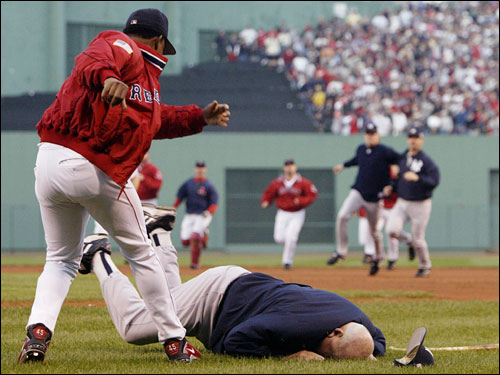
You ask any Red Sox or Yankees fan what they remember most clearly about the rivalry in recent past — apart from The Comeback — and a Boston fan will say Varitek’s Glove in A-Rod’s Face, while a New York fan will recount Pedro’s Body Slam of Zimmer.  These enduring images characterized and defined the rivalry, made it drop-everything, must-see television 19 or 26 times annually.  ESPN and Fox salivated all over it.  Passionate followers cleared their schedules and did everything they could to score the hottest ticket in town.  Casual fans tuned in because, hell, anything could happen.  No matter who you were, Red Sox-Yankees always found a way to find you.

Nowadays?  The media outlets aren’t nearly as enthralled, which is largely a reflection of popular sentiment.  And quite frankly, it’s because they have barely anything to hype.  The big storyline going into this weekend surrounds Joba Chamberlain and David Ortiz.  Joba, who has thrown at Kevin Youkilis on a few occasions, was called out by Big Papi, if you can even classify it as such.  Ortiz basically said that since Joba has shown head-hunting proclivities, he’s going to find it difficult to gain respect throughout the league.  (His comments contained almost as much vitriol as a certain drive-by argument…)

Would it be that out of line if Big Papi had said something just a tad more incendiary, to you know, send a message? I for one would love to see Joba hurl some chin music at Ortiz, watch Papi step out of the box and tell Joba to watch his corn-fed behind, then blast one into the center field bleachers.

IT’S PRETTY MUCH impossible to predict what the Patriots will do come draft day, which is why it’s so much fun tossing around various conspiracy theories.  Using the last two drafts as indicators, there’s truly no telling what Bill Belichick is up to.

Two years ago, the Randy Moss-to-New England rumors had come and gone before the draft, yet Belichick pulled a cat of out a hat in New York and in came Moss for (even at the time) a laughable fourth-round pick.  And a year ago, clearly deviating from his track record of only selecting linemen high in the first round, Belichick traded down from the seventh to tenth overall pick and selected linebacker Jerod Mayo.

While the possibility of Julius Peppers becoming a Patriot has been declared dead for all intents and purposes, it is for that very reason that it could still be alive.  When Peter King reports that New England is looking to trade its first-round and a second-round pick to move into the low top 10, but professes to have little idea as to why, the theories are free to fly.

All that’s for sure are the following facts: 1) New England was initially offering a second-round pick for Peppers, which was not enough, 2) Having shored up their secondary (signing Shawn Springs and Leigh Bodden) and running game (Fred Taylor), the outside linebacker position is the Patriots’ only glaring weakness, 3) A low top 10 pick is an excellent bargaining chip, given the caliber of talent available there, as well as the slightly smaller financial obligation necessary to sign the player.

If Peter King doesn’t have a bead on what the Patriots will do, it’s legitimately anyone’s guess.  But that’s what makes following Belichick’s moves on draft day so intriguing.

THE CELTICS WERE the champs again on Thursday night in Chicago.  After a pair of scintillating games at the Garden that could have gone either way, Paul Pierce took command of Game 3 from the outset and the Celtics defense suffocated the suddenly overmatched Bulls all night.

Even with Kevin Garnett on the bench in a suit, it was a vintage performance from the Green on the defensive end, as they held Chicago to under 41 percent shooting and forced 22 turnovers.  For the first time in the series, Pierce played like the best player on the court.  And Rajon Rondo, who battled to a stalemate with Derrick Rose in Boston, took decisive control of the point guard showdown, racking up 20 points, 11 rebounds, 6 assists and 5 steals.

This series may still be extended — Chicago was 28-13 at home before Thursday — but for the Bulls, there’s ultimately no recovering from such a colossal beatdown in their own building.  Especially against the champs.

I HAVE NEVER written about the Bruins, because 1) I don’t know enough about hockey to throw my weight around, and 2) the Bruins have done nothing but disappoint for a very long time.  They infamously blew a 3-1 series lead against Montreal as the No. 1 seed in 2004, then attempted to reverse the script last year as the underdog, before falling to the Habs in seven.

All I remember from last year’s playoffs was how a few choice Boston crackpots decided to beat up visiting Montreal fans leaving the Garden.  It was an unnecessary and classless thing to do, though it paled in comparison to the disgraceful act staged by Canadiens fans before Game 3 Monday in Montreal: booing the American national anthem.

It was fitting that the Bruins proceeded to snuff out Montreal’s season with a pair of systematic thrashings, while formalizing a tidy four-game sweep in which Boston outscored the Habs 17-6.   I can officially say I’m back on the bandwagon, and am eagerly anticipating the Bruins’ projected second-round matchup with the New York Rangers.

To bring this rambling column full circle:  Maybe a little Bruins-Rangers is just what the doctored ordered for a suffering Boston-New York rivalry.

(Unless of course Joba decides to throw one behind Big Papi Friday night.)

See Ya Manny, So Long Dynasty

I received a text from a friend the night before the trade deadline when it looked like Manny Ramirez was headed to South Florida to join the Marlins. The text read: “Worried yet?”

My response: “They won’t do it. Not with a dynasty on the line.”

(One of the great sports debates is what constitutes a dynasty. It’s clearly a subjective interpretation of greatness. In this scribe’s opinion a team must win back-to-back titles plus another one within a few years, which is to say any franchise that wins three out of five championships is worthy of some manifestation of the term “dynasty”. A banner in 2008 would mean three out of five for the Sox.)

So my rationale was the Red Sox brass would not threaten what is at least arguably a potential dynasty in the making, particularly given that David Ortiz spent a significant period of time on the shelf and the team didn’t fade.

Given that Josh Beckett is fixing to turn it up, that Dice-K has been far from the liability most believed he would be this year and Jon Lester is the second-best lefty in the American League.

Given that Jonathan Papelbon is still the surest thing this side of Mariano Rivera when it comes to closing games in October.

Given that the most prolific offensive tandem since Babe Ruth and Lou Gehrig was intact again for the first time since it co-slugged its way to a second World Series in four years.

Given that cumulatively this team was unequivocally gearing up for another title run.

I didn’t think it would happen because I’ve come to understand the whims of this ownership. John Henry, Tom Werner and Larry Lucchino have personalized the experience of being a Red Sox fan because they themselves are Red Sox fans — ones who happen to be ridiculously wealthy businessmen who assumed control of the enterprise.

Too often in sports business and figures detract from what is ultimately best for a team. With Manny’s eight-year, $160 million deal, it was at times a wise business move for the ownership to remove all those dollars from its weighty payroll. Hence irrevocable waivers in 2003, a busted trade for Alex Rodriguez in 2004, and annual deadline talks with the Mets’ Omar Minaya about a Manny move to Flushing.

In all instances, getting rid of Manny was the smart business move, the best for the bottom line. But Theo Epstein — acting on behalf of the trio — abstained from ever pulling the string because of one prevailing reason: The guy was too damned good and too vital to the most important end of winning. Winning superseded personal relationships. Winning supplanted smart business.

To this ownership, winning mattered most. And in pennant races and pursuits of October glory, Ramirez behind Ortiz gave the Red Sox a decisive inside track to victory.

I’ll be frank: Manny has always been a pain in the rear (to put it gently) through the eyes of ownership and his colleagues. It was just always kept more or less under wraps, in that Manny for the most part squawked privately and off the record, which meant only bits and pieces were divulged.

I’m sorry, but it’s no coincidence that the historically publicly soft-spoken Manny signed with Scott Boras before (essentially) a contract year — the Red Sox held two $20 million club options for 2009 and 2010 on Ramirez — then proceeded to start voicing all the displeasures he’s traditionally voiced behind the scenes directly to the media.

Boras, who’s likely still peeved at the Red Sox for holding him hostage two summers ago over the Dice-K contract, saw the perfect opportunity to turn the tables on the only contingent to have gotten the better of him at the negotiating table.

He knew that unleashing the Manny circus on the public would force the hand of the club, force them to 1) pay monetarily to get rid of Manny (which they have, $7 million), 2) dispose of him for seventy cents on the dollar (which they did, for Jason Bay), and 3) line Manny up to get shown the money come this offseason (which if I were a betting man…).

Done and done. And just like that the Manny Ramirez era came to a prompt conclusion in Boston.

What truly perplexes me is the fact that lots of fans and writers are on board with the move. Proponents of the trade would point to the fact that Manny’s bullheadedness was tearing the team apart from the inside, that his antics have been far worse this year than in the past.

Not true.

Manny has always been Manny. To the fans and outside world he was frequently endearing, quirky and warm, while behind closed doors he was consistently self-centered, obstinate and vexing. Bottom line is he has forever lived in Manny World, in spite of everyone around him — be it media, teammates or bosses.

(If you’re not convinced, pick up Seth Mnookin’s Feeding the Monster. It is the single most illuminating piece of writing about Manny and the organization.)

Due to that longstanding discord it was obvious that Manny and Boston would part ways after this season. After finishing what unofficially kicked off in 2003, the most prosperous era in Red Sox history. Like it or not, like him or not, the Red Sox with Manny Ramirez were most sufficiently primed to defend a World Series crown for the first time in nearly a century.

Debating team chemistry, managing motives and money is moot. Through everything that has gone down in the last week, only two facts have emerged: 1) The Red Sox are a decidedly worse team today than they were on the morning of July 31, 2008, and 2) If they should get there, the Red Sox will be a far less intimidating force in October than they were in ’04 or ’07.

Don’t believe me?

Just ask any Angels or Yankees fan.

Believing on the Bayou: a Sox/Tigers Narrative

The whys and hows associated with extraordinary happenings in sports can only be thoroughly assessed with the assistance of hindsight. That’s the beauty of The Moment: it rips you from reality, sweeps you up, and spits you out in a state of euphoria. Reflection is not possible when living The Moment. Only realization. Realization that wherever you are and whatever the circumstances, The Moment will always be with you.

—————————————————————————————————————————

It was Saturday morning, October 20. Curt Schilling was approximately eight hours from throwing the first pitch of Game 6 of the ALCS at Fenway. I was in Baton Rouge, Louisiana, priming myself for what I knew could end up being the most intense sports experience of my life. Not only was I preparing for another Game 6 with the Sox in the midst of another furious ALCS comeback, I was preparing to miss it.

Friends of mine had come through with dynamite tickets to the completely sold out LSU-Auburn game. A game, for LSU-faithful, that was equally as important to the Tigers as Game 6 was to the Sox. One loss for either squad meant no championship in ’07. Of course, the predicament these two odds-on favorites had to contend with was a result of their own doing. The Red Sox played uninspired baseball for three straight games against Cleveland, pushing them to the brink of elimination. LSU, meanwhile, a week after pulling a cat out of a hat against the defending-national champs, Florida, lost a back-breaker in triple overtime to Kentucky. Just like that, two teams that had visions of perfection were left with the disturbing actuality that seasons so full of haughty expectation were improbably teetering on the brink.

By mid-afternoon outside Tiger Stadium all you could see were purple tents; all you could hear was classic rock and all you could feel were Tiger-fans zoning themselves in for a showdown with…the Tigers (of Auburn). Then there was me. I was, you might say, a fish out of water. But not to most of the tens of thousands milling around me. Garbed in a yellow-LSU t-shirt and Red Sox cap, I tacitly fit in. No matter how much I appeared to belong, the ritual I was engulfed in was like nothing I had ever been a part of. Baking under the scorching southern-sun, I drank beer, ate gumbo and jambalaya, and did my best to engage the Fighting Tiger-faithful.

However, as the hours passed and the bodies multiplied, the angst started to take form. As I wrote before, a Sox-Indians ALCS was nowhere near as angst-inducing as another Sox-Yankees would have been. That said, with the way my heart was palpitating around 7:00 pm, my future cardiologist thanks Cleveland for ousting the Yankees. Because I literally could no longer sit still, I decided to make some rounds.

I crossed the street outside the stadium, and as I was peering through a steel fence into one of the cavernous tunnels that marks a point of entry, I heard a voice that seemed to be addressing me. I was already toasty enough to not really care about acknowledging the belligerence around me, but next thing I knew a guy was in front of me, asking if I knew how to traverse the fence and get to the tunnel. Before my synapses had a chance to fire, I was doused with an affront that made me see New York.

“AWWWWWW,” the guy said. “You’re a Red Sox fan!?”

“Abso-(expletive)-lutely,” I retorted.

Typical of a Yankees fan, he threw a few more barbs about my allegiances before again asking me for directions. I wish I had known where he was trying to get, so I could have then sent him in the exact opposite direction. As we were parting, I on my own and he with another couple, he turned.

“Later bro,” he said. “I’m going to meet my ex-girl and her new guy so I can beat his ass.”

“Sounds good pal,” I returned. “Maybe he’s a Red Sox fan. At least it’ll be worth it.”

Chuckling at the fact that Sox-Yanks beef really does invade all environments, I decided to test out my new headphones and old-school AM/FM walk-man, which beginning in about thirty minutes, was going to be my lifeline to Schil and the Sox. I had already researched the ESPN Radio affiliate in Baton Rouge, which was AM 1300. Tuning into the station expecting to hear some ALCS pregame, I instead heard LSU pregame. I wasn’t worried, since I knew that the LSU games were broadcast on FM. I received a call from my friends, who said they were heading into the stadium. I told them I was going to try and catch the beginning of the baseball game on TV and I’d meet them for kickoff.

I began gravitating in and out of various tailgates, accepting beers and talking to different people while waiting for some piece of Red Sox bait that I could gobble up and parlay into a first-inning viewing. Opportunity presented itself when I found myself inside a tent the size of a tractor trailer. I got talking to a guy who quickly noticed my hat, and conveyed his support for my team. He had given his tickets to his sons, so he would be sedentary for the duration, which made him one of few not attempting to imminently enter the stadium. I asked him if, by chance, I could take in the first forty minutes of the Sox game. He obliged, told me to take a seat, handed me a 22 ounce can of Natural Light, and we exchanged formal greetings. SCORE.

The game began, and still a bit wary about the lack of any pregame coverage on the radio, I decided once and for all to locate the broadcast. For the entire first half inning, during which Schilling set down the Indians, and throughout the bulk of the Red Sox half of the first, I desperately tried to find the right station, to no avail. When Manny came up with nobody out and the bases loaded, I resolved to the fact that the first inning would be it for me because this game definitely wasn’t being broadcast in Baton Rouge. An early score had never been so imperative.My palms were drenched as Manny pin wheeled the bat, while my host (whose name I had long forgot) popped open another Natty Light. Strikeout. You’ve got to be kidding me. Mike Lowell the run producer was next up. Pop out.

Kill me now.

J.D. Drew was up with two outs and the bases loaded. I was about to see a microcosm of his entire Red Sox season as my final send off into Tiger Stadium. Then, without me even knowing it, the seeds of The Moment were planted.

“Now that J.D. Drew is a ballplayer,” said the guy.

I cringed. Luckily I was too frozen in place to produce any identifiable reaction, because had I been able to, it would not have been a very polite reciprocation of my new friend’s hospitality. Drew worked the count to 3-1, which helped me temporarily emerge from my comatose state.

Just a walk, J.D. Puhhhhh-leeeease, J.D.!!! Do the one thing we’ve paid you $14 million to do this year. Just take ball fou—

—CRACK!!!!!!

“There it goes,” said the guy.

No way.

No EFFING WAY.

GRAND SLAM!!!!!! J.D. DREW!!!!!!!!!

I don’t know what I did next; that’s usually how it goes when you encounter The Moment. I think I ran around a few tents screaming at the top of my lungs before returning to my new best friend.

“THAT J.D. DREW IS A BALLPLAYER!!!!!!” I bellowed. “HE PLAYS BASEBALL!!!!!!!!”

All I needed to do before jigging my way into Tiger Stadium was solidify one piece of information for my official recollection of The Moment.

“What’s your name again, sir?” I asked the guy.

“Bobby,” he said. “Bobby Sage.”

“Thank you, Bobby Sage!” I said. “I will never forget you, Bobby Sage!!”

On that ecstatic note I headed into the stadium, visions of Drew rounding the bases consuming my mind and prickly chills stinging my spine. What greeted me was an abyss of purple and gold, over 92,000 strong, packed into an imposing structure, aptly deemed “Death Valley”. The noise level was so high even my thoughts were deafened. Our seats were in the North endzone, next to the student section. Mayhem.
Unfortunately, the ensuing Tiger-performance bore no resemblance to what inhabitants of Death Valley know to be the norm; namely dominant football. Auburn moved the ball on a seemingly-porous LSU-defense. The Tigers offense turned the ball over; receivers dropped passes. By halftime, the deficit was 17-7, and LSU fans started resembling Red Sox fans after Game 4. Specifically, there was a pervasive sense of frustration bordering on incredulity. Never, however, was there a sense of defeat among the fans, which made me feel right at home as a Sox fan.

Sure enough, the Tigers battled back, and led in the fourth quarter, 23-17, until Auburn scored a touchdown with 3:21 remaining. With the extra point, it was a 24-23 deficit for LSU. As was the case in the game against Florida (when LSU converted five out of five fourth downs), the Tigers played their best with their backs against the wall. An authoritative drive led by quarterback Matt Flynn culminated with the closest a regulation-football game can come to a walkoff victory: Flynn threw a touchdown pass to Demetrius Byrd with one second remaining to end the game.

And in the dwelling of Baton Rouge, a place that feels its heartbeat determined by the play of its Tigers, The Moment took over.

—————————————————————————————————————————

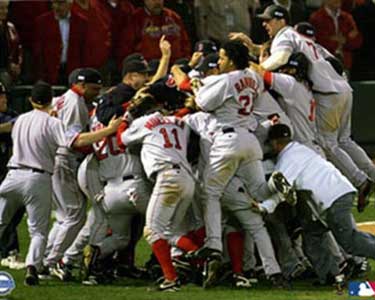
Only after the campus of LSU stopped shaking sometime Sunday morning, and after the Red Sox formally clinched their 12th pennant later Sunday night, was I able to start to reflect on the weekend that was. The Moment, which had officially spanned more than 24 hours, three historic games and two sports, ultimately subsided. In its place came the whys and hows. Why is it that the Red Sox become unbeatable only when they’re at their most beaten? How is it that the Tigers never say die in Death Valley?

The latter is an easier question to answer: teams get scared when darkness descends on Tiger Stadium. In their last 25 Saturday night home games, the LSU Tigers are a perfect 25-0. While the Tigers have been a force in college football for the last five years (a cumulative 51-9 record and national champions in 2003), the home-field advantage on a Saturday night in Death Valley goes way back and is unparalleled in college football. Whenever 92,000 people flow into Tiger Stadium on a Saturday night, they are determined to emerge victorious; so too are the players and team they support. Many times the games are laughers. A handful of nights turn magical. What stays unchanged is a collective assertion of will over the adversary and the constancy of winning under the Louisiana stars.
As for the Red Sox, the transformation this team has undergone since 1999, from uncanny chokers to torchbearers of comebacks, is both glorious and amazing. It’s also completely impossible to diagnose. As you’ve probably read or heard somewhere by now, the Red Sox are 14-3 in their last 17 elimination games, and have seemingly instilled trepidation in the opposition to such a degree that in the future teams are actually going to dread getting up in a series against this team. Beginning in ’99, continuing in ’03, culminating in ’04, and returning in ’07, the Red Sox have changed the face of playoff baseball. Since ’99, they’ve played .823 baseball when each game could be their last, and .438 baseball (14-18) when it’s just another meaningless, non-life-or-death battle in October. Wow.

Now it’s time to look ahead. With triumph again born from tribulation, the Sox and Tigers are each ready to resume pursuit of all that matters in the eyes of their faithful: hanging a banner in ’07. Great moments are often the impetus of and the driving force behind what ultimately become great teams. On the weekend of October 20, the towns of Boston and Baton Rouge officially started believing; believing that for their teams, greatness was indeed again on the horizon.

Cally-Sox-Pats Points

I just spent 10 days in Los Angeles, which should explain the recent void in posting. For that I apologize. However the time I passed in Southern California was more or less a marathon of sports and gaming, culminating with a mega-sports weekend back in Boston. Before I get into the Red Sox and Patriots let me catch you up on the highlights of my wacky sports voyage out on the left coast.

LA is a city that couldn’t be any further removed from New York (and I’m not speaking continentally). In the City of Angels it’s 82 and sunny everyday, and woe to he who spots a cloud. Tans and radiance in LA are as common as suits and scowls in New York. Cars are either classy and ostentatious or average and unnoticed. That’s Southern California in a nutshell: an endless struggle to be seen. Sports act merely as another manifestation of the Hollywood-driven, image-conscious SoCal culture. So yes, sports fans exist in abundance, but their level of interest and passion is dwarfed by their East Coast fan-counterparts. But then again, when everyone is so smoking hot and the sun perpetually shines, I guess sports really don’t need to be so all-consuming.

Case in point was the Dodgers-Padres game I attended last Wednesday. In a do or die ballgame for the Dodgers, the Stadium at Chavez Ravine (a beautiful ballpark situated in the hills above LA) was at least 15,000 short of sold out. The only buzz generated before the late innings was in reaction to the timeless-Tommy Lasorda as he posed for a photo with a pair of cute coeds at his post behind the Dodgers on-deck circle. And the one time the crowd appeared genuinely united in celebration was during the “kiss cam” between innings. This is a ritual where some seedy guy with a camera prowls through the stadium looking to goad older couples and first dates into awkward embraces, all with the crowd peeping gleefully on the jumbotron. (Although I definitely got the best show because it turned out the couple in front of me were actually cousins, forced to sweat out that particular half-inning dreading the scenario in which they were compelled to become incestuous kiss cam-culprits).

The other infusion of energy came when the ever-chipper Vin Scully led the house in his token-double rendition of “Take me out to the ballgame”. While we’re here let me tell you how truly dumbfounded I was when a buddy of mine told me that Scully calls both the radio and television broadcasts, on his own, simultaneously. That’s like trying to recount a Vegas story for your grandmother and best friend on a conference call. Which reminds me…

Smack in the middle of the trip I had my first foray with the mercurial beast that is Las Vegas. Three friends made the trek with me. We got there at 1 am on a Monday night and proceeded to run the gauntlet for the next ten hours. We hit the MGM Grand, Paris, Bellagio, Caesars Palace and the Monte Carlo before calling it a day (or whatever you call unorthodox hours in succession spent in Vegas). Other than some ups and downs, a hooker sweet talking my buddy, and me riling up a blackjack dealer at the Grand, there was astonishingly little to report from Sin City. I was expecting Times Square on speed without the cops. I was ready to be baffled!! I ended up being befuddled. This sensation was later validated when I learned that Britney Spears had made a wrenching comeback at the MTV Video Music Awards the night before at the Palms. What eventually hit me like a sack of bricks was the realization that we unknowingly became those guys who decided to roll through the night after the biggest cooler in the history of Vegas. Excellent.

If you want to laugh or feel my pain watch the “performance” for yourself.

The good news was that a monstrous sports weekend was on the horizon 3,000 miles away in Beantown. The Yankees were visiting the Red Sox for their last regular season tilt beginning on Friday while the Patriots were absorbing a cheating scandal and trying to prepare for a playoff rematch with the San Diego Chargers on Sunday.

Friday’s Sox-Yanks game was spent on the couch at my buddy’s place. A few mornings at the beach combined with the still-present Vegas-hangover was sufficient enough to keep us out of the bar. With the three-game sweep statement the Yankees made at the Stadium two weeks before, it was vital for the Sox to come out and reciprocate that statement. Everything looked nice, as Dice-K submitted his first good start in a month and the Sox carried a 7-2 lead into the eighth inning. It was then that the Yankees decided to reciprocate what the Sox did to Mariano Rivera in the clubs first meeting of the season, way back on April 20th. Namely score a lot of runs in a very short period of time. They battered Hideki Okajima and Jonathan Papelbon for six lightning-quick scores, turning a sure “W” into a ringing “L”. The Sox saved face behind their ace on Saturday, as Josh Beckett proved once again he’s the stopper. But the empty feeling was back on Sunday night as the Nation watched Big Papi fly out with the bases loaded and the game on the line against Mo. The Sox will now enter October having dropped five of six to the Bombers.

So the obvious question is how worried should we be? Seeing Dice-K throw well, albeit laboriously, was about the best thing we could’ve seen minus Manny making a triumphant and healthy return last weekend. The Sox need Dice-K in the playoffs. As for Manny, his oblique muscle strain is absolutely a cause for concern, because the soreness affects both his swing and mobility. It looks like he’s going to end up having a whole month to rehab and strengthen the muscle, which should be enough time. If Manny comes back healthy the lineup is not a concern entering the postseason. The bullpen evidently is. Okajima hasn’t been able to get anybody out the last month and Eric Gagne has cost the team four wins since he came on board six weeks ago. Mike Timlin seems to have finally gotten old. Papelbon has sputtered of late but will be lights out come October because he scares people.

Don’t be fooled, if the Red Sox keep playing the way they’ve been playing they’ll surely surrender the AL East. At 90-63 it’s realistic that they could go 5-4 over their last nine, finish with 95 wins, and (like 2005) lose the division to the Yanks with identical 95-67 records because they dropped the season series 10-8. For this scenario to come to fruition, the Yankees would only have to win seven of their last 10. Shivering yet?

I’ll give you reason for optimism. First, the Red Sox are ambassadors of the wild card, and have their habitual meal ticket to October already punched if need be. While these Sox may not douse themselves in champagne, donning “Wild Card Champion” T-shirts like the Cowboys or Idiots, there’s always comfort in knowing they’re “in” on September 20th. Second, look at the recent past. Last year the Tigers pushed the self-destruct button in September and allowed the Twins to erase a late-August double digit lead and take the division on the last day of the season. The wild card Tigers then chomped their way to the AL pennant before losing a bizarre World Series marred by rainouts and the Cardinals. Then there are the 2000 Yankees, who lost 15 of their last 17 and almost let the in-shambles-Red Sox steal the division, before abruptly steamrolling their way to a third-straight championship. So rest (relatively) easy for the time being and let me talk about the reason why I barely watched the last Sox-Yankees game.

It was very difficult to turn away from NBC on Sunday night, even if the network refused to acknowledge the existence of one of the most thorough NFL thrashings in some time. ESPN.com’s Sportsguy tackled that in his latest column, detailing in form everything Al Michaels and John Madden chose not cover (like, for instance, the Pats-Chargers game that took place in Foxborough). Assuming you’ve read Sportsguy or one of the other gazillion pieces written about the Patriots lately, I’ll abstain from dropping stats, except this one: Roosevelt Colvin finished the game with 5 tackles, 2 sacks, an interception and two forced fumbles. That’s next level. Collectively that’s where the Patriots appear to be residing on a perch of their own these days. Yet, like NBC, the football world and national media currently know only two words to associate with the Patriots: CameraGate. Or maybe that’s one word. Whatever.

In any event what strikes me is that most people I’ve talked to (on both coasts) are in agreement on two fronts about this Patriots team. First is the common belief that, injuries notwithstanding, the ’07 Patriots have a better than 50% chance of vanquishing the ’72 Dolphins by becoming the first team in league history to go 19-0. Second is the fairly unified and time-honored notion that the rat is dirty too. While Bill Belichick decided to interpret NFL rules in his own way (read: cheat), it was Eric Mangini who had no qualms about blowing the whistle on Belichick and assuming the role of “the rat”. Why Belichick was being so brazen in defiance of NFL mandates, in the presence of the one guy in the league who knows more about his skeletons in the closet than anybody else is beyond me.

That definitely doesn’t clean up what Mangini did, however. Football is not like other sports. If anything football represents the closest a game can come to combat. It’s the one sport where the boundary between “gamesmanship” and “cheating” cannot be clearly defined. In football, it shouldn’t be. Teams play once a week, 16 times a year. Preparation for a football game involves much more than scripting the first drive for your offense or honing your special teams unit. Preparation for a football game involves gathering sensitive information about your opponent; identifying and learning how to expose its weaknesses; discovering new ways to confuse and exploit it. You might as well liken being an NFL coach to being a CIA field office chief overseas (within context of course). The goal is to target a system (be it a mark or a team) and infiltrate that system, all towards the greater goal of gaining intelligence about your adversary that you can later use when the time warrants. By nature the work is devious and manipulative. Some work, as they say, is not for the faint of heart. Whereas the CIA develops human assets as its principle means of gathering intelligence, NFL coaches employ the use of video cameras.

Again, I’m not condoning Belichick’s actions; the videotaping of the Jets signals he authorized was a shady and underhanded tactic aimed at gaining inside info about the Jets defensive calls so as to better prepare for the teams second meeting later this season. It was also a means he used to more thoroughly prepare for the teams second meeting later this season. (No, I’m not being redundant.) Fact is, scheming and illegal as it was, it’s pretty commonly held throughout the league that all teams and all coaches do exactly what Belichick was doing, just not as arrogantly. The terms “squeaky clean” and “football” have no business being uttered in the same breath. Rules and violations aside, anyone who sits down and watches football on Sundays knows implicitly that the game is raucous and dirty, defined by battles in the trenches and chess-like maneuvers by coaches. Players don’t hesitate in classifying it as “war”.

What I find interesting in everything that’s happened is the fact that Eric Mangini presented the entire league and its franchises with a golden opportunity to permanently relegate Belichick and the Patriots to the fringes of NFL-society. Yet last Sunday it was Mangini himself who drew the ire of Ravens head coach, Brian Billick. Ater the Jets dropped a hard-fought 20-13 game to the Ravens, Billick said the Jets defense “did a very, very effective job of illegally simulating the snap count” to thwart the Ravens’ offensive line. Coaches are rarely impulsive in press conferences, especially those with the stature and tenure of Billick. While he later backed off what he said, pointing the finger instead at the officials for not properly harnessing the Jets’ maneuvers, Billick’s postgame comments should assuredly not be taken with a grain of salt. In modifying his statement from after the game, Billick later said, “I was more upset that [the Jets] were doing it better than we were. We all do it.”

Very crafty on Billick’s part in my opinion. He succeeded both in blowing the whistle on the whistle blower and subtly conveying that in a word, s–t goes down in the NFL. So you know what? Let’s leave it at that and get back to some football because I’ve lost all feeling in my fingers.