Skip to content

Posts from the ‘Red Sox’ Category

Manny Became Manny: Red Sox World Series Champs

“If it doesn’t happen, so who cares? There’s always next year. It’s not like it’s the end of the world.”

– Manny Ramirez, before Game 5 of the ALCS

—————————————————————————————————————————-

Three days after the Red Sox won their second title in four years, I found myself thinking one thing: this was Manny’s October. Of course, it was Beckett’s as well. And Papelbon’s. And Papi’s and Lowell’s and the young guys’ and everyone else (including Drew and Lugo!). It obviously took a resolute effort by all parties involved to win eleven games. That’s how World Series are captured. It was Manny, however, by virtue of the comments he made before Game 5 in Cleveland, who galvanized this team.

Manny the Galvanizer? you may ask. True, it may not roll off the tongue as easy as, say “William the Conqueror”, but for the record, since Manny made those remarks with the Red Sox facing a 3-1 ALCS deficit, the Sockers are undefeated, and will remain so until next April.

Statistically, Manny’s imprints are all over this postseason. He led the Sox or tied for the team lead in home runs (4), RBI (16), walks (16) and on base percentage (.508). He hit the walk-off blast in Game 2 of the ALDS that brought the element of the surreal back to Fenway. And when the Sox again found themselves on the brink of elimination, he channeled the guy who had made it all seem so simple three years prior.

Whenever I think back to 2004, I see Kevin Millar, working The Walk that led to The Steal. I also see Millar, on the field before Game 4, talking to the fans. Most of them were holding signs vividly detailing their despair and heartache. And there was Millar, telling the fans (in reference to the Yankees), something along the lines of “don’t let us get this one. Because then we have Pedro in Game 5 and Schilling in Game 6 and anything can happen in Game 7.” He then directed himself to the clubhouse, where he led some of his teammates in a shot of Beam, and the rest became history that the sport of baseball had never known.

The parallels between the ’04 and ’07 teams are significant. Both squads played with a distinct confidence; the Idiots used Varitek’s Glove in A-Rod’s Face as a rallying cry, and plowed their way through the final two months of the season and the Angels en route to the 2004 ALCS; the ’07 team was a slower, steadier roll, as it surged into first place in April and never relinquished its lead, sweeping basically the same Angels team again in the first round. Then for both teams, something happened. They hit a brick wall. Never will I understand how the Idiots got down three games to the Yankees. I only understood how they came back. They came back because they were all battled-tested from the shock of 2003 and because they had a blue-collar swagger that had captivated a Nation.

The explanation for how the ’07 team got down 3-1 was not only identifiable, it was cut and dry: they stopped hitting. They stopped hitting because they had two perpetually unproductive players (Drew and Lugo) who began feeling the gravity of Boston and the weight of their contracts and a rookie catalyst at the top of the lineup (Pedroia) who started to stall out as the games became more important.

Enter Manny (or as I like to now call him, “Media Cowboy of October”). In truly Millarian (ie what the %$&# are you thinking??) fashion, Manny, as had become a regularity in the ’07 postseason, addressed the media, and verbally shrugged his shoulders about the implications of defeat in Game 5.

Manny the Trivial? Now that sounds more accurate.

You know what? He was right. He was absolutely right. After 2004, Red Sox Nation could no longer be compared to Atlas, Greek god of heavy burdens who had to hold the heavens on his shoulders. After 2004, for once in eight generations, it really wasn’t the end of the world if the Red Sox lost. Manny was well aware of that. His hot and cold relationship with the city of Boston started frigidly; he requested out multiple times early in his contract because the team had no camaraderie and the sports climate in Boston was cooking him alive. But when his career became marked by its greatest achievement and a fan base with its 86 years of baggage was finally vindicated, Manny must have realized that only green pastures lay ahead.

The fact that Manny came out and said what every Red Sox fan was thinking in the recesses of their minds makes him a genius. Manny, ladies and gentlemen, has seen and endured it all and emerged as, you guessed it, Manny. While his time in Boston has tested him to the nth degree, at certain points he’s survived it and others he’s relished it, in the process he’s carved himself what is going down as one of the great legacies of all-time.

So he got in front of the camera and, for the benefit of Lugo and Pedroia and Drew and the Nation, issued a collective tranquilo. He saw his team needed a load taken off, and he nominated himself point man. In doing so he brought us all back to earth, and brought his teammates back to baseball. Over the subsequent seven games, Lugo played with an electricity none of us had seen before, Pedroia grew up (again) before our very eyes, this time into a five and a half foot long-range assassin, and Drew hit a I’ll-never-forget-where-I-was-when-this-happened grand slam that he’s now receiving a check in the amount of $14 million for.

Oh, and Red Sox Nation got another parade. So there. It all worked out.

Just like Manny cared it would.

Believing on the Bayou: a Sox/Tigers Narrative

The whys and hows associated with extraordinary happenings in sports can only be thoroughly assessed with the assistance of hindsight. That’s the beauty of The Moment: it rips you from reality, sweeps you up, and spits you out in a state of euphoria. Reflection is not possible when living The Moment. Only realization. Realization that wherever you are and whatever the circumstances, The Moment will always be with you.

—————————————————————————————————————————

It was Saturday morning, October 20. Curt Schilling was approximately eight hours from throwing the first pitch of Game 6 of the ALCS at Fenway. I was in Baton Rouge, Louisiana, priming myself for what I knew could end up being the most intense sports experience of my life. Not only was I preparing for another Game 6 with the Sox in the midst of another furious ALCS comeback, I was preparing to miss it.

Friends of mine had come through with dynamite tickets to the completely sold out LSU-Auburn game. A game, for LSU-faithful, that was equally as important to the Tigers as Game 6 was to the Sox. One loss for either squad meant no championship in ’07. Of course, the predicament these two odds-on favorites had to contend with was a result of their own doing. The Red Sox played uninspired baseball for three straight games against Cleveland, pushing them to the brink of elimination. LSU, meanwhile, a week after pulling a cat out of a hat against the defending-national champs, Florida, lost a back-breaker in triple overtime to Kentucky. Just like that, two teams that had visions of perfection were left with the disturbing actuality that seasons so full of haughty expectation were improbably teetering on the brink.

By mid-afternoon outside Tiger Stadium all you could see were purple tents; all you could hear was classic rock and all you could feel were Tiger-fans zoning themselves in for a showdown with…the Tigers (of Auburn). Then there was me. I was, you might say, a fish out of water. But not to most of the tens of thousands milling around me. Garbed in a yellow-LSU t-shirt and Red Sox cap, I tacitly fit in. No matter how much I appeared to belong, the ritual I was engulfed in was like nothing I had ever been a part of. Baking under the scorching southern-sun, I drank beer, ate gumbo and jambalaya, and did my best to engage the Fighting Tiger-faithful.

However, as the hours passed and the bodies multiplied, the angst started to take form. As I wrote before, a Sox-Indians ALCS was nowhere near as angst-inducing as another Sox-Yankees would have been. That said, with the way my heart was palpitating around 7:00 pm, my future cardiologist thanks Cleveland for ousting the Yankees. Because I literally could no longer sit still, I decided to make some rounds.

I crossed the street outside the stadium, and as I was peering through a steel fence into one of the cavernous tunnels that marks a point of entry, I heard a voice that seemed to be addressing me. I was already toasty enough to not really care about acknowledging the belligerence around me, but next thing I knew a guy was in front of me, asking if I knew how to traverse the fence and get to the tunnel. Before my synapses had a chance to fire, I was doused with an affront that made me see New York.

“AWWWWWW,” the guy said. “You’re a Red Sox fan!?”

“Abso-(expletive)-lutely,” I retorted.

Typical of a Yankees fan, he threw a few more barbs about my allegiances before again asking me for directions. I wish I had known where he was trying to get, so I could have then sent him in the exact opposite direction. As we were parting, I on my own and he with another couple, he turned.

“Later bro,” he said. “I’m going to meet my ex-girl and her new guy so I can beat his ass.”

“Sounds good pal,” I returned. “Maybe he’s a Red Sox fan. At least it’ll be worth it.”

Chuckling at the fact that Sox-Yanks beef really does invade all environments, I decided to test out my new headphones and old-school AM/FM walk-man, which beginning in about thirty minutes, was going to be my lifeline to Schil and the Sox. I had already researched the ESPN Radio affiliate in Baton Rouge, which was AM 1300. Tuning into the station expecting to hear some ALCS pregame, I instead heard LSU pregame. I wasn’t worried, since I knew that the LSU games were broadcast on FM. I received a call from my friends, who said they were heading into the stadium. I told them I was going to try and catch the beginning of the baseball game on TV and I’d meet them for kickoff.

I began gravitating in and out of various tailgates, accepting beers and talking to different people while waiting for some piece of Red Sox bait that I could gobble up and parlay into a first-inning viewing. Opportunity presented itself when I found myself inside a tent the size of a tractor trailer. I got talking to a guy who quickly noticed my hat, and conveyed his support for my team. He had given his tickets to his sons, so he would be sedentary for the duration, which made him one of few not attempting to imminently enter the stadium. I asked him if, by chance, I could take in the first forty minutes of the Sox game. He obliged, told me to take a seat, handed me a 22 ounce can of Natural Light, and we exchanged formal greetings. SCORE.

The game began, and still a bit wary about the lack of any pregame coverage on the radio, I decided once and for all to locate the broadcast. For the entire first half inning, during which Schilling set down the Indians, and throughout the bulk of the Red Sox half of the first, I desperately tried to find the right station, to no avail. When Manny came up with nobody out and the bases loaded, I resolved to the fact that the first inning would be it for me because this game definitely wasn’t being broadcast in Baton Rouge. An early score had never been so imperative.My palms were drenched as Manny pin wheeled the bat, while my host (whose name I had long forgot) popped open another Natty Light. Strikeout. You’ve got to be kidding me. Mike Lowell the run producer was next up. Pop out.

Kill me now.

J.D. Drew was up with two outs and the bases loaded. I was about to see a microcosm of his entire Red Sox season as my final send off into Tiger Stadium. Then, without me even knowing it, the seeds of The Moment were planted.

“Now that J.D. Drew is a ballplayer,” said the guy.

I cringed. Luckily I was too frozen in place to produce any identifiable reaction, because had I been able to, it would not have been a very polite reciprocation of my new friend’s hospitality. Drew worked the count to 3-1, which helped me temporarily emerge from my comatose state.

Just a walk, J.D. Puhhhhh-leeeease, J.D.!!! Do the one thing we’ve paid you $14 million to do this year. Just take ball fou—

—CRACK!!!!!!

“There it goes,” said the guy.

No way.

No EFFING WAY.

GRAND SLAM!!!!!! J.D. DREW!!!!!!!!!

I don’t know what I did next; that’s usually how it goes when you encounter The Moment. I think I ran around a few tents screaming at the top of my lungs before returning to my new best friend.

“THAT J.D. DREW IS A BALLPLAYER!!!!!!” I bellowed. “HE PLAYS BASEBALL!!!!!!!!”

All I needed to do before jigging my way into Tiger Stadium was solidify one piece of information for my official recollection of The Moment.

“What’s your name again, sir?” I asked the guy.

“Bobby,” he said. “Bobby Sage.”

“Thank you, Bobby Sage!” I said. “I will never forget you, Bobby Sage!!”

On that ecstatic note I headed into the stadium, visions of Drew rounding the bases consuming my mind and prickly chills stinging my spine. What greeted me was an abyss of purple and gold, over 92,000 strong, packed into an imposing structure, aptly deemed “Death Valley”. The noise level was so high even my thoughts were deafened. Our seats were in the North endzone, next to the student section. Mayhem.

Unfortunately, the ensuing Tiger-performance bore no resemblance to what inhabitants of Death Valley know to be the norm; namely dominant football. Auburn moved the ball on a seemingly-porous LSU-defense. The Tigers offense turned the ball over; receivers dropped passes. By halftime, the deficit was 17-7, and LSU fans started resembling Red Sox fans after Game 4. Specifically, there was a pervasive sense of frustration bordering on incredulity. Never, however, was there a sense of defeat among the fans, which made me feel right at home as a Sox fan.

Sure enough, the Tigers battled back, and led in the fourth quarter, 23-17, until Auburn scored a touchdown with 3:21 remaining. With the extra point, it was a 24-23 deficit for LSU. As was the case in the game against Florida (when LSU converted five out of five fourth downs), the Tigers played their best with their backs against the wall. An authoritative drive led by quarterback Matt Flynn culminated with the closest a regulation-football game can come to a walkoff victory: Flynn threw a touchdown pass to Demetrius Byrd with one second remaining to end the game.

And in the dwelling of Baton Rouge, a place that feels its heartbeat determined by the play of its Tigers, The Moment took over.

—————————————————————————————————————————

Only after the campus of LSU stopped shaking sometime Sunday morning, and after the Red Sox formally clinched their 12th pennant later Sunday night, was I able to start to reflect on the weekend that was. The Moment, which had officially spanned more than 24 hours, three historic games and two sports, ultimately subsided. In its place came the whys and hows. Why is it that the Red Sox become unbeatable only when they’re at their most beaten? How is it that the Tigers never say die in Death Valley?

The latter is an easier question to answer: teams get scared when darkness descends on Tiger Stadium. In their last 25 Saturday night home games, the LSU Tigers are a perfect 25-0. While the Tigers have been a force in college football for the last five years (a cumulative 51-9 record and national champions in 2003), the home-field advantage on a Saturday night in Death Valley goes way back and is unparalleled in college football. Whenever 92,000 people flow into Tiger Stadium on a Saturday night, they are determined to emerge victorious; so too are the players and team they support. Many times the games are laughers. A handful of nights turn magical. What stays unchanged is a collective assertion of will over the adversary and the constancy of winning under the Louisiana stars.
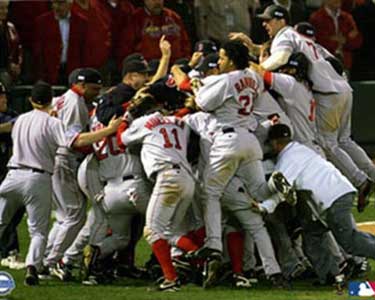
As for the Red Sox, the transformation this team has undergone since 1999, from uncanny chokers to torchbearers of comebacks, is both glorious and amazing. It’s also completely impossible to diagnose. As you’ve probably read or heard somewhere by now, the Red Sox are 14-3 in their last 17 elimination games, and have seemingly instilled trepidation in the opposition to such a degree that in the future teams are actually going to dread getting up in a series against this team. Beginning in ’99, continuing in ’03, culminating in ’04, and returning in ’07, the Red Sox have changed the face of playoff baseball. Since ’99, they’ve played .823 baseball when each game could be their last, and .438 baseball (14-18) when it’s just another meaningless, non-life-or-death battle in October. Wow.

Now it’s time to look ahead. With triumph again born from tribulation, the Sox and Tigers are each ready to resume pursuit of all that matters in the eyes of their faithful: hanging a banner in ’07. Great moments are often the impetus of and the driving force behind what ultimately become great teams. On the weekend of October 20, the towns of Boston and Baton Rouge officially started believing; believing that for their teams, greatness was indeed again on the horizon.

Thoughts from the Nation

One swing away from going up 2-0 and suddenly down 2-1.

That’s October baseball. That’s the Red Sox 2007 ALCS summed up in a single statement.

But there’s more, much more, inside why the Sox are now facing an uphill battle in the playoffs for the first time since 2004. (Note: For the purposes of this column I am going to eradicate the Red Sox 2005 “postseason” from relevance in present matters. For the record, they were swept in the ALDS by the White Sox after trotting out Matt Clement in Game 1.)

The first explanation for this abrupt shift of Sox-momentum is the Angels. They were a banged up team that had no shot of beating the Red Sox, and they knew it, which only made it more painful. The trouncing the Red Sox finished in Disneyland on the 7th of October gave way to Game 1 of the ALCS, in which they pummeled Indians ace, C.C. Sabathia, the front-running candidate for the AL Cy Young. That’s reason number two: the Nation was immensely confident, and understandably so, after four successive wins out of the gate in October. Perhaps overconfident. The “humble pie” that’s been the Patriots fare of choice down the road in Foxborough definitely wasn’t being offered by the Fenway vendors before Game 2; just boiled franks, greasy sausages and lots of good October vibes on Lansdowne Street.

My buddy took me to the game, which marked my first appearance at a Sox playoff clash since Game 5 of the 2003 ALCS against the Yankees. It was a weird feeling; a pennant on the line without the Yankees. Since the playoffs expanded to eight teams in 1995, each of three Red Sox appearances in the ALCS has been against New York (1999/2003/2004). The acute queasiness in the pit of your stomach and typical angst of a Sox-Yanks series weren’t there. Those feelings were replaced by a giddy buoyancy, and inside the ballpark, the sensation was palatable.

Throughout the beginning of Game 2, which ended up becoming the most thrilling, punch-for-punch, see-saw (albeit anti-climactic) affair thus far in the playoffs, there was an electricity in the old ballyard that I had never felt. It wasn’t the normal “desperation buzz” that, for the last half-century, has characterized, defined, and enshrined Fenway as the ultimate October experience. No, this was different. The fans were enjoying themselves. Being situated in left field almost within ear shot of Manny, our section was obviously enamored with the aloof man of power as he defended the Great Wall of Fenway that loomed over his hulking shoulders. Shoulders which, of course, he chose to stretch out not during pregame warmups nor in the dugout before taking the field, but as Curt Schilling’s opening pitches were being thrown to Grady Sizemore. When Sizemore lined a ball to the left-center field gap and Manny “sprung” into action, it was evident that again he was arriving fashionably late.

However, no one even flinched when the Tribe jumped on Schil in the first for a quick run. In fact, two guys to our left, between participation in “Let’s Go Red Sox” chants, found time to muse about the TBS division series coverage of the Sox, which they rightly asserted was “intolerable” (or phonetically, “in-taw-lah-rubble”). Though they did point out that the new TBS late night show, Frank TV, looks “phenomenal” (“fah-gnaw-mun-al”). It was in this spirit that Game 2 played out; 38,000 wildly excited fans, having a ball watching their team exchange sucker punches with a formidable opponent, and merely waiting to see how an imminent victory would transpire. It would take an aligning of the stars or Terry Francona being out-managed to lose this one.

As it turned out, it was a little of each.

It wasn’t that Francona made the wrong moves, because he didn’t. He made the right move by bringing in Papelbon in a 6-6 game in the ninth. He made the right move by pinch-running Jacoby Ellsbury for Dustin Pedroia in the bottom of the ninth. Ellsbury stole second, which set the table for Kevin Youkilis to win the game with a hit and send the Sox to Cleveland with the assurance of the series returning to Fenway for Game 6 if necessary. Youk had an epic at bat against Rafael Betancourt, fouling off six 3-2 pitches, all with Fenway primed to explode, before sending a liner to center field that Sizemore had to slide to one knee in order to secure. And finally, Tito made the right move by sending Papelbon back out for the tenth with the heart of the Red Sox lineup due up in the last of that inning.

By the time Tom Mastny had retired Ortiz, Manny and Lowell in succession it was blatant that Francona had managed the perfect ten-inning game that was now going eleven. On the other side, you had two relievers (Betancourt and Mastny) who had played with Fenway-fire and miraculously, somehow emerged unscathed, and a manager (Eric Wedge) who ultimately managed a superior game simply by refraining from using his eminently-beatable closer (Joe Borowski). Certainly an odd juxtaposition of managerial maneuvering. And all this skipper-jousting came after Betancourt very nearly had his name stamped on the dubious list of those who have exited the wrong side of a postseason walk-off at Fenway. (Rich Harden, Jarrod Washburn, Paul Quantrill, Esteban Loaiza and Francisco Rodriguez would gladly welcome some more company.)

The great escape by Betancourt and Wedge’s calculated non-insertion of Borowski until the game was secured were the unique recipe for downing the Red Sox in Game 2. Granted, Borowksi did protect a two-run lead in Game 3 back in Cleveland, but the Sox laid a monumental egg in that contest, and all that matters now is one thing.

Get this series back to Fenway.

There’s a reason I’m writing just prior to Game 4, which has been billed by many as a “must win” for the Sox. It’s no coincidence that those same people have advocated starting Josh Beckett on short rest for Game 4. The reality is Tuesday is not must-win. The reality is one of these next two games is, and if the Red Sox have proven anything over their recent history, it’s that if you’re playing a five game series it’s the first team with three losses that’s eliminated, and if it’s a seven game series, you guessed it. Four losses and out.

The 2004 Red Sox did what we all know they did, under manager Terry Francona. They lost three straight to the Yankees, then won four one-game eliminations in a row and said good riddance to 86 years of baggage. Yes, only seven guys remain from that team, but don’t let “experts” and “analysts” undersell the Fenway-mystique, and how it has certainly transcended different Sox ballclubs over the last nine years.

Since 1999, the Red Sox have played eight elimination games at Fenway Park. They’ve won six of them (two against Cleveland in the ’99 ALDS, which led to a comeback from down 0-2; two against Oakland in the ’03 ALDS, which turned into another 0-2 comeback; and two against the Yankees in the ’04 ALCS, which were the first two blows in “The Comeback”).

That 6-2 record includes a loss in Game 3 of the now-eradicated 2005 ALDS against Chicago. The only other loss came at the hands of the ’99 Yankees, who were a vastly superior team and in the middle of a run of three consecutive titles. Of the six wins, three of them the Sox walked off. So I reiterate: Game 4 is not a must-win; it’s a should-win. What the Red Sox must do is get back to Boston, preferably up 3-2, but all that really matters is seeing more baseball in Beantown. The outcome of Game 2 has thrust that original “certainty” into short-term peril, but I can assure you the Red Sox players are not panicking, nor is their manager.

They’ve been here before.

Only seven of them of them were toasting at Yankee Stadium three Octobers ago, and only two (Tim Wakefield and Jason Varitek) were there when Pedro Martinez led the waterfalls of Cristal at Jacobs Field five falls prior to that. But these Red Sox and these Indians alike know too well the mystique of Fenway; whether they’ve seen it on TV or felt it in the flesh, they are aware that baseball games become more when the Red Sox are on their last breath in their house.

For these Indians, they want nothing more than to exorcise the Red Sox ghosts from ’99, within the breezy confines of the Jake. For these Red Sox, they want nothing more than get this series back to Fenway.

And this time, instead of starting a comeback, it’ll be their chance to finish one.

Manny Becoming Manny

It was just another pop foul, but Manny’s career must have flashed before his eyes.

With the Red Sox trailing, 3-2, in Game 2 against the Angels, Manny was up with Dustin Pedroia representing the tying run ninety feet away. His partner in crime, David Ortiz (aka Senor Octubre), had been intentionally walked. The Angels wanted Manny. In the heyday of this prolific tandem, a Papi free-pass was about the only thing that could make Manny’s blood boil. Little else could evoke such a palpable sense of anger and disdain from the goofy and benign slugger. In the heyday, the instant four fingers were held up from the dugout, Manny was simultaneously “locked in”. You could always feel it; feel the Manny-brainwaves buzzing: You serious? You want Manny?? I’m one of the best hitters in the history of the game! And you want me!? You loco?? More often than not Manny would step to the plate, peering down the line at Papi, and hit the first good pitch he saw square on the seams. And it would usually go far, very far.

This was the case again in the fifth inning of Game 2; Mike Scioscia had decided he’d seen enough of Ortiz beating his club, and concluded he’d rather take his chances with Manny. After the first intentional ball was thrown to Papi, like a slow roll of thunder, the Fenway-chant began: Manny-Mannnny-MAAAANNNNNNNYYYYY. By the time Ortiz was trotting down to first, the entire Nation was on its feet; the chorus echoed from coast to coast. He stepped to the plate, and appeared to be “locked in”, just like the old days.

Then came the pop foul, followed by a collective, incredulous sigh from the Nation. Then came the first web gem in playoff history by a 17-year old kid (aka the anti-Bartman), who stole the ball away from Angels’ catcher, Jeff Mathis. Manny parlayed his new life into a walk, which allowed Mike Lowell’s fly ball to tie the game.

That moment represented more, though. For Manny, who this year has been as un-Manny-like as we’ve ever seen, that moment represented clarity. After that at bat he was locked in for the first time in ’07. Despite the ongoing struggles of mind versus body, preparation versus timing, Manny was finally able to rediscover himself. It was a feat he couldn’t accomplish while healthy early in the season, nor while ailing late in the season. Like everything with Manny, his swing and swagger were things only he was going to find again, and on his terms.

When Papi came up in the bottom of the ninth with two outs and Julio Lugo as the winning run on second base, there was little doubt that the game would be Manny’s to stamp. Scioscia held up four fingers; Manny started to stew. As the guy on deck for each one of Senor Octubre’s playoff walk-offs at the Fens, Manny might just have begun to feel a sense of history. Here he was, one of the great run-producers of all-time, just shy of 500 home runs, second-most postseason homers in MLB history, a sure-fire first ballot Hall of Famer with a World Series MVP to boot, yet eleven years removed his last walk-off home run.

Manny’s “legacy” is something that probably never held much water in his proverbial cup of tea. He is, and has always been, a studious and artful baseball mind, dedicated to mastering every conceivable aspect of hitting a baseball. For a guy who at times doesn’t even know the count when he’s up at bat, to say that his legacy was ever a matter of personal concern would be to greatly overestimate what is most important to Manny. In Manny’s world, the concepts of “time” and “history” are less significant than those of “routine” and “consistency”. By following routine and maintaining consistency, over time Manny ultimately impacted and changed history. That’s his career in a nutshell: 13 full seasons, 11 of them with 30+ home runs and 100+ RBIs; .313 career average; 490 home runs; 1,604 RBIs; nine playoff appearances; one title (and counting).
Manny’s body of work itself is history. However his mode of thought and workmanlike nature simply never allowed that notion to register. His production was a constant; time and years didn’t pass, merely at bats and games. Until this year. This year Manny never found his stroke; never settled into his trademark groove. For the first time in his career Manny went an entire season without being truly, undeniably, “locked in”.

By the time he came up in the ninth against K-Rod he could’ve been about to pilot the space shuttle and still wouldn’t have been as locked in as he was in that batters box. The Manny-stare was back. The Manny-swing followed suit. And once the ball cleared the coke bottles above the seats on top of the Green Monster, with Manny’s (plus another 38,000) hands raised towards the heavens, the entire baseball universe was shown that the Manny-swagger had returned as well.

And then he spoke.

Players concerned with and aware of their image are talkers. Those select few who contain greatness and are thus concerned with and aware of their legacy are illustrators. They’ll achieve greatness on the field before using the media to mold and re-craft it in such a way as to maximize its magnitude and staying power. Manny has forever epitomized the “silent star”. He didn’t need to talk in Cleveland (guys like Roberto Alomar, Albert Belle, Kenny Lofton and Jim Thome handled that) and never really desired to talk in Boston (minus, of course, “Media” Manny of 2003). Other than an interview he gave before the 2006 season, the last we heard from Manny was during the 2004 playoffs. That was when he talked about how the Sox “took it to another level” against the Yankees, explaining that “it was destination”.

Frank and sincere; witty and at times lost in translation, whenever Manny has spoken it has always been from the heart and informative. No spin. No slant. Just Manny being Manny (where have I heard that one before…). The microphone was Manny’s after Game 2. He gave an on-field interview to TBS, then he granted an exclusive to Peter Gammons for ESPN. To cap it off he made his first appearance in a post game press conference since I-don’t-know-when.

When Manny speaks he doesn’t embody the aura and potency of his track record. He’s just a guy, who knows he’s the best at what he does, talking about doing what he’s great at, with injections of humor. His personality lies in his sense of humor, which is pointed, but sometimes difficult to decipher because some jargon is tough to translate from Spanish. We do know that Manny’s “train doesn’t stop there” and that he is indeed “a bad man”, regardless of how he’s feeling.

The Nation got some reassurance in Game 3 that Manny seems to be feeling perfect at the ideal time of year. In his first at bat, Jered Weaver threw him a 3-2 changeup, which Manny just barely got a piece of. He stepped out of the box and took another look at the swing on the scoreboard replay, almost refusing to believe that he came so close to missing the pitch. The ensuing pitch was ball four. In his next at bat, following an Ortiz-home run, Manny fouled off two 3-2 pitches before sending a hanging breaking ball way over the left-center field wall. This was the same pitch that he’d been fouling straight back all year, but no longer. A game after hitting a walk-off home run for the first time in his playoff-career, he went back-to-back with Papi for the first time this season.

Recently there have been quite a few “firsts” for a guy who, over 13 years, has been one of the steadiest the game has ever seen. For as long as Manny has been Manny, he’s been the complete hitting package. We all know Manny’s train will stop in Cooperstown.

As for his legacy, if Manny stays as hot as these unseasonable October nights, sky’s the limit.

Cally-Sox-Pats Points

I just spent 10 days in Los Angeles, which should explain the recent void in posting. For that I apologize. However the time I passed in Southern California was more or less a marathon of sports and gaming, culminating with a mega-sports weekend back in Boston. Before I get into the Red Sox and Patriots let me catch you up on the highlights of my wacky sports voyage out on the left coast.

LA is a city that couldn’t be any further removed from New York (and I’m not speaking continentally). In the City of Angels it’s 82 and sunny everyday, and woe to he who spots a cloud. Tans and radiance in LA are as common as suits and scowls in New York. Cars are either classy and ostentatious or average and unnoticed. That’s Southern California in a nutshell: an endless struggle to be seen. Sports act merely as another manifestation of the Hollywood-driven, image-conscious SoCal culture. So yes, sports fans exist in abundance, but their level of interest and passion is dwarfed by their East Coast fan-counterparts. But then again, when everyone is so smoking hot and the sun perpetually shines, I guess sports really don’t need to be so all-consuming.

Case in point was the Dodgers-Padres game I attended last Wednesday. In a do or die ballgame for the Dodgers, the Stadium at Chavez Ravine (a beautiful ballpark situated in the hills above LA) was at least 15,000 short of sold out. The only buzz generated before the late innings was in reaction to the timeless-Tommy Lasorda as he posed for a photo with a pair of cute coeds at his post behind the Dodgers on-deck circle. And the one time the crowd appeared genuinely united in celebration was during the “kiss cam” between innings. This is a ritual where some seedy guy with a camera prowls through the stadium looking to goad older couples and first dates into awkward embraces, all with the crowd peeping gleefully on the jumbotron. (Although I definitely got the best show because it turned out the couple in front of me were actually cousins, forced to sweat out that particular half-inning dreading the scenario in which they were compelled to become incestuous kiss cam-culprits).

The other infusion of energy came when the ever-chipper Vin Scully led the house in his token-double rendition of “Take me out to the ballgame”. While we’re here let me tell you how truly dumbfounded I was when a buddy of mine told me that Scully calls both the radio and television broadcasts, on his own, simultaneously. That’s like trying to recount a Vegas story for your grandmother and best friend on a conference call. Which reminds me…

Smack in the middle of the trip I had my first foray with the mercurial beast that is Las Vegas. Three friends made the trek with me. We got there at 1 am on a Monday night and proceeded to run the gauntlet for the next ten hours. We hit the MGM Grand, Paris, Bellagio, Caesars Palace and the Monte Carlo before calling it a day (or whatever you call unorthodox hours in succession spent in Vegas). Other than some ups and downs, a hooker sweet talking my buddy, and me riling up a blackjack dealer at the Grand, there was astonishingly little to report from Sin City. I was expecting Times Square on speed without the cops. I was ready to be baffled!! I ended up being befuddled. This sensation was later validated when I learned that Britney Spears had made a wrenching comeback at the MTV Video Music Awards the night before at the Palms. What eventually hit me like a sack of bricks was the realization that we unknowingly became those guys who decided to roll through the night after the biggest cooler in the history of Vegas. Excellent.

If you want to laugh or feel my pain watch the “performance” for yourself.

The good news was that a monstrous sports weekend was on the horizon 3,000 miles away in Beantown. The Yankees were visiting the Red Sox for their last regular season tilt beginning on Friday while the Patriots were absorbing a cheating scandal and trying to prepare for a playoff rematch with the San Diego Chargers on Sunday.

Friday’s Sox-Yanks game was spent on the couch at my buddy’s place. A few mornings at the beach combined with the still-present Vegas-hangover was sufficient enough to keep us out of the bar. With the three-game sweep statement the Yankees made at the Stadium two weeks before, it was vital for the Sox to come out and reciprocate that statement. Everything looked nice, as Dice-K submitted his first good start in a month and the Sox carried a 7-2 lead into the eighth inning. It was then that the Yankees decided to reciprocate what the Sox did to Mariano Rivera in the clubs first meeting of the season, way back on April 20th. Namely score a lot of runs in a very short period of time. They battered Hideki Okajima and Jonathan Papelbon for six lightning-quick scores, turning a sure “W” into a ringing “L”. The Sox saved face behind their ace on Saturday, as Josh Beckett proved once again he’s the stopper. But the empty feeling was back on Sunday night as the Nation watched Big Papi fly out with the bases loaded and the game on the line against Mo. The Sox will now enter October having dropped five of six to the Bombers.

So the obvious question is how worried should we be? Seeing Dice-K throw well, albeit laboriously, was about the best thing we could’ve seen minus Manny making a triumphant and healthy return last weekend. The Sox need Dice-K in the playoffs. As for Manny, his oblique muscle strain is absolutely a cause for concern, because the soreness affects both his swing and mobility. It looks like he’s going to end up having a whole month to rehab and strengthen the muscle, which should be enough time. If Manny comes back healthy the lineup is not a concern entering the postseason. The bullpen evidently is. Okajima hasn’t been able to get anybody out the last month and Eric Gagne has cost the team four wins since he came on board six weeks ago. Mike Timlin seems to have finally gotten old. Papelbon has sputtered of late but will be lights out come October because he scares people.

Don’t be fooled, if the Red Sox keep playing the way they’ve been playing they’ll surely surrender the AL East. At 90-63 it’s realistic that they could go 5-4 over their last nine, finish with 95 wins, and (like 2005) lose the division to the Yanks with identical 95-67 records because they dropped the season series 10-8. For this scenario to come to fruition, the Yankees would only have to win seven of their last 10. Shivering yet?

I’ll give you reason for optimism. First, the Red Sox are ambassadors of the wild card, and have their habitual meal ticket to October already punched if need be. While these Sox may not douse themselves in champagne, donning “Wild Card Champion” T-shirts like the Cowboys or Idiots, there’s always comfort in knowing they’re “in” on September 20th. Second, look at the recent past. Last year the Tigers pushed the self-destruct button in September and allowed the Twins to erase a late-August double digit lead and take the division on the last day of the season. The wild card Tigers then chomped their way to the AL pennant before losing a bizarre World Series marred by rainouts and the Cardinals. Then there are the 2000 Yankees, who lost 15 of their last 17 and almost let the in-shambles-Red Sox steal the division, before abruptly steamrolling their way to a third-straight championship. So rest (relatively) easy for the time being and let me talk about the reason why I barely watched the last Sox-Yankees game.

It was very difficult to turn away from NBC on Sunday night, even if the network refused to acknowledge the existence of one of the most thorough NFL thrashings in some time. ESPN.com’s Sportsguy tackled that in his latest column, detailing in form everything Al Michaels and John Madden chose not cover (like, for instance, the Pats-Chargers game that took place in Foxborough). Assuming you’ve read Sportsguy or one of the other gazillion pieces written about the Patriots lately, I’ll abstain from dropping stats, except this one: Roosevelt Colvin finished the game with 5 tackles, 2 sacks, an interception and two forced fumbles. That’s next level. Collectively that’s where the Patriots appear to be residing on a perch of their own these days. Yet, like NBC, the football world and national media currently know only two words to associate with the Patriots: CameraGate. Or maybe that’s one word. Whatever.

In any event what strikes me is that most people I’ve talked to (on both coasts) are in agreement on two fronts about this Patriots team. First is the common belief that, injuries notwithstanding, the ’07 Patriots have a better than 50% chance of vanquishing the ’72 Dolphins by becoming the first team in league history to go 19-0. Second is the fairly unified and time-honored notion that the rat is dirty too. While Bill Belichick decided to interpret NFL rules in his own way (read: cheat), it was Eric Mangini who had no qualms about blowing the whistle on Belichick and assuming the role of “the rat”. Why Belichick was being so brazen in defiance of NFL mandates, in the presence of the one guy in the league who knows more about his skeletons in the closet than anybody else is beyond me.

That definitely doesn’t clean up what Mangini did, however. Football is not like other sports. If anything football represents the closest a game can come to combat. It’s the one sport where the boundary between “gamesmanship” and “cheating” cannot be clearly defined. In football, it shouldn’t be. Teams play once a week, 16 times a year. Preparation for a football game involves much more than scripting the first drive for your offense or honing your special teams unit. Preparation for a football game involves gathering sensitive information about your opponent; identifying and learning how to expose its weaknesses; discovering new ways to confuse and exploit it. You might as well liken being an NFL coach to being a CIA field office chief overseas (within context of course). The goal is to target a system (be it a mark or a team) and infiltrate that system, all towards the greater goal of gaining intelligence about your adversary that you can later use when the time warrants. By nature the work is devious and manipulative. Some work, as they say, is not for the faint of heart. Whereas the CIA develops human assets as its principle means of gathering intelligence, NFL coaches employ the use of video cameras.

Again, I’m not condoning Belichick’s actions; the videotaping of the Jets signals he authorized was a shady and underhanded tactic aimed at gaining inside info about the Jets defensive calls so as to better prepare for the teams second meeting later this season. It was also a means he used to more thoroughly prepare for the teams second meeting later this season. (No, I’m not being redundant.) Fact is, scheming and illegal as it was, it’s pretty commonly held throughout the league that all teams and all coaches do exactly what Belichick was doing, just not as arrogantly. The terms “squeaky clean” and “football” have no business being uttered in the same breath. Rules and violations aside, anyone who sits down and watches football on Sundays knows implicitly that the game is raucous and dirty, defined by battles in the trenches and chess-like maneuvers by coaches. Players don’t hesitate in classifying it as “war”.

What I find interesting in everything that’s happened is the fact that Eric Mangini presented the entire league and its franchises with a golden opportunity to permanently relegate Belichick and the Patriots to the fringes of NFL-society. Yet last Sunday it was Mangini himself who drew the ire of Ravens head coach, Brian Billick. Ater the Jets dropped a hard-fought 20-13 game to the Ravens, Billick said the Jets defense “did a very, very effective job of illegally simulating the snap count” to thwart the Ravens’ offensive line. Coaches are rarely impulsive in press conferences, especially those with the stature and tenure of Billick. While he later backed off what he said, pointing the finger instead at the officials for not properly harnessing the Jets’ maneuvers, Billick’s postgame comments should assuredly not be taken with a grain of salt. In modifying his statement from after the game, Billick later said, “I was more upset that [the Jets] were doing it better than we were. We all do it.”

Very crafty on Billick’s part in my opinion. He succeeded both in blowing the whistle on the whistle blower and subtly conveying that in a word, s–t goes down in the NFL. So you know what? Let’s leave it at that and get back to some football because I’ve lost all feeling in my fingers.

MLB Races Points

NL East The Mets have turned it on the last two weeks (9-4) and have all but sewn up a second consecutive NL East title. Carlos Beltran has been the catalyst of the recent Mets-surge (5 home runs, 19 RBIs). With Beltran back, the Mets lineup is at last starting to resemble the one that abused NL pitching staffs all of last year. The difference this year being that the Mets pitching staff is vastly superior to that of a year ago. John Maine and Oliver Perez have suffered setbacks (Maine the physical rigor of throwing 150+ innings and Perez battling health issues) but both are still on pace to start 30 games, win 15 and have ERAs under four. Tom Glavine has continued to be what he is: the last true old-school, non-power throwing workhorse (and possibly the final 300-game winner of all-time).

Then there’s Orlando Hernandez. El Duque has quietly been one of the best and most consistent pitchers in the entire NL. He’s 9-4 with a 3.07 ERA and has submitted 17 quality starts in 22 outings. You may not see his name on the top of the Cy Young balloting come October, but you will assuredly see him winning in October. Like Glavine, El Duque is a rare breed and an invaluable asset on a championship-contending team. And don’t forget about Pedro. Slowly but surely (and fairly quietly) Pedro has been working his way back. Each start he’s made in Class-A ball he’s shown improvement. Whereas at this time last year the news about Pedro was worsening with each day, this season it’s the exact opposite. Expect the wiry-Dominican to be making his return to Shea against either the Astros or Braves the second week of September.

AL East Unless the Yankees can find a way to squeeze a five-game sweep out of a three-game set with the Red Sox this week, the perennial AL East champs from the Bronx are cooked. At seven games back in the loss column with about 30 to play, the Yanks are not only cooked, they’re filleted and about to be served on a silver platter to the Sox starting Tuesday. Now whether the Red Sox opt to devour the meal or not will determine if the Bombers can even continue to contend for a wild card berth. The Yankees are wrapping up a painful road trip Monday in Detroit, needing to salvage a split with the Tigers to pull back within seven of the Red Sox and stay within two of Seattle for the wild card. Currently 2-4 on the swing, the Yankees started in Anaheim where they lost two of three, which included a 18-9 thumping in the second game. Then they headed to Detroit for a game that was delayed four hours by rain. The game itself ended up lasting 11 innings and another four hours and change before Carlos Guillen hit a walkoff three-run home run at 3:30 in the morning.

To say the Yankees will be returning a disheveled and demoralized team to the Bronx would be a severe understatement (then again, a picture does tell a thousand words). Beginning Tuesday it will be time for Jeter et al to man up or tap out, because the nine-game homestand they begin against the Red Sox will ultimatley decide their season. After Boston, Tampa Bay comes in for three. If the Yankees can take one or two from the Sox and sweep the Devil Rays, they’ll be primed to assume control of the the wild card race with Seattle coming to the Stadium for three games. As for the Red Sox, one win in New York this week will finish off the Yankees, and the Sox can set their sights on 100 wins with heavy September-doses of the Orioles and Devil Dogs.

Other NL Races It’s sad to imagine the Cardinals have a realistic chance of defending their crown with something similar to the 83 wins that enabled them to win the World Series last year. The NL Central has just become that mediocre. That said, even though the Cardinals have put together a nice stretch of baseball (13 of 19) and closed to within two games of the Cubs, I don’t see either the Brewers or St. Louis thwarting Chicago down the stretch. The Cubbies managed to take over the division lead without the services of Alfonso Soriano. Now Soriano’s back, the starting staff has been stabilized by Carlos Zambrano (with Ted Lilly and Rich Hill rounding out a quality top three), and their September schedule is very manageable. Oh yeah, and have I mentioned that Lou Piniella is calling the shots on a playoff-contending team for the first time since his beard turned gray?

Out in the wiki-wild NL West the division will likely again come down to the final week of the season (probably the final weekend). The Diamondbacks, Dodgers, and Padres will all be playing multiple series against one another in September, with each having to tangle with the hard-hitting Rockies a few times as well. Watch out for the Dodgers. Their offense has been anemic in August, scoring two runs or less nine times, including being shut out four times. However, this team showed last year that September is winning time, as Los Angeles won 17 games in the final month to tie San Diego with 88 wins and snag the NL wild card. The division is the Dbacks to lose at this point, but out west who knows what to expect.

Other AL Races Many feel that the Indians rigorous schedule over the last leg of the season will be enough to do them in and pave the way for the Tigers to back into the AL Central crown. I would have been inclined to agree with that line of thinking until I found out that Gary Sheffield could be sidelined for the rest of the season. Coupled with the fact that it seems any of Detroit’s “aces” can be tuned up on any given night I think the Tigers are going find it difficult to string together a sufficient stretch of consistent baseball. Cleveland’s lineup is good enough to win on a nightly basis, and with the viable tag team of C.C. Sabathia and Fausto Carmona starting twice every five days I think that should be enough for the Tribe to win 87 games and take the division.

I’ll be the first to admit I had no reason to believe the Mariners would be even close to contending for a playoff berth come the last week of August, let alone occupying one. Nonetheless, the Angels have watched Seattle trim their AL West lead down to two games, as well as take control of the wild card chase. Felix Hernandez is undoubtedly the ace of what is the weakest starting staff of contending AL teams, and he has only thrown 11 quality starts in 23 appearances. With the likes of Jarrod Washburn, Miguel Batista, and Jeff Weaver rounding out the Mariners staff, there’s no way this team wins the 90 games necessary to overtake either the Angels for the division or the Yankees for the wild card.

Sox/Yanks Race Points

Walking to the hardware store in the Flatbush section of Brooklyn this afternoon, I had the luck of running into one of my pinstripe-loving neighbors. He wore a sly grin as he approached from the opposite direction with his toddler. Guiding his son’s stroller with his left hand he raised his right hand and gave me a deliberate and flamboyant four-fingered wave. (You gotta love the subtle simplicities of Yankee fans.)

“Four games back!!” he yelped, just in case the rest of Church Avenue couldn’t decipher the hidden meaning behind his gestural greeting.

“Now what I wanna know is this,” he said as he neared. “You go on the Yankees website and it says four games. You go on the Red Sox site and it’s four and a half. What the f— is that? When are they gonna they change it?”

Alas, it appears that balance has been restored: Yankee fans are once again only concerned with the accuracy of the documentation of their winning. As opposed to the first three and a half months of the season when they were so un-Yankee-like it actually creeped me out.

What exactly constituted un-Yankee-like? In public in manifested itself in the form of consistently bewildered/angered expressions. For instance, imagine you ran into your high school bully when you were 22. After a brief moment of disbelief you’d want to pounce on the guy. This is how Yankee fans walked around for the first half of the season; toeing the line between confused and enraged. This foreign and conflicted state of mind that Yankee fans were stuck in was a direct result of the realization that had gripped them all: the fact that A-Rod, the poster boy of Yankee-failure since October of 2004, was himself the single reason the Bombers weren’t totally buried by July 1st. His Herculean effort the first three months of the year kept the Yanks at least fighting for air, and gave Yankee-faithful the slightest justification to keep monitoring the (gasp!) wild card race in dark corners and most discreet fashion.

In 2007, A-Rod has been the enabler. He’s enabled Bobby Abreu to start bashing; enabled Robinson Cano and Hideki Matsui to start mashing. He’s enabled Joe Torre to keep managing. Because of A-Rod, the Yankees token-late summer run is not being staged in vain. Accordingly, order has been restored throughout Yankee fandom. Like always it began in the Bronx and trickled down the avenues of Manhattan; crossed over the bridges into the other boroughs before permeating the entire Tri-State area. If I had a nickel for each time I’ve heard some variation of “Yanks are back!!! Watch out Sox!!!” in the last few days, I’d have, well a nice stack of nickels. Each of which I’d probably want to hurl back at the taunting Yankee fan of the moment. But that’s the thing. I’m happy with that; happy to be finally having those kinds of exchanges again.

So, you might be wondering, why the bleep are you not pressing the panic button when the walls are crashing down around Red Sox nation? Well first off, if you’ve been monitoring my baseball writing this year I’ve been trying to brace the Nation for a pennant race, little as anybody desired to hear the words. Well here it is folks. The good news is we’re still “the chased”. The better news is that one player is responsible for the Red Sox losing an unacceptable two games in the standings on a weekend when they were in Baltimore and the Yanks were in Cleveland. He is Eric Gagne (and for illustrative purposes you may pronounce his name phonetically).

Much is made of the “closer mentality” and the need to be in a closing situation in order to perform ably. There is no doubt that Gagne has shown this year that he still has the stuff to be a very good closer. Not on the Red Sox, though. He knows Jonathan Papelbon does the closing for the Boston Red Sox. He knew it when he removed the Sox from his no-trade list. He knew it when Theo Epstein agreed to pay him his closing bonuses to become one of the Red Sox setup men. Granted, transitioning from a closer to a setup role is a process, and evidently requires a change of psyche. To say the least, that process has been rocky for Gagne thus far. He gave up multiple hits and single runs in two of his first three appearances out of the Boston bullpen. That was promptly followed by a total implosion on Friday night in Baltimore, when he entered in the eighth inning with a 5-1 lead and left one out later, having giving up four runs and (basically) the game.

Friday night is on Gagne. He needs to get his ducks in a row, and I’d rather see him suffer through the growing (or diverging) pains of becoming a setup guy sooner than later. Sunday was a totally different story. Sunday afternoon in Baltimore marked the last game (as well as the rubber game) of the Sox nine-game road trip, their toughest of the second half. With a 3-1 lead in the eighth inning Terry Francona opted to use setup man Hideki Okajima as a matchup reliever, and go back to Gagne to face Miguel Tejada, who represented the tying run. Tejada deposited a 3-2 pitch ten rows deep in the left-center field bleachers to tie the game.

Whether this was an act of appeasement to Gagne (a fulfillment of some unstated clause in his contract) or mere micro-managing by Tito, the blame falls squarely on the shoulders of the Red Sox manager. The Red Sox have now blown four games this year when leading after seven innings, and two of them have been courtesy of Francona and Gagne this past weekend. Going forward it needs to be communicated to Gagne that on this team he must earn the right to be a setup man, even if he’s being compensated as a closer. Until then (and possibly beyond) Okajima will precede Papelbon because he’s been doing it all year, with near flawless results. I doubt that Gagne will become a $6 million mistake, but if he does Francona and/or Theo better pull the plug and cut their losses because they already have a very good thing going without the guy.

So here we are in mid-August, in a pennant race. Today the Yankees sit four games behind the Red Sox, with three on tap at the Stadium in two weeks. How the teams fare over their next respective 14 games will say a lot about the gravity of that pending series. The Yankees start a seven game home stand Monday night before embarking on a seven game road trip that will lead them back to the Bronx for the Sox series. After three with Baltimore the Bombers will have eight games with Detroit sandwiched around a trio against the Angels. That’s 11 games versus the two teams that have disposed of the Yankees the last two Octobers. The .742 baseball New York has been playing since the All-Star break is sure to cease. The Red Sox, meanwhile, get a few of the teams the Yanks have been torching of late. That includes Tampa Bay six times and the White Sox four, which should set the stage for all this recent bad news to be safely in the rear view come August 28th.

However, as any Yanks fan will gladly (though uncharacteristically) assert, all objects in the rear view are indeed closer than they appear.

MLB Points 7/17

The first week after the All Star break is usually a good indicator of how a team will perform in the second half. For already-contending teams it’s vital to slip back into a winning groove, while for underachievers the last 70 games can take on a rebirth of sorts. The two squads I highlighted as “big money sleepers” in my midseason report last week, the Cubs and Yankees, have clearly embraced the second installment of the season as a second life, as they’ve combined to go 8-1 since the All Star respite. Meanwhile, my pennant front-runners, the Mets and Red Sox, are a combined 6-4 over the last week, but most importantly both have reverted back to their respective bread and butter. Let’s expand on those thoughts.

Cubs They are men on a mission in Wrigleyville.  They have a coach, Lou Piniella, who has them believing they can’t lose. And he may just be right. The Cubs are the best team in baseball since June 1 (26-12), and have run off four straight to begin the second half. More impressive is the fashion in which they’ve won the games. First Carlos Zambrano threw 6.2 shutout innings against Houston, his seventh start in the last eight giving up two runs or less. In the second game Ted Lilly beat Roy Oswalt before the Cubs completed the three-game sweep by roaring back from a second-inning, 5-0 deficit to win 7-6. Finally, Rich Hill showed signs of returning to form as he pitched eight solid innings as Chicago beat the Giants 3-2. The Cubs are sniffing first place in the NL Central, and are closer to the Brewers (3.5 games) than they’ve been since April. Milwaukee has been playing mediocre baseball of late (6-8 since the end of June) and now their ace, Ben Sheets, has landed himself back on the DL and could be sidelined until late-August. Watch as the Cubs take over the lead in the NL Central in the next few weeks.

Yankees The time is now for the Yanks and they’ve responded. Obviously Yankees fans are (and have been) talking about 1978 and 2005. They won’t listen to me but I’ll spare the words: the AL East is lost. There will be no epic Sox collapse this year; no Bucky Dent reincarnate; no Matt Clement. In my opinion the Yankees should try comparing themselves to the 2004 Red Sox if anything. Here’s my rationale: the infamous Varitek-glove-in-A-Rod’s-face game was a watershed moment for the Red Sox, and a career-turning-point for A-Rod. Since that July-game in ’04 the Red Sox have had the upper hand in the rivalry, with Tek representing the bullying Red Sox and A-Rod the cowering-Yankees. The Yankees have not won a playoff series since The Comeback and A-Rod’s pitiful cumulative postseason performance (4-43 since Game 3 of the ’04 ALCS) has been one of the chief reasons. So what’s my point? A-Rod might have had his watershed moment for the Yankees last month. His statement-home run on ESPN against Jonathan Papelbon in the top of the ninth inning gave New York their most important victory over Boston since the late-September game that effectively clinched the ’05 AL East. That bomb represented two games in the standings (a possible 14.5 game lead became 12.5) and that game was the last time the two teams played before a two-month hiatus that they are currently in the middle of. Since that Sunday night A-Rod has been a monster and the Bombers have had their best extended stretch (23-14) but still have made up only 3.5 games (and the Sox have been playing poorly to boot). So the Yanks best bet is to remember ’04, grab up that wild card and try to come take back Fenway in the ALCS.

Mets The Metropolitans sputtered into the All Star break, with a pitching staff that seemed to get old overnight (even though it had been quite old for quite some time). Part of the problem was a lack of stability around the young staff-ace, John Maine. Another part of the problem was the absence of Oliver Perez. The Mets lost six of eight in the week and a half leading up to the All Star break, while giving up an average of seven runs a game during that period. Mets fans have been happy to see that the pitching staff has righted the ship on all fronts. Perez has returned healthy, and pitched a quality-six innings in his return to the mound in defeating the Reds. The elder statesmen, Tom Glavine and El Duque, both benefited from the time away as well, each winning their start while giving up two runs or less. Minus a hiccup from Maine in his first post-break start the Mets staff as a whole has taken back the reigns of the team, which is good news. Even better news is Pedro’s progress back from rotator cuff surgery. Of late he has been throwing as well as talking, which at its essence is the Pedro power-combo. He is scheduled to throw a second simulated game on Friday before embarking on a rehab assignment in the minors. All signs point to him returning to a pennant race in mid-August wearing an antagonistic smirk and boasting a reconstructed shoulder capable of throwing over 90. Time to start getting excited in Flushing.

Red Sox PHEW!! After watching Manny and Papi the last week I think Red Sox Nation has collectively exhaled. Our bash brothers in the middle (remember the tandem who’s only comparison is Ruth/Gehrig?) have at last begun to awake from their surreal power-slumber. In five games since the break Ortiz is hitting .429 (9-21) with two home runs, 7 RBI and five extra base hits. Manuel has hit at a .350 clip (7-20) with two blasts and 8 RBI. It’s hard to fathom the Red Sox doing much of anything without Manny and Ortiz throughout the stretch run and into the postseason. That said, they’ve gotten to where they are (56-36, still the best record in baseball) on the strength of their pitching staff and guys like Mike Lowell and Kevin Youkilis. With the middle of the lineup having finally returned to being the most fearsome in baseball and Curt Schilling making slow but steady progress back to the mound (he’s targeting the last day of July), this team is primed to shake off six weeks of very pedestrian baseball and start winning games in bunches again. And that, ladies and gentleman, is why the Yankees have absolutely zero chance of catching the Red Sox this year.

Red Sox Midseason Report

With the halfway point of the season just around the corner and the All Star break following soon after let’s step back for a moment and hand out some midseason grades for the 2007 Red Sox.

Offense The Sox offense has been sufficient so far. In the vital categories of runs, home runs and batting average the Red Sox rank sixth, sixth, and fifth in the league respectively. Good enough all things considered but in the words of Johnny Drama the haggler, “I like it–I don’t love it.” For an offense that should be in the top two or three statistically in the AL, there are two glaring reasons for their rather ordinary offensive standing. Their team batting average of .273 has been heavily weighed down by Julio Lugo, who has the worst batting average (.193) among everyday players in baseball. As for their lack of run production and home runs, look no further than the men in the middle, Manny Ramirez and David Ortiz. Combined they have fewer home runs (24) than each league leader, Alex Rodriguez (28) and Prince Fielder (26). For some reason or another they don’t seem to be sweating it, and neither should we. Both are hitting over .300 and if Manny ever spoke to the media he’d likely be the first to point out that he’s hitting .400 over the last month (with a whopping four home runs and 13 RBI). But in all seriousness the only people who need worry about Manny and Papi are opposing pitching staffs (like, maybe Texas and Tampa Bay’s when they arrive at Fenway at the end of the week. Just sayin.) The runs haven’t come in bunches just yet, but they will. Grade: B

Starting Pitching The performance of the starting staff this year is undoubtedly the most significant reason the Red Sox have the best record in baseball. The two elder statesmen of the rotation, Curt Schilling and Tim Wakefield, have had their ups and downs but are still a combined 13-12 with a 4.35 ERA. Schilling appeared to have expended a little too much too early in the season against Oakland a couple weeks ago when he nearly threw a no-hitter. The result was consecutive starts against Colorado and Atlanta in which he had no velocity on his fastball and little control of his all-important splitter. The ever-streaky Wakefield has had his fair share of struggles as well, but he continues to battle and rarely exits a game before the sixth inning. At this stage of his career we know what we’re getting from Wake.

The most unexpected lift has come from Julian Tavarez. After a horrid start Tavarez has pitched exceptionally. Over the last five weeks he’s unbeaten in seven starts (six of them Red Sox wins) with a 4-0 record and an ERA of about three and a half. Then there’s the dynamic duo of Josh Beckett and Dice-K. Quite simply they are the most dominant top-two tag team in baseball. They’re both on pace for 20 wins and both have answered the critics. Beckett has effectively changed speeds on his fastball this season, as opposed to trying to blow everyone away with 97 mph heat. He’s also fine-tuned his breaking ball to the point where it has become a primary out-pitch. Matsuzaka meanwhile, has given up a total of five runs in his last four starts, while striking out 34 in 26 innings. Wildness in the early to middle innings continues to be his only significant problem, but he is clearly getting better with each start, and has lived up to his proclamation of being a slow starter. With no structural damage in Schilling’s shoulder and the possibility of Mark Buehrle arriving via trade it sure looks like this already-potent staff is only going to get stronger. Grade: A-

Bullpen A case can be made that Hideki Okajima is the best setup man in baseball. One can also be made that Jonathan Papelbon is the best closer in baseball. Aright, I’ll take the honors. Okajima has a 0.98 ERA with a 2-0 record, four saves and 12 holds. Opponents are hitting .151 against him and he’s given up four runs all season (one of which came on his first big league pitch). Papelbon has 18 saves in 19 chances and a 1.65 ERA; 38 strikeouts in 21.1 innings pitched. Opponents are hitting .153 against him, and are consistently overmatched and/or blatantly intimidated when facing him. Cases closed. The rest of the bullpen has been solid as well. As a core, the Sox relievers have the second-lowest ERA in baseball behind San Diego. Brendan Donnelly was earning his paycheck before he landed on the 15-day DL. Kyle Snyder and Javier Lopez have been workmanlike and productive as matchup relievers. And now Manny Delcarmen is slowing being reintegrated back into the pen. With far less of the load on his young shoulders this season look for Delcarmen to make significant strides and become more important as the campaign continues (especially if Donnelly is slow to return). All and all the AL’s deepest and best bullpen. Grade: A

Overall It’s hard to be a Red Sox fan not loving life these days. At 48-26 they are the best team in baseball, they have an 11.5-game lead over the Yankees and are 4-2 on their current high-mileage road trip (through Atlanta, San Diego and Seattle). Because of their strong pitching staff they’ve only once lost more than two games in succession. And the curious way in which Manny and Papi are hitting (ie very well with little power) makes me wonder if they have some sort of wager on who can get to the All Star break with the fewest home runs and still crack 45 this year. It’s been that kind of season for the Sox. Through all the question marks, from Schilling to Lugo and J.D. Drew, from Coco Crisp to Manny and Ortiz, the wins have just kept coming, and there ain’t nothin wrong with that. October baseball will be returning to Fenway this fall, that much I can assure you of. And if all goes well October baseball will be going through Fenway this fall. In the meantime though, sit back, relax and enjoy the boys of summer. Grade: A-

AL East Points

 (Note: this is the last piece I wrote for my blog, published on June 18)

The Yankees won nine straight and 11 of the last 12 to get back within 8.5 games of the Red Sox. With the Mets sliding and the Yanks taking two of three in the Subway Series this past weekend (a solid Roger Clemens outing resulting in the only loss), Yankees fans have re-acquired that winning two-step. (And of course the swagger comes complimentary.) They really believe it’s only a matter of time before they’re back knocking on the door of first place in the division. It’s certainly not out of the question, and a pennant race in September is imminent. But it’s still an uphill climb like these Yankees have never known.

Two years ago around this time the Red Sox took decisive control of the division (from the Orioles believe it or not) while the Yankees were mired in a prolonged stretch of losing baseball. Behind A-Rod and Jeter the Bombers made their token late-summer run and beat the Sox in the first two games of the final series of the season, to clinch the AL East. The two clubs finished with identical 95-67 records (the Yanks took the season series 10-9 for the tiebreaker).

An impressive/expected comeback? Indeed. Will history repeat itself? I doubt it. Why? First, because of the sheer numbers. I picked the Red Sox and Yankees to each win 98 games this year, so let’s work with that number. For the Sox to win 98 they must go 54-40 the rest of the way, which is a .574 clip. The Yankees on the other hand, need to string together three and a half months of .663 baseball (or a record of 63-32), in order to win their 98. Truthfully, I think the Yankees can do that. They’ve done it before.

As opposed to ’05, however, the Red Sox are not going to fall drastically off their current pace, which is 105 wins. The reason is pitching. The ’05 team had a front four of Matt Clement, David Wells, Bronson Arroyo and Tim Wakefield. There wasn’t even a single viable number two starter in that rotation. Then there was Curt Schilling, who spent half the season on the DL before returning as a very pedestrian closer. Their horribly insufficient pitching staff was the explanation for both their sustained mediocrity over the last two months and for the thrashing they took in the ALDS against the White Sox.

When you look at their top four right now (Beckett, Schilling, Dice-K, Wakefield) there still may not be a viable number two, only because there are arguably three number ones. All have pitched like aces more often than not. And most important, they pick each other up. Opponents have yet to solve them in succession, which is why the Sox have not been swept this year. With Papelbon anchoring the best bullpen in the league there is simply no reason for the Red Sox to cease playing at least .600 ball the rest of the way (which would assure them of their first 100-win season since 1946).

Are the Yankees starting to hit their stride? Sure seems so. Will they be participating in October festivities? Umm, is Derek Jeter still a Yankee? Nuff said. All I’m saying is for once, I really don’t care. Curt Schilling declared the ’04 squad the “best Red Sox team ever”. And you know what? He was absolutely right. But this one just may be better. Only time will tell.

For now all I have to say is enjoy that wild card race, Yanks.