Skip to content

Rethinking the Patriots

Watching the Pats-Jets game Sunday, it dawned on me that’s it’s been a full season-plus since I’ve needed to take an interest in how the Patriots won, as opposed to by how much. Let’s be honest: the 2007 season was surreal. But it didn’t end with a title. Conversely, what the 2001, ’03 and ’04 campaigns lacked in showy predictability, they made up for in hardware.

Technically, all New England did in ’07 was prove beyond a reasonable doubt that talent alone doesn’t win championships in the NFL. The irony being that they fell victim to the very tenet that they themselves established earlier this decade.

When those Patriots won a record 21 consecutive games from the beginning of the 2003 season through the middle of ’04, their average margin of victory was roughly a touchdown. Their formula for success was simple, yet effective: control the line of scrimmage on both sides of the ball, force turnovers and capitalize on them, gain a lead and turn to the ground game to protect that lead, seal the game with one decisive stop on defense.

With Tom Brady running a smart and efficient offense, the Patriots were able to set a new standard for winning. As spectacular as the Patriots were last year, they didn’t resemble anything close to the team that went three out of four.

Upon learning that the league’s MVP would be sidelined for the year, it became immediately clear that if the Pats are to have success this year, they’ll have to revert to “the sum is greater than its parts” mantra.

With that in mind, let’s break down New England’s Week 2 performance in a way that hasn’t been necessary in a long time.

Offense

Considering Matt Cassel hadn’t started a game at quarterback since high school, he did a formidable job of leading the offense. He clearly has the intellectual capacity and longevity to handle the system. However, two of the most critical aspects of the quarterback position — pacing and field vision — are skills that can only be honed through live action.

There’s little doubt that Brady is the standard-setter when it comes to managing the clock and seeing the whole field. Cassel did those things well Sunday. He consistently got the unit up to the line of scrimmage in the face of a bloodthirsty crowd, and didn’t hesitate to use a timeout when the play clock was winding down. Much of the game plan was centered around short, quick passes to Wes Welker and the running backs, which Cassel executed with crispness and precision. He exhibited good field vision in the red-zone on third-and-6 of the Patriots’ final drive. Out of the shotgun with three receivers to his left — including Randy Moss in the near slot — Cassel saw tight end David Thomas on his right slip past the coverage and head to the corner of the end zone. He made the adjustment and tried to hit Thomas but the ball was tipped. A good sight adjustment nevertheless, considering the play was meant for Moss.

As for the running game, the four-headed monster of Laurence Maroney, Sammy Morris, Kevin Faulk and LaMont Jordan was up to the task of assuming the brunt of the offense. Maroney missed a good chunk of the game with a shoulder but returned at the end and took a big hit in stride. Morris got the tough yardage and scored the unit’s only touchdown. Faulk had 66 total yards (including receptions) out of the backfield. And a revitalized Jordan came in on fresh legs late in the third and assumed the “clock-killin’ Corey Dillon” role, churning away at the fatigued Jets defensive front for 62 yards on 11 carries.

Defense

Lots to address here, all good. The D-line was stout in the trenches, with the immovable Vince Wilfork anchoring a run defense that will undoubtedly be tops in the league this year. Richard Seymour, who was just never right last year, finally appears to be healthy. Whenever plays end and Seymour is strutting back to the line of scrimmage from the backfield, twitching his left shoulder pad, it’s a sign he’s feeling good. In nine games last season, he recorded 15 solo tackles and 1.5 sacks. He had two solo tackles — including a huge tackle for a loss on the goal line — and a sack Sunday.

For the second week running, rookie Jerod Mayo played every defensive snap and was among the team leaders in tackles. Ellis Hobbs had two passes defended and seems ready to undertake the duty of number one corner. Brandon Meriweather snatched his first career interception. Then there was Adalius Thomas, who made the play of the season thus far, sacking Brett Favre along with his blocker, Leon Washington for a 20-yard loss that iced the game on the Jets’ final drive. The man is a freak. You will be seeing that play on the 2008 highlight reel come January.

Special Teams

Stephen Gostkowski, who is suddenly a much bigger piece of the offensive equation than anyone could have imagined, did his job in spades Sunday. He was a perfect 4-for-4 in field goal attempts and booted a few of his kickoffs into the Hudson River. And Kevin Faulk returned three punts, each one into Jets territory, for a combined 53 yards.

Conclusion

It may have been a bit unnerving and new, but Patriots 19 Jets 10 was a Patriots victory. There was no Brady-to-Moss, but there was Moss saying this after the game: “The New England Patriots [are] 2-0. We got one in the division, so all you haters keep hating. We’re coming.”

Week 3 Picks (Home teams in CAPS)

ATLANTA over Kansas City
CHICAGO
over Tampa Bay
NEW ENGLAND over Miami
TENNESSEE over Houston
Detroit over SAN FRANCISCO
DENVER
over New Orleans
Jacksonville
over INDIANAPOLIS
BUFFALO
over Oakland
Carolina
over MINNESOTA
NY GIANTS over Cincinnati
WASHINGTON over Arizona
SEATTLE over St. Louis
Pittsburgh
over PHILADELPHIA
Cleveland
over BALTIMORE
GREEN BAY over Dallas
SAN DIEGO over NY Jets

Last week: 9-6

Overall: 19-12


Life After Brady’s Knee

I’m a die hard Patriots fan. I live in New York. Ever since the sun came up on February 4, 2008, times have been rough.

For six straight months I tried my best to duck all talk of football, the perfect season, the miracle catch, Eli Manning, the Giants. For six moons I attempted to convince myself that Mercury Morris was nothing more than the insolent next door neighbor on a short-lived sitcom.

I walked the streets of Gotham with my head down. I pretended I didn’t understand street vendors whenever they pitched me a Giants championship T-shirt. I changed the channel every time I heard the words “Relive the historic season of the New York Giants”. I playfully — and painfully — feigned amnesia when coworkers and acquaintances broached the topic. I abruptly dismissed any chatter amongst my friends; sometimes through threats, others through a mere slow shake of the head. Please guys, just spare me.

For 219 days I waited, uncharacteristically hushed and vulnerable. I — like many out there — patiently loafed in the wake of Super Bowl XLII.

For all Patriots fans, those darks months helped us come to grips with the fact that what was done in that game couldn’t be undone. Yet that empty feeling was accompanied by a renewed, albeit reserved, swagger. Time might have stood still since 00:00 of the Super Bowl, but days were passing. Redemption was brewing.

Whether our suddenly fragile fan complexes would allow it to surface or not, the fact was that a part of us was waiting to see who dared beat the Patriots again. Another perfect season may not have been expected, but the notion was stuck there in the basement of our consciousness, idling like a custom softail in neutral.

September 7 was the day Tom Brady would finally throw that Harley into gear and see how far it could carry us through The Season After Imperfection.

Then it was over. Brady — along with the mission — crumpled up in a heap on the Foxborough grass not a quarter into the first game of the year. We all thought back to June, when Paul Pierce appeared to tear apart his knee before the NBA Finals had even warmed up. We comforted ourselves with the hope that the script would be rewritten for Brady, that he’d come jogging back onto the field to the tune of Rocky sometime later in the game or the season.

Not this time.

This time, in a town that has experienced unparalleled winning this decade — but is historically conditioned to expect the worst — the worst was apparently meant to be.

Now we must turn back the clocks to another day, a day when the Patriots were a team actually competing in a sport, passably at best. Lest we forget that’s how the true identity of this team was forged. Not through multiple titles, offensive records and devious behavior, but through an ironclad and all-consuming concept of “T-E-A-M”. Those were the Patriots the nation grew to love, the ones that came storming out of the Super Dome tunnel as one.

If you’re desperate for a silver lining, that’s just it. This is an opportunity for the Patriots, a chance to hearken back to a time when the men in red, white and blue were as blue collar as the people cheering them on. When neutral fans came together in support of them, and not against them. Although they became a steely juggernaut, the Patriots used to symbolize hope and overcoming the odds.

That’s how they must move forward without their leader.

As mighty as the Patriots have been this decade, it doesn’t matter how you slice it: the two most catastrophic plays in the history of the franchise happened within 10 minutes of one another. The combined impact of The Helmet Catch and Brady’s Knee will be felt for years to come. Their place is already permanently lodged in the annals of NFL history.

History. For now, that’s what the Pats are.

For the first time since 2002, the playing field is level.

Week 2 Picks (Home Teams in CAPS)

Green Bay over DETROIT
NY Giants over ST. LOUIS
Tennessee over CINCINNATI
CAROLINA
over Chicago
SEATTLE
over San Francisco
New England over NY JETS
San Diego over DENVER
KANSAS CITY
over Oakland
Indianapolis over MINNESOTA
New Orleans over WASHINGTON
JACKSONVILLE over Buffalo
TAMPA BAY
over Atlanta
ARIZONA over Miami
Pittsburgh
over CLEVELAND
Baltimore over HOUSTON
Philadelphia
over DALLAS

Last Week: 10-6 Overall: 10-6

Redeem Team Does US Proud

Anyone who watched Kobe Bryant get thoroughly handled by Paul Pierce and the Boston Celtics in the 2008 NBA Finals knew the other shoe would drop soon enough.

The guy has never been able to stomach losing — from growing up in Italy challenging his dad’s teammates to games of one-on-one as a tyke to rounding into the force that has competed for five NBA championships, it’s always been win or bust for the Black Mamba.

That said, the spanking his Lakers took in June at the hands of an old rival registered a full 11 on the Kobe revenge-o-meter. If there hadn’t been a certain hardwood redemption project in the works, you could’ve probably found him busting guys up on the Venice Beach courts all summer. A reassertion of the MVP’s supremacy was not only necessary, it was imminent. The only question was who would draw the short straw.

To describe the Beijing Olympics as timely would be to understate the urgency of Kobe’s desire to restore the basketball order.

Thus it was fitting that Spain — and not a wannabe And One Mixtape contingent from Inglewood — fell victim to the Mamba’s wrath. It was also revealing — considering that until the waning minutes of the final game the (no longer “so-called”) Redeem Team was able to thrive with the world’s best player serving as an auxiliary.

Kobe the role player? On this team he was, they all were. Which is why it was downright inspiring to see a group of the game’s greatest check their egos at customs, band together as a unit and take back what has always been rightfully America’s: title of best balling nation on the planet.

It was a spectacle to behold from the beginning of the eight-game run to redemption. Assembled by Jerry Colangelo and spurred on by Mike Krzyzewski, Team USA played suffocating defense, exhibited sincere unselfishness, finished quarters strong, refused to respond to the pugnacious ploys of other countries, and visibly relished representing their homeland.

Fluid and flawless as their performance was on the court (average margin of victory: 27.9 points), so too was their work as ambassadors off it. As opposed to the bad taste USA Basketball left in the mouths of most everyone associated with the 2004 Athens Games, the players this time around embraced their status as representatives of their nation.

In a country where Kobe Bryant and Lebron James are as popular as Yao Ming, 12 tall gentlemen were crucial to shaping the American image in China. If accessibility and amiability were tallied in points, the score would’ve been in the thousands for the Redeem Team.

Again, with the reclusive and moody Athens squad as the most recent basis for comparison, the 2008 team registered a PR blowout. They kicked it in the Olympic Village, dined out, signed countless autographs, attended other events in different venues, soaked up the vast cultural and touristic offerings of the host country — all the while living a kind of existence only the Beatles could relate to. Which is to say the experience was equal parts thrilling and daunting.

Overwhelming as the reception may have been at times, they were in it together, a team united as much off the court as on, which not only bolstered the image of their sport and country but demonstrated how they’ve all caught up to the game the world has caught up to. A team game.

From Carmelo Anthony’s rugged international style to smooth Chris Paul’s million dollar smile, from Lebron’s vocal leadership to Jason Kidd’s experience, Dwyane Wade’s panache and Kobe’s competitiveness, these 12 men came to embody everything we as Americans could’ve hoped for: charming, witty, classy winners.

So I found myself nodding my head when Kobe took over the gold-medal game late, having a hand in 18 of Team USA’s final 27 points in a thrilling fourth quarter that tested the resolve of Team Redeem. His time had come after all, the time to reaffirm his place as the best player in the world. He hadn’t forced it though, hadn’t once unleashed the revenge-seeking Black Mamba just because he could. There was something far greater at stake, and he knew it. They all did.

That was the spirit of this squad. All for one.

For that reason USA Basketball has respectfully regained it’s throne atop the basketball world. And they did it on the world’s terms, not their own. They did it the right way.

Olympic Points

National pride is a sensation that — for most of us — rarely manifests itself in a profound way. As Americans, the concept of nationalism is more or less implicit. We’re intrinsically proud to be American (with caveats) but rarely wake up with a burning desire to be closer to Uncle Sam.

It’s for this reason that you don’t commonly observe reverent citizens gathered around American flags in the streets of US cities or see 50,000 people breaking down in tears before sporting events when the Star Spangled Banner is performed.

Indeed, the two most tangible representations of American nationalism — the flag and the national anthem — are so omnipresent that more often than not they evoke a sense of formality rather than one of visceral emotion. In my lifetime there have only been two recurring instances where I’ve felt an instinctive and deep-seated connection to my flag and national anthem.

First is when I’m traveling abroad. Exploring the culture and examining the history of foreign lands has always piqued my interest. It’s also summoned my frequently dormant patriotism.

(Case in point: A vacation I was on in Normandy, France. A friend of mine owns a seaside house on Omaha Beach, site of the American invasion into German-occupied France during World War II. Situated a mere half-mile or so from my friend’s property is the Normandy American Cemetery, a magnificent and powerful memorial that contains the remains of the thousands of American military that perished in the D-Day battle. On a balmy June morning a few years back, I led 15 excited French kids up the hill that adjoins to the Cimetiere Americain while belting out the Star Spangled Banner. It was a goofy and endearing sequence that was also one of most prideful moments I’ve ever had as an American. Chances are it shall remain such.)

The only other happening that can arouse my inner patriotism is the Olympics. I enjoy the clash of countries and cultures through the competition of sport. Frequently I will casually tune into some coverage knowing it’s only a matter of time before I’m totally swept up: as a sports fan, as a journalist, as an American.

This happened on Sunday night, or day three of the 2008 Beijing Games. Work had precluded me from watching any of the Opening Ceremonies or early events, so I was already psyched to get my first dose of the summer games since Athens.

Political and idealogical implications of these Olympics notwithstanding, Michael Phelps’ quest for Olympic immortality (eight gold medals) has been top news thus far. He took home his first gold in the 400 meter individual medley, which preceded what was said to be his toughest event, the 4 x 100m freestyle relay. It was purported to be his sole “long shot” because he would need to rely on three other guys to have a chance.

I don’t know a whole lot about the event, but I do know that the Americans owned it from 1964 through 1996. They relinquished their stranglehold on gold in the 2000 Sydney Games at the hands of the host Aussies before slipping to bronze medal status in Athens four years ago.

Leading up to Beijing, gold in the men’s relay became synonymous with the French. They were the presumptive favorites. Quite presumptive in fact. The French anchor and world-record holder in the 100m freestyle, Alain Bernard, took it up a notch, saying, “The Americans? We’re going to smash them. That’s what we came here for.”

And so French — again — became synonymous with tactless arrogance.

Since I’ve spent so much time in France, love the language and may very well reside there one day, I’ve always had the back of the French when unknowing folks take unfounded shots at them. Which only serves to underscore the wave of patriotism and French antipathy I suddenly harbored upon seeing those comments.

Wait, you’re talkin about my boys? Faux real?! I stewed. Oh it’s on now Frenchy!

As the race began — with Phelps swimming the lead-off leg — I was locked in. Sure enough, the Americans fell behind during the middle legs. By the time the American anchor, Jason Lezak, hit the water, he was more than a half-second behind the world-record holding Bernard (which I’m pretty sure is a hell of a lot).

He made up no eau in the first 50 meters and needed a miraculous push in the home stretch to have any shot at thwarting the brash Frenchman. With a little more than 30 meters to go he started to make his move. The crowd felt it. At 20 meters he had gained more ground, at 10 slightly more.

With one final dominating stroke, Lezak pulled into the end wall a fraction of a second ahead of Bernard — eight-hundredths of a second to be exact. It was so close that Phelps and the rest of the team — along with the announcers — had to look at the official scoreboard to affirm their rapturous delight.

What followed was a state of euphoria experienced communally by the improbable gold medalists, the delirious announcers, the awestruck crowd and every proud American following it all half a world away.

Phelps struck a muscle pose that could grace the cover of any fitness magazine. The broadcaster’s voice cracked. I jumped up and nearly hit the ceiling.

The quest for unprecedented gold continued.

And to think, ten minutes before that piece of history I was mindlessly channel surfing my way through an otherwise mundane Sunday night.

That’s the glory of the Olympics.

See Ya Manny, So Long Dynasty

I received a text from a friend the night before the trade deadline when it looked like Manny Ramirez was headed to South Florida to join the Marlins. The text read: “Worried yet?”

My response: “They won’t do it. Not with a dynasty on the line.”

(One of the great sports debates is what constitutes a dynasty. It’s clearly a subjective interpretation of greatness. In this scribe’s opinion a team must win back-to-back titles plus another one within a few years, which is to say any franchise that wins three out of five championships is worthy of some manifestation of the term “dynasty”. A banner in 2008 would mean three out of five for the Sox.)

So my rationale was the Red Sox brass would not threaten what is at least arguably a potential dynasty in the making, particularly given that David Ortiz spent a significant period of time on the shelf and the team didn’t fade.

Given that Josh Beckett is fixing to turn it up, that Dice-K has been far from the liability most believed he would be this year and Jon Lester is the second-best lefty in the American League.

Given that Jonathan Papelbon is still the surest thing this side of Mariano Rivera when it comes to closing games in October.

Given that the most prolific offensive tandem since Babe Ruth and Lou Gehrig was intact again for the first time since it co-slugged its way to a second World Series in four years.

Given that cumulatively this team was unequivocally gearing up for another title run.

I didn’t think it would happen because I’ve come to understand the whims of this ownership. John Henry, Tom Werner and Larry Lucchino have personalized the experience of being a Red Sox fan because they themselves are Red Sox fans — ones who happen to be ridiculously wealthy businessmen who assumed control of the enterprise.

Too often in sports business and figures detract from what is ultimately best for a team. With Manny’s eight-year, $160 million deal, it was at times a wise business move for the ownership to remove all those dollars from its weighty payroll. Hence irrevocable waivers in 2003, a busted trade for Alex Rodriguez in 2004, and annual deadline talks with the Mets’ Omar Minaya about a Manny move to Flushing.

In all instances, getting rid of Manny was the smart business move, the best for the bottom line. But Theo Epstein — acting on behalf of the trio — abstained from ever pulling the string because of one prevailing reason: The guy was too damned good and too vital to the most important end of winning. Winning superseded personal relationships. Winning supplanted smart business.

To this ownership, winning mattered most. And in pennant races and pursuits of October glory, Ramirez behind Ortiz gave the Red Sox a decisive inside track to victory.

I’ll be frank: Manny has always been a pain in the rear (to put it gently) through the eyes of ownership and his colleagues. It was just always kept more or less under wraps, in that Manny for the most part squawked privately and off the record, which meant only bits and pieces were divulged.

I’m sorry, but it’s no coincidence that the historically publicly soft-spoken Manny signed with Scott Boras before (essentially) a contract year — the Red Sox held two $20 million club options for 2009 and 2010 on Ramirez — then proceeded to start voicing all the displeasures he’s traditionally voiced behind the scenes directly to the media.

Boras, who’s likely still peeved at the Red Sox for holding him hostage two summers ago over the Dice-K contract, saw the perfect opportunity to turn the tables on the only contingent to have gotten the better of him at the negotiating table.

He knew that unleashing the Manny circus on the public would force the hand of the club, force them to 1) pay monetarily to get rid of Manny (which they have, $7 million), 2) dispose of him for seventy cents on the dollar (which they did, for Jason Bay), and 3) line Manny up to get shown the money come this offseason (which if I were a betting man…).

Done and done. And just like that the Manny Ramirez era came to a prompt conclusion in Boston.

What truly perplexes me is the fact that lots of fans and writers are on board with the move. Proponents of the trade would point to the fact that Manny’s bullheadedness was tearing the team apart from the inside, that his antics have been far worse this year than in the past.

Not true.

Manny has always been Manny. To the fans and outside world he was frequently endearing, quirky and warm, while behind closed doors he was consistently self-centered, obstinate and vexing. Bottom line is he has forever lived in Manny World, in spite of everyone around him — be it media, teammates or bosses.

(If you’re not convinced, pick up Seth Mnookin’s Feeding the Monster. It is the single most illuminating piece of writing about Manny and the organization.)

Due to that longstanding discord it was obvious that Manny and Boston would part ways after this season. After finishing what unofficially kicked off in 2003, the most prosperous era in Red Sox history. Like it or not, like him or not, the Red Sox with Manny Ramirez were most sufficiently primed to defend a World Series crown for the first time in nearly a century.

Debating team chemistry, managing motives and money is moot. Through everything that has gone down in the last week, only two facts have emerged: 1) The Red Sox are a decidedly worse team today than they were on the morning of July 31, 2008, and 2) If they should get there, the Red Sox will be a far less intimidating force in October than they were in ’04 or ’07.

Don’t believe me?

Just ask any Angels or Yankees fan.

Deal or No Deal? Three Keys to Makin’ Deadline Moves

With another MLB trade deadline upon us and most fantasy deadlines looming soon thereafter, it’s time to start dealing. Now is it always imperative to make a move just because some predetermined date in time says you must? No, I’ve never been a proponent of dealing for the sake of dealing.

However…

Unless your team has been leading the pack from the word go (in which case it’d be wise to stick with what you’ve got) or been feeding on the sewage of the basement since April (in which case it’d be wise to bounce that overdue check to the commish), chances are you need to make a trade.

Of course, sometimes making a move can be detrimental. I swung a deadline swap with a buddy last year, sending him Gary Sheffield (at the time a Top-5 fantasy player) for Roy Oswalt and Placido Polanco. Oswalt went 6-2 with a 2.57 ERA in the second half while Polanco batted .348. Sheffield hit .203 before going on the shelf.

(Yes, the trade was only detrimental to him, and yes, our friendship was temporarily bludgeoned.)

Truthfully, I got lucky considering before that move I had an ultimately nixed proposition on the table with another friend that would’ve netted me Eric Gagne (you know, the Texas closer who saved 12 games with a 1.32 ERA before the All-Star break, remember him?). I can’t recall off the top of my head what I was going to be giving up for him, but I do know that it was more than Richie Sexson and a bag of baseballs.

Needless to say, hindsight gave way to elation when Gagne pitched his way into the recesses of the Boston bullpen and onto the waiver wire, sparing me the regret of having been party to the worst fantasy deal of all-time.

So you see? That’s the glory of swinging deals at the deadline, that element of the unknown. Because of that, there remains no fool proof method to deadline maneuvering. Though there are a few keys.

Without further ado…

Key No. 1 — Be thorough with assessments This is the most basic, yet most integral aspect of crafting the successful deadline deal. With two-thirds of the season on the back burner, the only direction you should be looking is forward. However, within this context more often than not that requires looking back to previous years. For various reasons, certain guys simply live for the twilight. You must seek them out, for these are the players who will bring home the most bread in the shortest period of time. Some don’t heat up until the pressure starts to mount (Bobby Abreu, Robinson Cano, David Ortiz) while others just don’t seem to find their stroke until they’re waist deep in the dog days of summer (Garrett Atkins, Mark Teixeira, Nick Markakis) So before locking in a proposal be sure to, you know, cover your bases. (Sorry, I couldn’t resist.)

Key No. 2 — Don’t be afraid to shake things up (aka the Theo Epstein Corollary) A mere four trade deadlines ago, Theo Epstein literally put his career on the line by trading away the iconic Nomar Garciaparra for Orlando Cabrera and Doug Mientkiewicz. The Red Sox were an underperforming .500 ballclub in need of an overhaul. So Theo pulled the trigger on one of the most controversial trades in Red Sox history, a deal that marked a watershed moment for a tortured franchise. My point being, if Theo was willing to assume the burden of seven generations of rabid and crazy Red Sox fans, don’t balk at the prospect of pulling something of a fantasy equivalent. If your team has been sitting middle of the pack, the time has come to part with a titan. Max out the value of a Josh Hamilton, Adrian Gonzalez, Carlos Quentin or Nate McLouth by packaging one of them and going in a different direction. It’s worked before. (And as opposed to Theo, if it all fails you won’t have to board up your windows.)

Key No. 3 — There’s no harm in asking (aka the Danny Ainge Corollary) When Ainge (the Celtics GM) sent to his buddy Kevin McHale (the Timberwolves GM) a pu pu platter wrapped in a green ribbon, not many believed Kevin Garnett would emerge in return. True, most fantasy commissioners would scream collusion if something similar happened between friends in fantasy baseball, but hey, if Ainge and McHale were able to pull one over David Stern, I say anything is possible. So for all you owners out there still stewing over the 11th pick you received in the draft, make your play for Hanley or Utley. Worst case scenario is a rejection. (Or put another way: A supermodel isn’t going to ask you out. You just gotta try your luck.)

Why the All-Star Break’s Not All-Fun

Look, I love the All-Star break. Watching the Howards and Brauns of the world take aim at Tim Wakefieldesque fastballs in the Home Run Derby while the Mannys and Chippers soak it all in with camcorders in one hand and tykes in the other, that’s always cool. Seeing the AL and NL band together against one another with home field in the World Series on the line is a great twist. And if you’ve ever had the opportunity to attend a FanFest, you know what I’m talking about. I mean, who wouldn’t want the virtual experience of stepping into the batters box against Pedro in his prime?

So yeah, All-Star festivities are awesome and there’s no disputing it. There’s just one small problem.

No fantasy baseball for three days. Three days! That’s 72 hours. Or about 65 hours longer than the longest I’ve gone in between checking the progress of my squads these last three months and change. Chances are if you’re reading this column you’re nodding your head right now in acknowledgment of this hobby/sickness we share.

(Take some deep breaths, they help.)

Indeed, it only took that first day to slip into a full scale fantasy withdrawal. I’m not kidding; I woke up Monday — forgetting that it was that Monday, the one like no other from April through September — and per habitude groggily opened up Yahoo Fantasy Sports. I was horrified to discover that not only was I about to embark on my annual thrice-sunset fantasy fast, but Yahoo was performing site maintenance and the entire fantasy shebang was going to be shut down for at least 24 hours.

(Paper bags, they also help.)

So there I was, totally in the dark, no idea of what the latest standings were or what new smack talk was up on the rumor mill — two of the only things that can lighten up a Monday morning. Sure, it will be better Tuesday, but there still won’t be any pitching matchups to troll through or stats from the previous night to digest. The wait will continue.

Some of the sparse contingent of fantasy haters like to point out that it’s pure folly to invest so much time and effort into something that produces no monetary return other than prize pool money. (Yes, some of these folks call Wall Street home.) That notion introduces the other tier of this fantasy withdrawal we’re experiencing.

Work. Of the estimated 19.4 million fantasy sports participants in North America (according to Ipsos), I would assume a good deal of them are among the working class. I’d also surmise that a decent proportion of them probably feel something ranging from mild discontent to outright hate for their vocation. Fantasy is figuratively and — within this context — literally their escape.

Only fantasy baseball can allow someone to indulge a daily passion and also scorn a boss — all while on the clock. In other words, the list of people who scour fantasy stats on their own time is a lot shorter than the list of those who do it on their employer’s buck.

Take two of the guys in my league. One of them is an investment banker who spends so much time making sure he’s on top of all baseball intel I wouldn’t be surprised if he knew about Edinson Volquez before the Texas Rangers. The other is a public school teacher that the kids love because of all the movies he shows during homeroom while simultaneously bootlegging Wi-Fi and meticulously adjusting his roster before the night’s games. They, like so many during this mandated fantasy catnap, are feeling the emptiness and that sense of a loss of equilibrium.

I wish I had a remedy, but I don’t. My only intention is let you know that it’s aright, you’re not alone. There are lots of others out there just like you — starving souls, breathlessly waiting for Thursday to come, for that singular pursuit to resume.

Second Half will Tell All in MLB, Fantasy

Something funny happened last weekend. The Red Sox and Yankees played a pretty darned good split four-game series, yet nobody seemed to notice. Of course the talking heads will cite how the Yankees aren’t that good (they aren’t) and how the whole Sox-Yanks thing has become totally watered down (it has).

Fact is, the rivalry hasn’t been close to what it was in the glory days of 2003-05 — when five hour, extra-inning, extra hating blood matches were the norm, and seven-game epics with pennants on the line were the closing acts. It had, however, maintained its standing as the story of the moment whenever it renewed itself — until now.
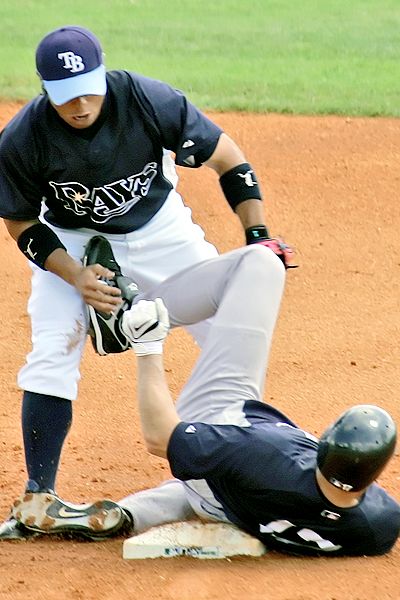
Alas, thanks to a devilish doormat promptly shedding half of its moniker and undergoing a hasty metamorphosis, Sox and Yanks are now as dated as the Devil Rays themselves.

The Rays though? Now there’s a story.

Spawned by predecessors who could never fare better than worst — and were most noteworthy for sporadic “jayvee vs. varsity” dustups with the Sawx and Bombers — this new and improved and monosyllabic contingent from Tampa has taken baseball by the jugular in ’08.

They’ve been a lap ahead of New York all year and have swept Boston twice at Tropicana Field. The most recent broom job, culminating on July 2, had those talking heads foaming at the mouth. Some waxed poetic, associating the Rays’ many weapons with the various tentacles emerging from the body of an octopus. Others boldly proclaimed that the Rays would use the thrilling series as a springboard to a championship. And all this gushing was amid constant reminders that — you might want to be sitting for this one — Rays fans somehow managed to outnumber Sox fans at the Trop! Three games in a row! Heady stuff.

Look, as a Red Sox fan with a keen interest in the Rays after what they did to my team (twice), I’m not about to dismiss the path traveled by this young and redoubtable ballclub. Though I will point out the possibly hazardous path that lies ahead.

Any team that can pull into the All-Star break improbably leading its division is automatically branded with expectation. When play begins in the second half and that bullseye is suddenly squarely on your back, that’s when things can start going awry. It should be noted that the term “second half” is a bit misleading. When the Rays begin playing again after the All-Star break, they will do so with 94 games (or 58 percent) already in the books. That leaves just over 40 percent (or 68 games) of the season to be played, which means after a handful of contests the Rays are going to find themselves in the thick of a pennant race.

It’s a pennant race that’s going to have to be waged over two months against a couple of Goliaths who have no love lost for this new flavor in the AL East (and if anything, have softened a bit on each other as they mutually acknowledge the new blood).

If the baseball season as a whole is like a marathon, the second half is more like an 800-meter race — pacing remains critical but the event feels more like a sprint. One poor road trip while your competitors are taking care of business can be fatal. The pressure mounts with each passing day.

While the Red Sox (two titles in the last four years) and Yankees (a combined 147-80 over the last three second halves) have proven themselves to be the standard-setters for finishes, the Rays have no basis for comparison because they have played the spoiler role down the stretch every year of their existence.

Am I writing the Rays off? Far from it. I’m just calling for some tempering of October predictions until the young guns have actually experienced an existence with bona fide expectations. Lest we forget, expectations have been known to weigh down even the fleetest of foot.

And now here are some players who — like the Red Sox and Yankees — are established second half destroyers, and should be accordingly protected/coveted.

Garrett Atkins One of the true all-around hitters in the game. Atkins hones his batting eye over the course of the season and by the time the All-Star break comes and goes, the third baseman is locked in. He batted .354 with a .437 on-base percentage, 18 homers and 62 RBIs after the hiatus in 2006 and followed that up with a .349/.409/12/58 second half last year. Hold onto him tight, his best is still to come.

Nick Markakis He may be one half German and the other half Greek, but the young outfielder is all about the second half. In 2006 — his first year in the bigs — Markakis batted .311 with 14 homers and 41 RBIs after the break. Last year his second half was even bigger, as he sported a .325 average with 14 homers and 61 RBIs over the last 40 percent of the season. Do what you can to secure the services of an established twilight performer.

Mark Teixeira Of all the blue-chip sluggers out there, Teixeira is the one who has made second half dominance his calling card — at least over the last two years. In the first halves of 2006 and 2007, Teixeira meandered along, doing his best Brian Daubach impression (9 homers/49 RBIs in ’06 and 12/41 in ’07). Then, after the All-Star respites, he got mad (maybe because some fool dared utter his name in the same breath as Brian Daubach), going off for 24 bombs and 61 RBIs in ’06 with an encore of 18 and 67 last year. If someone offered me Teixeira for Adrian Gonzalez today, I’d do it in a heartbeat. But that’s just me.

Johan Santana Second half surges from the rubber begin and end with Johan. Forgetting last year — when Johan was less himself than John Malkovich was in “Being John Malkovich” — Santana has been downright nasty when the margin for error becomes smaller. Please allow his second half numbers to speak for themselves: 10-1, 2.54 ERA in 2006; 9-2, 1.54 ERA in 2005; 13-0, 1.21 ERA in 2004. So… Yeah… You might want to keep the guy around for the remainder of ’08.

Southside Baller

So I was at a Talib Kweli show at the Museum of Natural History last weekend, and I bumped into an old buddy that I studied abroad with in Paris back in 2003-04. He was a former collegiate athlete who played soccer at Morehouse College, and his story was the first feature I ever put together. Set partly against the backdrop of Paris, the piece never made it into print. Feeling a wave of nostalgia, I decided to dig into the vault and pull out the story. It’s both a window into the life of an interesting guy as well as a case study of my formative years.

——————————


Khalil Um’rani sits in his eighth-floor bedroom, which overlooks the sprawling east side of Paris. A storm is moving in, the jet-black clouds inching closer to the outskirts of the city. However, in the 11th arrondissement of Paris the sun is shining bright.

“More rain out in the banlieue,” Um’rani observes. He huffs. “Whatever, I just go and play soccer, then get the hell out.”

While the thirty-minute trip he takes out to the suburbs of Paris every week may not be a long journey, it is indeed a voyage to a different world. But then again, Um’rani is a voyager. One who happens to be pretty good at a game more global than even Um’rani himself.


He grew up on the Southside of Chicago with a passion. He looks like a soccer player, tall and lean, his features sleek. The contrast between his dark skin and light eyes gives off an air of competitiveness. His friends were athletes too, but while they were practicing cross-over dribbles and touchdown-jigs, Um’rani was traveling two hours out to the suburbs of Chicago to play club soccer.

“My friends didn’t even understand where I was coming back from,” Um’rani remembers. “And they definitely didn’t understand what I was doing with these weird white boys.”

Even he may not have been able to answer that question, but Um’rani knew one thing: he wanted to play soccer. Ever since seeing it on television and wishing he had a goal in his backyard, soccer was it for Um’rani. So he went to the only school on the Southside, Hyde Park Elementary, which offered the sport. He was the best. He then tried his hand at youth soccer, scoring 20 goals in an eight-game season. Undisputed.

Club soccer seemed to be the best venue for this talented young player. But that meant dedication, time, and money. And that was just for his parents, Rashad and Deborah.

“Soccer was what he took to,” his father recalls. “It was kind of an oddball hobby, but it was what he wanted to do.”

Um’rani knows that his parents had to make sacrifices in order for him to play, especially when he decided to go out for the city’s most elite club team, the Chicago Magic. Um’rani joined the team in sixth-grade, and continued right through high school. Spending an average of six hours per-day dedicated solely to club soccer, Um’rani honed his self-proclaimed “fast and gritty skills” into a package worthy of competing at the next level.

Sure, he played high school too, starting and scoring 19 goals as a freshman for St. Ignatius College Prep. But in terms of significance, high school soccer was a distant second to club.

“Club soccer is a year-round event,” Um’rani says. “Kids are dropping two, three grand a year to play. All the coaches are professional, and, as opposed to high school, you don’t have to watch your teammates smoking weed before games.”

On the club, it was all business: kids who wanted to be there, kids who wanted to be discovered. Whenever college coaches came to Chicago, they came to see the Magic.

“Recruiting is all in the club leagues,” Um’rani explains. “It doesn’t matter if you score forty goals in a school season, you’re not going to get the looks.”

Um’rani started to get the looks junior year in high school, after the Magic joined forces with Chicago’s other major club, the Sockers, and won Nationals in Florida. A little more than a year later he was headed to Atlanta to play Division II soccer at Morehouse College.

It was there that Um’rani learned valuable lessons. They were not, however, lessons that he wanted to learn. He knew something was wrong when he red-shirted his freshman year, but still appeared in a few games under the names of active players. The team finished 16-3, but because Morehouse is an independent school, it did not receive a bid to the Division II tournament.

The following season, two players left school early to turn pro.

“We won like two games that year,” he recalls. “And we would be taking these long road trips to Alabama, Tennessee, just to get blown out the water. I had never lost like that before. It really makes you feel powerless.”

While Um’rani felt at a loss, he had no idea of what was to come. The previous coach of the team, Dr. Augustine Konneh, had been fired the year before Um’rani arrived amid allegations that he had used ineligible players. The scandal came to a head after Um’rani’s sophomore campaign.

“The NCAA discovered that this guy wasn’t just using ineligible players, he was bringing kids off the streets of Atlanta to play,” Um’rani says.

What resulted was a one-year suspension of the Morehouse program and a student-athlete beginning to appreciate firsthand the flaws of collegiate sports.

“After all this I was just thinking screw-Morehouse soccer,” Um’rani says. “It was evident that soccer and Morehouse were not going in the same direction.”

It was time, Um’rani resolved, to take his own life in a different direction. Having already attended the University of the Antilles in Martinique between his freshman and sophomore year, where he had taken a French culture class, Um’rani decided to study abroad in Paris.

He entered a complete French-immersion program at Paris’s most distinguished University, La Sorbonne. It was in his own quartier, or neighborhood, however, that he made some buddies.

“These kids were as baffled as my boys at home when I told them that soccer was my game,” Um’rani chuckles. “They figured I played le base-ball or le football americain.

They were even more astounded when they saw what this kid from “Sheecago” could do on the field. And he wasn’t even playing his normal position.

“The first time our team, East Paris, assembled for practice the captain came up to me and asked me what I play,” Um’rani recounts. “I told him the best I could that I score the ball. He responded, ‘d’accord, tu peut jouer la défense’. So it was then that I became a defender.”

Um’rani embraced his new role, on a new team, in a new city. From then on every Friday night he would lace up his cleats, and defend like he had never imagined.

His coach, Thomas Jousset, admired Um’rani’s ability to adapt to new situations.

“Khalil became accustomed to our team and style of play very quickly. One must have lots of courage and ability to do something like that,” Jousset believes. “He is very valuable to our team.”

While the evolution of his soccer career had gone hand in hand with the concept of meeting change head on, playing in a foreign league ultimately exposed Um’rani to new cultural experiences that even he couldn’t have fathomed. He remembers playing one of his first games out in the suburbs of Paris. “Our team had lost two in a row, so the guys were already on edge,” Um’rani recalls. “Around the 20th minute of the first half, our libero, or last defender, missed a tackle and the other team scored an easy goal.

“Needless to say everyone was pissed off, but I was astounded to watch as this one kid on my team goes up to the kid who had missed the tackle, and punches him in the face.”

Apparently Um’rani wasn’t the only baffled observer on the field, as one of the few fans hesitantly approached Um’rani with a simple question: Where are you guys from? Um’rani answered that they were from the east side of Paris. The man nodded, remaining puzzled. Does this kind of thing happen often in Paris?

Paris is very segregated,” Um’rani explains. “People from the suburbs don’t understand the city.”


Back in his room Um’rani prepares for his next game, watching as the threatening storm clouds hang over the périphérie of Paris. He’s ready to play, but if the game is called, he won’t be discouraged. For Um’rani, soccer is pleasure these days. Granted, the fierce, competitive fire still burns inside him, but his days of doing battle are over.

Now, he is looking toward the future. And for this economics major that has one eye on Wall Street and the other on international markets, the future looks bright. And his father, who didn’t always understand his son’s passion for soccer, believes that it furnished him with solid foundations.

“Overall the soccer was beneficial,” his father says. “But at this point in his life he’s on another level.”

When Um’rani returns from Paris he will head straight to New York, where he is going to intern this summer at a major investment-banking firm.

As for soccer, Um’rani knows it will always be a part of his life. He will forever be a fan of the game he grew up loving, and he hopes that someday he will help cement the sport in his own backyard.

I would like to start an inner city soccer club,” he explains. “That way kids like me who want to play soccer competitively can do so without having to drive two hours every day after school to get a game.”

For this voyager, it would be fitting that his journey ends where it began: on the Southside, with a passion. Except this time it could be an entire generation that benefits from that passion. And why not? Khalil Um’rani already did the hard part as a kid: he challenged and defeated the status quo.


17 for Them … and One for Us

One day long after Russell and the Cooz and Hondo have joined Red, Reggie and D.J. upstairs, one day when Bird too is talked about in the past tense and TD Banknorth Garden is referred to as “the old house”, I’ll look back on this day. Maybe I’ll be bouncing a grandkid on my lap. Maybe I’ll be perched on a park bench talking to anyone who’ll listen. But I’ll have a story. A story worth telling. One worth hearing. And I’ll recount it as if it were yesterday…

——————————

If one non-defensive play in Game 6 of the 2008 NBA Finals typified the champs it came in the second quarter with the Celtics leading 32-29. Paul Pierce drove and missed a four-footer; Glen Davis grabbed the rebound and went back up with authority but missed. Pierce beat everyone to the ensuing board and after gaining control of the ball kicked it out to Eddie House for a corner trey, which he struck off the back of the iron. James Posey hustled after the long board, hauled it in and threw it back up top for a reset. He went on to assume his place in the left corner, and on cue, received the ball on a crisp rotation from House and buried a three.

All told it was a 34-second possession for the Celtics, a possession that not only defined their stranglehold on the ’08 Finals but underscored what had been the m.o. of the champs from the word go: An undying total team commitment to hustle. From Player 1 (Pierce) to Player 6 (Posey) to Player 11 (Big Baby) — on coach Doc Rivers’ very loosely interpreted depth chart — the focus and dedication was there from the beginning and was highlighted by one microcosmic play that effectively marked the end. The 35-29 spread that resulted from that play would prove to be the closest the Lakers would ever get in what became the most lopsided clinching game in NBA Finals history.

The Lakers as a team were overmatched, which in light of Game 6 was an understatement. And while it would be difficult to find anyone who would dispute that Pierce was the best player in the series (he was the unanimous MVP on all nine ballots), you need look no further than the end of Game 5 for confirmation of said fact. A day after mounting the greatest comeback in Finals history the Celtics had staged yet another furious rally in the fourth quarter of Game 5, cutting a 14-point LA lead to two in the final minute. Much of the damage had been inflicted by Pierce, who through his trademark herky-jerky drives was getting to the basket with such consistency and ease that he had the entire Lakers team on its heels — literally.

As Paul crossed midcourt, ball in hand with the Celtics trailing 97-95, Kobe Bryant — the best player to lace em up since the best of all-time hung em up — waited in his defensive stance. When Pierce went to make his move Kobe darted behind him and back-tapped the ball away from a stunned Pierce. Lamar Odom scooped up the loose ball and threw a lob to Kobe — whose momentum had carried him into the backcourt — and Bryant threw down a two-handed slam that unofficially sent the series back to Boston for Game 6.

Dig a little deeper and you might be perplexed. For Kobe to make such a calculated gamble (back taps are successful about 25 percent of the time and fatal the other 75 percent because failed ones turn into five-on-four situations) with the lead meant only one thing: He knew he couldn’t stop Pierce.

Kobe couldn’t handle the Truth blowing by him for a game-tying or series-clinching bucket on his floor, in his town.

So he gambled (something, by the way, one Michael Jordan only did recreationally off the court). And while the gamble paid off (think going all in preflop in Texas Hold’Em with a pair of twos), Kobe showed his hand. He, the three-time champ and league MVP, needed one man-em-up defensive stand to seal the game and send the Lakers back to Beantown. But he chose not to man up Pierce, who had already dropped 38 in his house and was sniffing 40, 41, and most significantly, 17. Instead he resorted to a playground maneuver reserved for crafty old guys whose knees no longer permit them to get into a crouch and shuffle their feet.

That was the moment I knew it was over, even if it was actually the moment when we found out it was not. But it didn’t matter because Kobe had already given up. Not on his teammates, he had pretty much given up on them after Game 2. By virtue of that desperation play in a non-desperation situation Kobe essentially made it known he had come as far as he could, that there was a player in green who wanted it more than he did and could back it up on the court. And there wasn’t anything the MVP could do about it except roll the dice.

Of course Paul’s performance in itself was MVP-worthy. But it was validated by the best player in the world when he simply yielded to a colleague performing at a higher level. I never thought I’d view a turnover as a watershed moment in defining the greatness of someone I considered to be one of my heroes, but 40 years from now I’ll remember Game 5 of the ’08 Finals as the night Paul Pierce lost the game yet still owned LA.

I’ll also recall the Posey trey in Game 6, how on that 34-second possession the Celtics threw the final knockout blows by refusing to cede the ball, the game, the opportunity. The series ended then and there. The party began while the game turned into an up and down affair with one team playing its best ball in 22 years and another looking a lot like the Washington Generals. Like all vacations, the one that spanned the last two and a half quarters of the 2008 season didn’t last long enough.

Celtics 131

Lakers 92

I wasn’t ready for any of it. The score, the green confetti, the chills. But then I watched them react to it, and the crowd in turn to them, and it started to make sense. Nobody was prepared for it. For about an hour after the Celtics won their 17th championship the Garden was an uncensored window into the reactive mechanisms of a delirious team and its loyal followers.

First Pierce — apparently forgetting what sport he was playing — snuck up behind Doc Rivers and emptied a Gatorade cooler over the head of the (genuinely) surprised coach. The result was a few gallons of fruit punch splashing onto a parquet historically known to be covered in cigar ashes in similar moments. That prompted play-by-play guy Mike Breen to let us know that we’d be having “one more timeout.”

Let’s not forget about the crowd, which likely became the first fan contingent to get a “Dee-fense” chant going during the Larry O’Brien trophy presentation. These folks have always known the game of basketball, and when Doc Rivers responded to a question about how the whole thing got started by saying “defense”, they knew it was an appropriate final laudatory chorus for the champs.

Then there was Kevin Garnett. KG. The literal beating heart of the champs. On the verge of collapsing and nearly in convulsions while being propped up by Leon Powe, who assured him, “I got you, I got you”, Garnett had transformed into a half paralyzed, blissful wreck of a man.

When Michele Tafoya pulled him aside — with confetti already starting to dot the floor — and asked him what it meant to finally be an NBA champion, KG was speechless. He stood still for a few seconds, intense as ever, trying to harness millions of thoughts and emotions, before rearing back and bellowing “Anything’s possible!!! Anything’s possibllllllllllllle!!!”. By the time he gathered himself he was foaming at the mouth and letting out an exuberant and passionate train of thought, half screaming, half whimpering, wholly fulfilling.

As soon as he finished he found his mentor waiting for him a few hardwood squares away. Bill Russell embraced Garnett, the greatest champion to ever compete in athletics and one of the most emotionally drained champions you’ll ever see.

One-to-seventeen, they were all accounted for in that embrace.

————————-

By the time I’m on that park bench or at a birthday party in outer space for my 10-year old grandkid the Celtics may very well have won another 17 titles. Or perhaps not. Maybe they’ll go into a 22-year drought beginning with the 2037 season. Scores more or zero more, I’ll remember only one like it was yesterday. That’s number 17. The one that connected the old generation to the new. The one that gave life to the tradition after years upon years of retold stories of unseen glories.

Thanks to the 2008 Celtics, one day that job — the duty of adding a personalized link to the most storied basketball chain for the benefit of a younger and possibly less fortunate Green generation — will finally be mine.