It’s a Tough Road in the Finals
Just when it seemed like Lakers-Celtics would be the revival act for David Stern’s league, old friend (as in: seedy scumbag) Tim Donaghy had to resurface and cast a dark shadow over the whole shebang. Donaghy — from whatever hole he’s in awaiting sentencing for fixing NBA games — issued a statement before Game 3 of the Finals, alleging that Game 6 of the 2002 Western Conference finals between LA and Sacramento was handed to the Lakers by corrupt officials via an inordinate free throw discrepancy at the end of the game (LA shot 27 free throws in an unequivocally fishy fourth quarter).
This came, of course, after the Celtics took Game 2 from LA at least partly because of a 38-10 advantage in free throw attempts, and before the tables were turned in Game 3, when the Lakers prevailed after being awarded 12 more freebies than  Boston.
The ensuing tempest had the talking heads crying foul and the conspiracy theorists filling up their think tank with pointed skepticism. I’m not about to dispute them; some shady stuff has gone down in the NBA playoffs over the last five-plus years and there’s at least one guy who has tainted the entire game. The problem may or may not be systemic. But let’s be realistic. Donaghy is a weak and desperate man. And while at this point it’s nearly impossible to determine the validity of his claims, they are irrelevant to the matter at hand. The Celtics and Lakers were the two best teams in the NBA this year and are playing for the title. There is no fix.
Although I must say I’ve never seen anything like Game 2. It’s really quite simple: The Lakers got no calls; the Celtics got them all. From afar the disparity could be construed as illegitimate, when in fact it was merely a product of contrasting styles of play, and more significantly, the environment.
Lots has been written over the years (particularly by ESPN’s Sportsguy) about how crowds can adversely affect the outcomes of NBA playoff games. That when 18,000 people are united in cause and armed with mighty vocal cords they can succeed in fueling the home team, fazing the opponent and at times, freezing the refs. As an under-25 Celtics fan, this was one of the many truths I held to be self-evident, but never experienced.
Well, after an almost unfathomable act of generosity by my friend’s parents — yes, a ticket to Game 2 of Lakers-Celtics — I was given the opportunity to taste it for myself (and from row 12 no less). Now I may still be a relative newbie in the grand scheme of the sports spectrum, but over the years I’ve found ways to attend sporting events of great magnitude: Yanks-Sox in the 1999 and 2003 ALCS, LSU-Auburn with BCS title implications in 2007, and Game 6 of the 2002 Eastern Conference finals, to name a few.
 None of them matched the vibe inside the Garden on Sunday night. From the second the lights went down and the lineups were introduced the place became a force unto itself. With 18,000-plus unified, the building felt like it was taking on a life of its own. There was always a sustained level of clamor. It would subside slightly when the Celtics had the ball and rise to spine-tingling crescendos when the Lakers did.
Moreover, watching the wide-eyed Los Angeles subs get eaten alive by the fierce, ball-hawking Celtics bench was like an intravenous shot of adrenaline into a mass of fans whose blood was already boiling. Leon Powe (21 points off the bench) had a lot to do with it as he emerged from the Celtics bench-by-committee and immediately started taking passes in the post and making strong, often bullish yet agile moves into the heart of the soft interior defense of the Lakers. Led by Powe, the Celtics dared LA to match them physically, and LA succumbed.
Everyone in the stands, in turn, time and again rose up with such wild fervor that nothing could be done to curb what was taking place on the parquet below. That a single man with a whistle could foil the unrelenting will of the faithful and tame the swarming Celtics was pure malarkey. The way they played in the second and third quarter and the way the crowd rabidly pulsated throughout it all made it next to impossible for the refs to impact the game. They could’ve swapped their whistles for paintball guns and still wouldn’t have had a chance of halting play when the Celtics were being perhaps a tad overly aggressive. The arena simply wouldn’t allow it.
A series of Powe throw-downs at the end of the third quarter had me believing that if the old Garden was still sitting next door it would’ve crumbled after being rocked by the tremors emanating from the new house. So you’re telling me that in this environment, a wrist-slap on an ensuing Lakers possession was going to be identified and whistled by a referee? I think not.
Now is that the way it’s supposed to be? Probably not. Crowds — while an integral aspect of the game — should not be able  to sway the outcome and render the officials mere bystanders. But time was, that’s how it went down; that’s one of the reasons why the Boston Garden and LA Forum produced nearly half of all NBA titles. That sense of intimacy, of a stake in the action, that’s what has made basketball the unique professional sport from a fan perspective.
Unfortunately that which has given basketball its identity — the ability of a crowd to rise up and become a greater force than the men policing the game — is now threatening the game itself. And it’s all because of (hopefully) a single “rogue” (Stern’s word) official. Let’s get something straight: Calling fouls in basketball is, and has always been, purely subjective. Bodies clash and hands check on every possession of every game. It is the job of the referees to control the chaos.
There’s a monumental difference between refs getting swept up in the moment and attempting to dictate it for personal gain. During the heyday of the league, the former used to happen with great frequency. At this juncture we can only hope that Donaghy’s claims are those of a soulless and desperate man, that some semblance of the game’s integrity can ultimately be preserved.
What we can’t allow to happen is for the abhorrent transgressions of one to sully what remains a riveting throwback series between the two franchises that made the game what it is today. I finally experienced what I’d only previously known through lore, and nothing about what I watched was dirty. What it was was a singular and momentous two and half hours when fans and team together waged battle against an old adversary. That was always basketball at its finest. To hell with one man destroying what many far greater men worked so hard to build.
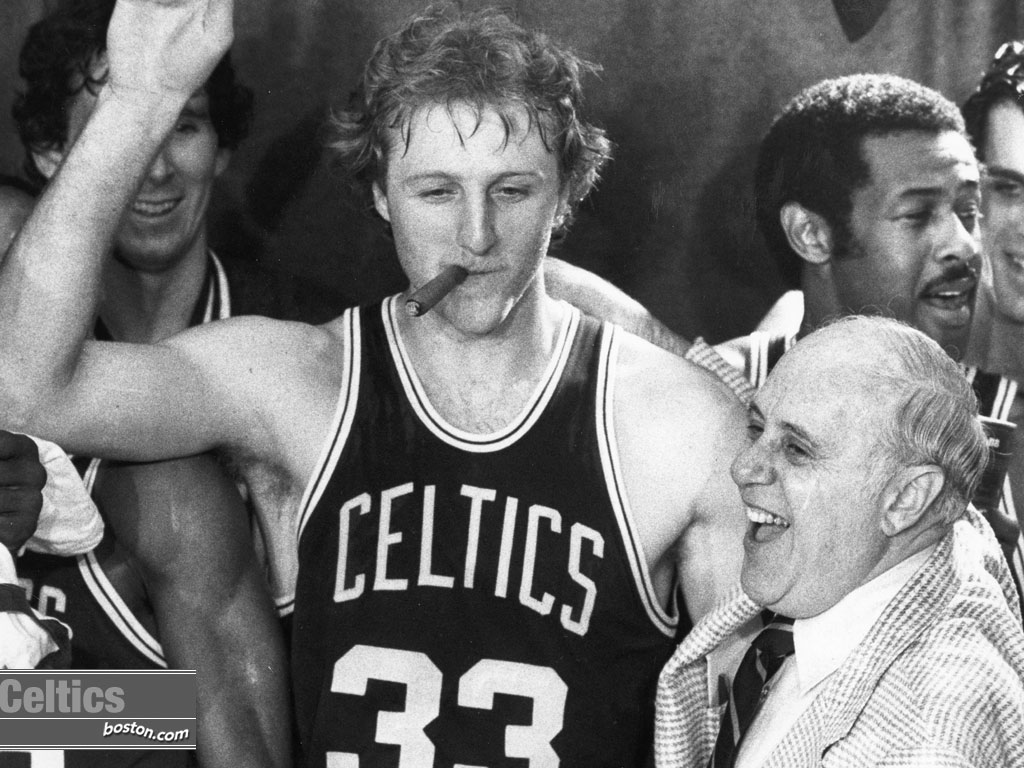 Hello, I’m a 25-year-old Celtics fan. There are many others like me.
 Wildcats and a certain “door”. Reality for us is not-Tim Duncan.
 I did know it was the proudest moment I’d ever had as a Celtics fan because the pride I felt was 100 percent genuine and solely my own. It was also the most unique moment I’d ever had as a sports fan because it had nothing to do with winning or losing.
 In decoded speak, the previous paragraph reads like this: Ray Allen (finally!) became Ray Allen again, Kendrick Perkins went all Bill Russell on us for three quarters, and the Celtics positioned themselves within a win of the NBA Finals for the first time in 21 years.
 of the third quarter Kevin Garnett missed a long jumper; Perkins positioned himself and hauled in the offensive board, felt single coverage from Antonio McDyess and calmly backed him down before sinking a turnaround shot. A few minutes later he swatted Jason Maxiell’s layup attempt, which led to a shot clock violation for the Pistons. He sported a KG-like scowl running back up the floor as the arena wildly applauded.
 vanquish an opponent in a Game 6 with the safety net of a final decisive game in Beantown on a Sunday.
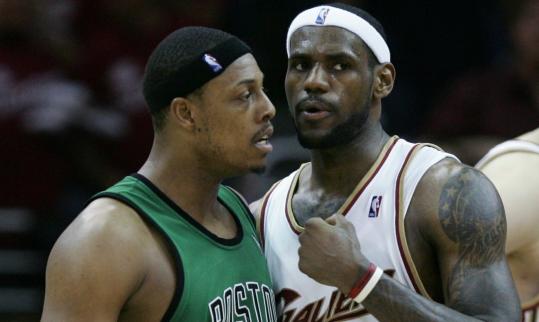 Then, as if sensing its visceral reaction was slightly misplaced and maybe premature, the stadium came to a prompt hush as Pierce was about to release the ball.
 When it was over and the Celtics had prevailed, survived, escaped–however you want to put it–the clock read 6:31 pm. Afternoon may have turned into evening outside on Causeway Street, but inside TD Banknorth Garden for three hours on a Sunday, time stood still.
 That one home “L”, endured by Orlando, enabled the Pistons to carry a comfy 3-1 series lead back to the Motor City. The other three series (Lakers-Jazz, Hornets-Spurs, Celtics-Cavs) are all knotted at home-cooked 2-2 splits.
 at Quicken Loans Arena in Games 3 and 4.
 your squad?
 stars like them, that can be the difference between a top-three finish and middle of the pack.
 (.341/6/16). Ryan Church (.318/4/22).
 permanently tagged “if necessary” on the schedule–I can’t help but think: Maybe this was a good thing.
 forced to reevaluate, forced to reflect — not on 66 wins, but on two losses.
 Excuse me for being blunt but if you’re a sports fan not watching these playoffs, well then, there’s just something wrong with you.
 On a scale of 1 to 10, what is his “can win a series by himself” potential? 9.9 out of 10. A tiny notch ahead of Garnett because of his age but still lacking the perfect 10 because it is possible to get the ball out of his terrifying hands at the end of games. In fact, these playoffs will probably spawn the “hack-a-Howard” strategy because he only shoots 59% from the free throw line. Of course there’s always the chance that in crunch time he will shed would-be foulers like ants. He truly does have the power and quickness to unilaterally overrule futile foul attempts. That said, if you’re an opposing coach, you simply can’t let Dwight Howard throw one down in the last seconds of a tied playoff game. If it must entail lining up a wall of oversized pawns to thwart him, so be it. It must be noted that Howard’s options on the perimeter (Hedo Turkoglu and Rashard Lewis) for a game-winning kick-out are not as reliable as KG’s. That will inevitably mark Superman’s downfall (this year at least).
 32 and 17 (plus a combined seven steals) in fact weren’t what stuck out the most. (And no, I’m not munching on the magic brownies.) It was the way he carried himself; the way he carried his team. In the tone-setting Game 1, each bucket he dropped and dime he dished was accompanied by a progressively meaner and more confident look in his eyes. Chest pounds and cries of “Let’s go!” had Hornets fans smelling blood and Mavs players anticipating the imminent (which was also the psychological precursor to the beating Paul gave them in Game 2). His intensity level was so high he appeared ready to take the contest into the parking lot after the game. We haven’t seen that from Dirk since Game 7 of the Spurs series in 2006. I’m surely not the first to say it, but I won’t be close to the last: We are witnessing the beginning of what may become the greatest career by a point guard all-time. His ceiling extends far beyond the bannerless rafters inside New Orleans Arena.
 accompany him. “The first time you get there, you feel it.”
 Ainge: (patting McHale on the shoulders) Who’s the man??
 While Ferry enjoyed having his own “pickins” for a period of time when the tournament was still a niche, he speaks with a justifiable sense of pride when detailing the evolution of the event. His one time diamond in the rough ultimately served as one of the launch pads to greatness for the likes of Rick Barry, Earl Monroe, Dave Cowens, Scottie Pippen and John Stockton.
 with his own reflection, he falls in love with each deep drive he strikes.
 Sheffield have had a lot do with that.