Skip to content

Celtics Ticket-less for Playoffs

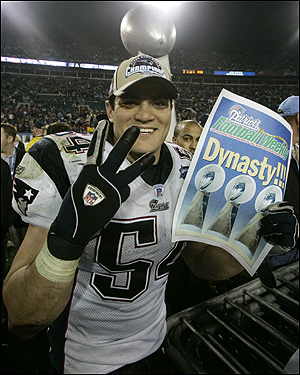
Tom Brady might be sitting courtside at TD Banknorth Garden on Saturday — when the Celtics officially begin their title defense — but unlike last postseason, he will not be the most important guy in street clothes next to the Celtics bench.

Unfortunately, that honor will go to the Big Ticket.

What many feared last month after Kevin Garnett’s brief and unsuccessful return from a knee strain is now a bitter reality: The MVP of the Celtics, Mr. Anything’s Possible himself, is out indefinitely.

We have all witnessed how the fire burns inside this unparalleled athlete. We saw him spill his guts every night for 12 years in Minnesota. We were awed when he brought his act to Boston and did the same over a surreal 97-game stretch last season; a series of extended encores punctuated by a world championship. And we were grateful when a long-suffering basketball town was returned to its rightful perch atop the hoops world.

Now, with 14 years and well over a thousand games under his belt, it appears his heart and passion for the game have proven to be more enduring than the knees entrusted with carrying all that extra weight, literal and otherwise.

There are still no reports of structural damage in his injured right knee, just a career’s worth of wear and tear of the highest degree. (Seems like the term “wear and tear” grossly understates the matter, no?) He hasn’t been officially ruled out of the entire playoffs, but it’s probably wise to keep expectations at a minimum going forward.

It’s tough not to be down at this point. When KG was healthy, the defending champs — spurred by an historic 27-2 start — were the story of the league.

Yet not long after that run, the main plot of 2008-09 season shifted away from the Celtics and towards Lebron and Kobe, Cleveland and LA.  Garnett went down, the Cavs were unbeatable at home (falling only to LA), and the Lakers had wrapped up the West before MLK Day.

While Cavs-Lakers was accordingly billed as the surest Finals since, well Lakers-Celtics, and would’ve had a good chance of happening even if KG was healthy, it’s a damned shame the Green won’t get a real shot at defending their crown. Anyone who tells you Cavs-Celtics would have been a foregone conclusion with Garnett back is full of it.

Garnett’s loss is a striking blow to a team that wore the championship belt and bullseye all year, battled multiple injuries throughout, integrated new players, and still emerged with 62 victories. It was an admirable first chapter to the team’s first title defense since 1987. Now, with the end game pretty much determined, all that’s left to see is how it concludes.

I don’t think it’s optimistic to believe the Celtics will fulfill their end of the bargain and give Lebron the rematch he’s wanted — albeit under different circumstances.

This team has dealt with a ton of adversity.  In addition to Garnett being sidelined for 25 games, key reserves Leon Powe (12 games), Tony Allen (36 games) and Brian Scalabrine (43 games) all missed significant time.  That enabled Glen Davis to grow into his skin, and helped accelerate the transition for newcomers Mikki Moore and Stephon Marbury.

Add to that Rajon Rondo’s emergence as an elite point guard and Kendrick Perkins’  continued development (both enter the playoffs as unquestionably better players than last year), and there is a solid and experienced supporting cast around the now Big Two, who are not to be forgotten.

Paul Pierce and Ray Allen are among the proudest players in the game, and will make it their personal mission to carry this team as far as they can.  Even with rings — and Pierce with a Finals MVP — both can vividly recall the days when they were some combination of underestimated and underappreciated.

Allen has been channeling Jesus Shuttlesworth since last year’s Eastern Conference finals.  He will take it up a notch.

As for Pierce, let’s just say a lot of people didn’t take him seriously last year when he proclaimed he was the best player in the world.  He may have overstepped a bit, but after manning up and dismissing Lebron and Kobe on the biggest stage, his point held water.

For the two most important months of the 2007-08 season, Paul Pierce was the best player in the world.  He’s always relished having something to prove, the greats always do.  Now he does (again).

The Celtics likely won’t make it back to the promised land without their leader, but that doesn’t change the fact that the belt is theirs until somebody rips it off them.

Knowing this team and its coach, knowing Allen and the reigning Finals MVP, I wouldn’t bank on anyone not named Lebron or Kobe taking the honors.

MLB Preview 2009

Need a comprehensive preview of the 2009 MLB season?  Want to know who’s going to make it through the gauntlet that leads to October?  Itching to find out which teams will rise out of nowhere to become legitimate threats?  Wondering how all the hardware will be distributed?

Well then, please read on.

AL East Champions — Boston Red Sox (96-66)

The Red Sox have been the team of the decade thus far.  They’ve won at least 93 games six times, played for four pennants and hung two banners.

Boston’s success has revolved around developing homegrown talent through its farm system (Dustin Pedroia, Kevin Youkilis, Jacoby Ellsbury, Jonathan Papelbon), and filling in the holes through trades (Hanley Ramirez for Josh Beckett and Mike Lowell before the 2006 season) and free agency (recent signings of John Smoltz, Brad Penny and Takashi Saito).

Combine that with a prolonged dedication to defensive proficiency, and you see how drastically the core philosophy of the franchise has changed in the last 10 years.  The Red Sox are a team built for the long run, both the grind of a 162-game season, as well as the future.

While the health of cogs David Ortiz, J.D. Drew and Lowell will be closely monitored throughout the ’09 season, Boston’s pitching and defense is good enough to make up for any offensive shortcomings.

The Red Sox will retake the AL East and make another run deep into October.

AL Central Champions — Cleveland Indians (89-73)

If the Indians have taught us anything in recent past, it’s that they are all about expectation.  When they’ve avoided it (2005 and 2007), they’ve flourished (average of 95 wins).  When they’ve encountered it (2006 and 2008), they’ve flopped (average of 80.5 wins).

Now that CC Sabathia is a distant memory and Fausto Carmona is fresh off a back-to-earth ’08 season, there is very little expectation in Cleveland.  Though that’s not to say there isn’t a quality ballclub there.  With a 26-year-old MVP candidate in Grady Sizemore at the top of the lineup, the Tribe will plate runs.  Versatile newcomer Mark DeRosa will complement the likes of Ryan Garko and Jhonny Peralta to form a solid one through nine.  And remember the name Shin-Soo Choo (1.038 OPS after the All-Star break last year).

The pitching staff is a question mark, especially given that no one is banking on a repeat of Cliff Lee’s 22-3 campaign of a year ago.  But then again, few are counting on much from Carmona, who was shaky and broken down last year after a 2007 season that saw him throw 230 innings (he had never thrown more than 173 innings at any level).  Given that he relies primarily on a hard sinker, so long as he consistently locate his pitches, there’s no reason to believe he won’t bounce back with a big season in ’09.

As for the bullpen, which was nothing short of a train wreck last year, Joe Borowski — along with his 89-mph fastball and countless blown saves — is out as Indians closer.  That alone is cause for elation among Cleveland fans.  New fireman Kerry Wood, health issues notwithstanding, is going to totally transform the vibe of that bullpen, not to mention the late-game managing strategies of Eric Wedge.

With a well-rounded club and scant expectation, the Tribe will do what they do best: fly under the radar en route to the postseason.

AL West Champions — Oakland A’s (88-74)

They are turning back the clocks in Oakland.  The days of Billy Beane jettisoning any and all valuable commodities for prospects are over.  By signing Matt Holliday, Orlando Cabrera and Nomar Garciaparra, and bringing back old friend Jason Giambi, Beane’s A’s are going for it.  Now.

They will be relying on a young and largely unproven rotation, headlined by an ace, Justin Duchscherer, who is not likely to post another sub-3.00 ERA.  But as opposed to last year, the Oakland hurlers will not take the mound knowing they must totally shut down the opposition to win, because their offense (worst in the AL in 2008) finally has the ability to plate a significant amount of runs.

Don’t underestimate how a change in clubhouse culture can affect play on the field as well.  With a veteran-laden, high-powered offense and a throwback leader in Giambi, the A’s clubhouse will be a light and comfortable atmosphere in which the young arms can mature without significant pressure.  Beane’s well-established track record of developing pitching would indicate that one or more from the top-prospect trio of Brett Anderson, Trevor Cahill and Vincent Mazzaro will make the leap in ’09.

The injury to projected closer Joey Devine is a blow to the bullpen, but the Oakland relief corps will still feature a variety of quality options (including Brad Ziegler, Russ Springer and Michael Wuertz).

Behind the new bats and a new mentality, the A’s will recapture the AL West after a two-year hiatus.

AL Wild Card — New York Yankees (94-68)

The new Steinbrenner contingent invested nearly half a billion dollars into their enterprise.  How then is it possible that the Yankees will finish as a second-place team?  Because the Red Sox have better pitching.  That doesn’t mean the Yankees staff isn’t formidable, because it is.  For whatever reason, CC Sabathia is not a fast-starter.  While his April struggles are dominating the headlines in New York right now, over the long run his poor debut in pinstripes — however extended it may be — will be old news once he wins 20 games and finishes at or near the top of the Cy Young balloting.

It wouldn’t be prudent to hold A.J. Burnett — the other high-priced newcomer to the New York rotation — in the same regard as Sabathia.  Last year marked only the second time in the last eight seasons that Burnett started 30-plus games (he’s averaged just under 24 starts per season in that span).  If Yankee fans aim for 20-25 starts from Burnett, they won’t be disappointed, because when he does pitch, he’s very good (3.81 career ERA, 8.40 K/9).

Behind Chien-Ming Wang and Andy Pettitte, Joba Chamberlain is slated to be the fifth starter.  Everyone knows he’s much better than that.  Considering the questions surrounding Pettitte (who will be 37 in June and posted a career-worst 4.57 ERA last year) and Wang (who spent considerable time on the DL), Joba is really only the fifth starter in theory.

Whatever hurdles the pitching staff encounters, the Yankees offense will more than make up for.  Sticking Mark Teixeira in the middle of that lineup is going to pay immediate dividends, and will be even more devastating once Alex Rodriguez returns.

The Yankees will be back in the playoffs.

Not Quite Enough

Tampa Bay Rays (91-71) Hands down the third-best team in the AL, but the rules say only two from the same division can make it.

Los Angeles Angels (87-75) Too much uncertainty surrounding the starting rotation, compounded by aging key contributors, will ultimately stall the Halos.

Sleepers

Texas Rangers Opposing staffs better hope to be throwing their frontline guys when clashing with a Texas offense that is genuinely fearsome.

Kansas City Royals Studs in the rotation and a sneaky-good lineup should have the Royals sniffing their first winning season since 2003.

Awards

Cy Young Josh Beckett

MVP Grady Sizemore

————————————————————

NL East Champions — New York Mets (92-70)

A new year, a new stadium, and new hopes in Flushing.  Gone is the hex-house that was Shea Stadium.  Citi Field is the new home of the Metropolitans.

Just like recent versions of the Mets, the ’09 one will feature an offense with considerable speed and power, as well as a deep bench.  The recent signing of Gary Sheffield gives added depth to the corner outfield tandem of Daniel Murphy and Ryan Church.  With one of those three coming off the bench every night, as well as Fernando Tatis and defensive specialist Alex Cora, Jerry Manuel will have versatile guys at his disposal late in games.

Late in games.  Those three words have haunted Mets fans over the last three years, as the staple of the Mets bullpen has been blowing leads late.  Just as Shea Stadium was dismantled in the offseason, so too was the New York relief corps.  Out went failed setup men Aaron Heilman and Duaner Sanchez, and in came documented closers J.J. Putz and Francisco Rodriguez.  No longer will the eighth and ninth innings be disaster central for the Mets.  To the contrary, in fact.

That swings the onus back to the starting rotation, which will be strong if John Maine and Oliver Perez can sufficiently back up frontline starters Johan Santana (already a far more vocal leader this year) and Mike Pelfrey (dominant in stretches last year).  Add it all up and the Mets will be leading many games late — and locking them down at the end.

The revamped bullpen will be the main reason why the Mets get over the hump and back to the postseason.

NL Central Champions — Chicago Cubs (98-64)

It’s tough to say what’s more difficult for Cubs fans to endure: knowing their team is guaranteed to be bad, or knowing their team is guaranteed to be the best — and fearfully counting down the days until the playoffs begin.  In years past, it was the former that Cubs fans had to come to grips with.  After consecutive NL Central crowns and a pair of embarrassing sweeps in the playoffs, it is now the latter.

There is, however, no getting around the fact that for the Cubs, the 2009 regular season is going to serve as nothing more than a 162-game warmup for a five-game series in October.  Remember the Cleveland Indians of the late 90s?  That’s the last team that was as much of an obvious runaway favorite as this year’s Cubs.

Chicago added Milton Bradley to a lineup that scored 855 runs last year, 56 more than any other team in the NL.  They will have a full year of Sean Marshall (and not Jason Marquis) as the fifth starter.  If Rich Harden can approach the 25 starts he made last year, they will have one of the game’s filthiest pitchers as their fourth starter.  Kevin Gregg is the new closer, with nasty setup man Carlos Marmol ready and willing to take the reigns when necessary.

The Cubs are going to win a lot of games, and for better or worse, with each one the disturbing reality of October is going to become a little more apparent.

NL West Champions — Los Angeles Dodgers (89-73)

Traditionally, when a team loses its ace and closer, panic tends to set in.  That was initially the case for the Dodgers when Derek Lowe signed with the Braves and Takashi Saito headed east to Boston.  Until the beginning of March, the Dodgers were nothing more than a young team with promise and a suspect pitching staff.
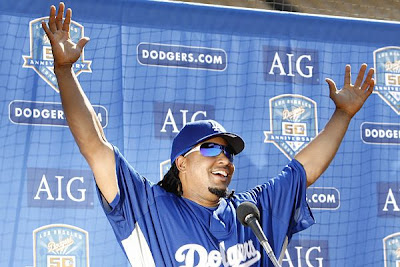
That is, until Scott Boras ended his four-month standoff with general manager Ned Colletti and agreed to terms on a new contract for Manny Ramirez.

Just like that the Dodgers offense transformed into one of the NL’s best.  Of course all this is old news to Dodgers fans.  Their team was mired in mediocrity for the first two-thirds of last season before Manny arrived.  After Ramirez abused opposing pitching staffs over the final two months of the season and into October, it became abundantly clear that one player can indeed be the difference between middle-of-the-pack status and bona fide contender.

While the offseason was replete with angst in Tinseltown, Manny’s presence has settled all nerves.  The pitching staff still has issues (Is Chad Billingsley a true No. 1? Can Clayton Kershaw take the next step so soon?  As the full-time closer, will Jonathan Broxton avoid the horrid stretches that have plagued him in the past?), but what was proven last year was a little Manny can go a long way.

How about a full season of Manny?  You know the answer.

NL Wild Card — Philadelphia Phillies (90-72)

By virtue of their dash to a world championship last fall, the Phillies changed a lot of perceptions about their franchise and city.

As for their chances of a repeat, let’s just say recent history isn’t on their side.  Of the eight World Series champions this decade, only the 2001 Yankees made it back to the Fall Classic.  Four failed to even qualify for the playoffs in the year of their title defense.

The Phillies will be able to avoid becoming the fifth team on that list, because their offense features three MVP candidates and a newcomer (Raul Ibanez) who is a run-producing machine.  They will have to score a boatload of runs, as their starting rotation is full of holes.  After Cole Hamels (who threw 262 1/3 innings last year and has been dealing with elbow problems), the Phils top three will round out with Brett Myers (erratic) and Jamie Moyer (46 years old).

Having Brad Lidge to close games is key.  His consistency and a potent offense will get Philadelphia to where it wants to be: in the postseason with a chance to defend its crown.

Not Quite Enough

Arizona Diamondbacks (87-75) Playing a full season in a division with Manny (five HR, 1.588 OPS in 12 games vs. ARI last year) will be the D-backs’ undoing.

Sleepers

San Francisco Giants A talented and well-rounded rotation will have the Giants breathing down the necks of the contenders out west.

Cincinnati Reds With young aces and young sluggers headlining in Cincy, the Reds will lack consistency but prove to be a headache for the duration.

Awards

Cy Young Johan Santana

MVP Manny Ramirez

——————————————————————–

Playoff Picks

ALDS

Red Sox over A’s; Yankees over Indians

NLDS

Mets over Dodgers; Cubs over Phillies

ALCS

Red Sox over Yankees

NLCS

Mets over Cubs

World Series

Red Sox over Mets

PLAY BALL.

Red Sox Preseason Report Card

The 2008 Red Sox were a deep and balanced team that fell just shy of the World Series.  If it weren’t for some big-time pitching from Matt Garza and David Price in Game 7 of the ALCS against the Rays, the Sox probably would have hung their third pennant in five years.

Understanding how close they had come, the Boston front office entered the offseason with the intention of shoring up the gaping hole in the middle of the lineup left by Manny Ramirez.  They dutifully pursued Mark Teixeira, only to be dissed at the last moment.

With the big prize off the market, Theo Epstein took a page from the Patriots handbook, signing a handful of veterans (John Smoltz, Brad Penny, Takashi Saito, Rocco Baldelli) — undervalued by their former teams for various reasons — to modest and incentive-laden deals.  These new faces have fortified the established nucleus from last year’s 101-win team.

As Opening Day 2009 inches closer, the Red Sox will begin the season with an even deeper squad than a year ago.  Let’s hand out some preseason grades.
Starting Pitching: A-minus

Led by the emergence of Jon Lester, the starting pitching was solid last year, with two caveats: Josh Beckett was not the Cy Young-caliber ace he had been in 2007, and there was never an established fifth starter.

As everyone knows, Beckett battled a strained oblique that dogged him repeatedly late last season.  That injury appears to be old news, as Beckett started more games (7) and logged more innings (27 2/3) than any other Sox hurler this spring.  He says he feels good, and his spring numbers (2-0, 3.25 ERA) back up the claim.  Beckett will be the Opening Day starter and looks poised to regain his status as staff ace.

As for the fifth slot in the rotation, there is nothing short of a logjam, which is excellent news.  Brad Penny is set to get the nod on April 12, the first day the team will need a fifth starter.  Penny is fresh off his best outing in a year, having repeatedly exhibited the mid-90s heat that propelled him to consecutive All-Star games in 2006-07.  If Penny returns to form, the Sox will have the best starting staff in baseball.

To illustrate the quality and depth of the Boston rotation, consider these points: Justin Masterson is fully capable of starting, Clay Buchholz gave up a total of seven earned runs in 25 innings this spring (and will begin the season in Triple-A), and John Smoltz is anxiously waiting in the wings.  If all goes well, let’s just say the team is fortunate that Tim Wakefield is such a good sport.

Bullpen: A-minus

Top closer in the game?  Check.  Dominant setup man capable of closing?  Check.  Multiple middle and long relief options?  Check.  Situation-specific matchup relievers?  Check.  Roger that.  Bullpen is a go.

While it all begins and ends with Jonathan Papelbon, technically it only ends with him when talking about the myriad arms that will be available to Terry Francona this year.  Given the rocks in the rotation, it’s fair to assume Tito will be consistently bridging no more than the seventh and eighth innings to Papelbon.  And on the rare occasion that a starter gets lit up, a mop-up man will not be necessary.

At his disposal will be mainstays Masterson, Hideki Okajima and Manny Delcarmen, each of whom can fulfill a variety of roles — including long relief.  Add to them newcomers Ramon Ramirez (likely a matchup guy) and Saito (who, if healthy, will be among the filthiest setup men in baseball), and toss in a lefty specialist (Javier Lopez), and voila!  Quite a dynamic stable out in the ‘pen for Tito to mix and match at his discretion.

Offense: B

It’s no secret that the Red Sox will find it difficult to approach the 845 runs they scored last year, third-most in baseball.  While fans have become accustomed to watching them cross the plate in droves (they’ve averaged 892 runs a season over the last six years), the ’09 Red Sox offense will revolve around smart baserunning and timely hitting.

And of course, health.

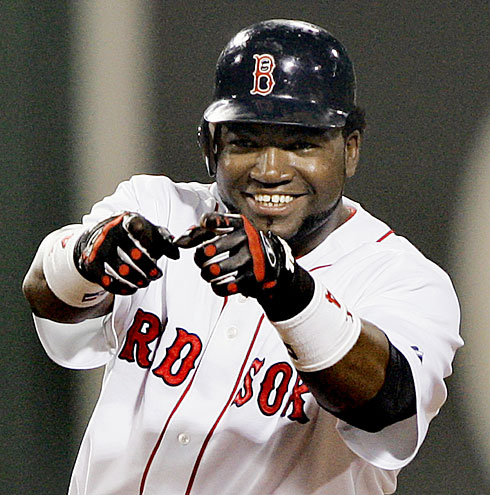
Assuming David Ortiz plays something close to a full season, and Mike Lowell and J.D. Drew avoid long stints on the DL, the lineup will have sufficient pop.

The evolution of Jacoby Ellsbury will continue and Dustin Pedroia should post similar numbers to his MVP season of a year ago (with a slight decline in the power categories).  Concerns have been voiced about the bottom of the lineup, but as it stands now, Jason Bay, Jason Varitek and Jed Lowrie will round out the lower third of the batting order. Bay is a five or six hitter in most lineups, and Lowrie tore it up this spring (.349, 11 extra-base hits).  That leaves Varitek as the only easy out in the order.

Again, operating under the assumption that the offense can avoid a catastrophic blow, this should be a unit that can plate something in the neighborhood of 800 runs.

Defense: A-minus

With a .986 team fielding percentage, the 2008 Red Sox tied for tops in the league with the Blue Jays and Yankees.  They committed 85 errors, two more than New York and one more than Toronto.

This year the defense projects to be even better.  In the outfield, Ellsbury now has a full year in center under his belt, and an entire season of Bay in left will be an obvious upgrade from Manny (notably on the road).

Every infielder has captured at least one Gold Glove, except for Lowrie, who committed only two errors in 97 games last year while boasting a sterling .992 fielding percentage.

Overall Preseason Grade: B-plus

As shown, the 2009 Red Sox are a loaded team.  There are indeed concerns about the middle of the order, but in this day and age, it’s all about pitching, pitching, pitching.

Considering the number and quality of arms on their pitching staff, the Red Sox should have no problem winning 90-plus games and returning to the playoffs for the sixth time in the last seven years.

In March, Guards Wear the Slipper

Teams that win national championships are talented, well-coached, deep, resilient … and exceptionally lucky somewhere along the way.

Alas, no would-be champion navigates the madness of March without the aid of a rabbit’s foot stashed somewhere precious.

What this tournament has taught us is that it’s folly to try and predict bounces of the ball.  Once the games begin, Cinderellas will rise.  Favorites will fall.   The only sure thing is that one of the top five or so teams in the nation will be left standing.  Other than that, anything goes.

There is, however, one factor that can transcend the Dance, and that’s guard play (which is to say, shooting).

Shooting is the essence of basketball.  It’s neither an art nor a science, yet there are elements of each within it.  And as much as any statistician will fight the notion, shooters are prone to hot and cold streaks that follow no logical pattern.  Anyone who has ever toed a basketball court is aware of the phenomenon that is shooting: Sometimes, inexplicably, the cylinder seems to expand and you suddenly can’t miss.

Nine times out of ten, when you hear news of a mammoth upset or Cinderella run, there is a shooting guard who caught fire behind the story.

So if you’re looking for a lower seed capable of a deep run in the tournament, it’s wise to start your search with the shooters.

With that said, pay attention to these teams and the gunners who are capable of carrying them far.

Team:  Boston College (22-11, No. 7 in Midwest)

Gunner: Tyrese Rice (G, Sr.)

Explanation: Rice is one of the more peculiar players on one of the more peculiar teams in the land.  After a junior campaign in which he averaged 21 points per game, many thought he would be among the nation’s scoring leaders this season.  Instead, he has mainly deferred to some of the younger talent around him, putting up almost a hundred fewer shots and averaging nearly four fewer points (17.1).  He has been dominant in big spots though, as evidenced by the combined 46 points he dropped in wins over North Carolina and Duke.  Rice is one of a handful of guards in the country who can spot up from anywhere and get to the bucket at will.  If he finds the zone, all bets are off for any team in his path.

Team: Texas (22-11, No. 7 in East)

Gunner: A.J. Abrams (G, Sr.)

Explanation: The Longhorns fizzled down the stretch, losing three of their last six, mainly because Abrams went cold.  The senior averaged 16.3 points and was a 38.9 percent 3-point shooter for the season.  Yet he made just 11 of 33 attempts from long range and scored only 11.5 points per game down the stretch.  If he can regain the form that saw him torch UCLA and Villanova in consecutive games early in the season, Texas could run through Duke in the second round and possibly find itself challenging Pittsburgh for a trip to the Final Four.  Abrams is that explosive.

Team: Temple (22-11, No. 11 in South)

Gunner: Dionte Christmas (G, Sr.)

Explanation: If you haven’t heard of him by now, you probably don’t watch Sportscenter too often.  The Owls, led by a man whose name is conducive to clichés, blitzed the Atlantic-10 tournament last week to earn an automatic bid to the Dance.  Eyes started opening in the semifinal game, when “Christmas came early” for Temple against perennial conference power Xavier.  The senior guard dropped 20 on the Musketeers before following that with a 29-point encore in the championship vs. Duquesne.  He hit a combined 10 threes in those contests.  Now the Owls find themselves matched up against Arizona State.  If Christmas goes off again, Syracuse (Temple’s likely second-round opponent) may have to up the threat level from “Orange” to red.

Team: Marquette (24-9, No. 6 in West)

Gunner(s): Jerel McNeal (G, Sr.) and Wesley Matthews (G, Sr.)

Explanation: The Golden Eagles were drastically altered when point guard Dominic James broke his foot against Connecticut on Feb. 25.  Including that game, Marquette dropped five of six to end the season.  In all five of those losses they battled, but fell to nationally-ranked Big East foes.  The good news is backup point guard Maurice Acker was able to get some significant playing time against big-time opponents.  If he can take care of the ball in the tournament, that will enable McNeal (19.7 ppg, .402 3-point shooter) and Matthews (18.4 ppg, .377 3-point shooter) to do what they do best: light up the scoreboard from outside and keep the pressure on the opposition.  The two have a combined eight years of experience.  Even without James, they are capable of shooting their way to the Sweet 16.

UConn-‘Cuse: Just Wow

I remember being at the semifinals of the 2003 Big East Championship.  Sitting about 20 rows back of where the baseline meets the sideline at Madison Square Garden, I watched Connecticut and Syracuse go at it.

Carmelo Anthony had been the story of the year but on that March night it was Ben Gordon who put the Huskies on his back to take down ‘Cuse and its freshman titan.  After the teams exchanged postgame handshakes — Anthony with Gordon and Emeka Okafor among others, pantheon coaches Jim Boeheim and Jim Calhoun with one another — I tracked Anthony as he exited the court and walked toward the tunnel.

I inched closer to floor level, getting to within shouting distance of him.  Intending to give him a piece of my mind (it’s a habit I have), I suddenly had no words (a rarity).  He had this steely and resolute look in his eyes, yet at the same time seemed to be fighting back a grin.  The contradiction froze me. 

The look, which could have been construed as a defiant acceptance of defeat, I interpreted differently.  It was almost as if he knew something nobody else did, and the moment of clarity just happened to come after a tournament loss in the world’s most famous arena.  To me he looked like a kid who knew the stage was about to be his, and to hell with anyone who dared stand in his way.

Can I be positive about this?  Of course not.  But I will say I left MSG that night knowing which team I’d have going the distance once the brackets were announced.  I left the Garden with the sneaking suspicion that I had witnessed some history wrapped in an otherwise ho-hum 80-67 final.

Three and a half weeks later I had won my first (and only) March Madness pool and was about to pen the first (of a few) “Respect Carmelo” columns for my school newspaper.

So why am I writing about that contest now?  Why give two hoots about some game that happened six years ago when the same teams just ran six overtimes less than 24 hours ago??  SIX!!!!!!  That’s three full halves PLUS two overtimes!!!

I’ll tell you why: Because it’s special to feel like you’re a part of history.  I witnessed one of the greatest college players lose for the final time, and am pretty sure I pegged the moment when he decided as much.  That moment still resonates.

I wasn’t even at MSG Thursday night but can say unequivocally that Connecticut-Syracuse on March 12, 2009 was a game I’ll be talking about when I’m an old-timer.  I may not have been as privileged as the 19,375 inside the Garden, but I still feel like I was a part of history.

This one was so epic you didn’t even have to be there, you just had to see it with your own eyes.

Had to see Eric Devendorf’s miracle three with 1.1 seconds left in regulation, a shot that would have Deven-dwarfed every buzzer-beater since Christian Laettner’s had there been 1.2 seconds remaining instead.

Had to see 7-foot-3 Hasheem Thabeet — disregarding the fact that his cranium is situated somewhere in the stratosphere — dive earthward for a loose ball to secure a possession in overtime.

Had to see UConn jump out to leads in each of the first FIVE extra sessions, only to watch Syracuse claw back and tie the game — but never take the lead — every time.

Had to see Paul Harris miss not one but two layups in the closing seconds of the fourth overtime that would have won the game for the Orange.

Had to see Jonny Flynn put a tad too much english on a reverse layup just moments before Harris.

Had to see, one by one, star players foul out and give way to walk-ons and benchwarmers.

Had to see those same walk-ons and benchwarmers make HUGE plays in the biggest moments of their lives.

Had to see all the drives, jays, blocks, acrobatic saves, bodies flying, near-daggers, rugby scrums for loose balls, volleyball battles for boards, clutch free throws, diabolic bounces off the tin, jumping jacks, and-ones…

Had to see Sean McDonough, Jay Bilas and Bill Raftery lose a few marbles.

Had to see the fans — who were as exhausted as the players — yelp like dogs with muted barks once it was all over.

Had to see Boeheim — no sucker for hyperbole — proclaim he had “never been prouder of any team”.

Had to see………hell you just HAD to see it.

If you’ve been reading this column up until now and feel like the last half has been one convoluted, impossible-to-follow run-on, that’s good because that’s exactly what I intended it to be.  I essentially just cut and pasted my notes into the piece.

Truth is, I can’t do justice to what transpired in midtown Manhattan Thursday night.  You gotta see it for yourself.

So check out ESPN Classic when you have a moment. Chances are they’re heading into overtime right now…

Red Sox Spring Storylines

Spring Training is in full swing for the Red Sox down in Fort Myers, but the vibe this year is different from past seasons.

Since spring storylines have traditionally revolved around Manny Ramirez this decade, the lack of all things Manny has cast a calm over camp.

If you recall, Spring Training 2008 was brief and full of headlines.  The Red Sox were defending champions and preparing for the Japan trip.  This spring it’s pretty much the opposite.  A year after kicking off the regular season historically early (March 25), Opening Day ’09 will not come until April 6 because of the World Baseball Classic.

Additionally, with five key players (Dice-K, David Ortiz, Jason Bay, Kevin Youkilis, Dustin Pedroia) participating in the WBC for four different countries, Fort Myers is missing many familiar faces.

That doesn’t mean there aren’t issues warranting close monitoring.  Be sure to keep an eye on the following storylines, in Florida and around the world, as the new season approaches.

The health of J.D. Drew and Mike Lowell It’s not worth mincing words: the Red Sox offense cannot survive another pair of injury-plagued and thus underperformed seasons from Drew and Lowell.  Last year the two missed a combined 102 games, but their losses were mitigated by Manny’s production and career years from Pedroia and Youkilis.  With Manny gone and it being unrealistic to project Pedroia and Youk to match their production from a year ago, the team is staking the middle of the lineup on two guys with health concerns.  How Drew responds to a cortisonal shot in his lower back and how Lowell recovers from offseason hip surgery are issues of great concern.  Let’s put it this way: if come June, Terry Francona’s lineup card has a six-through-nine of Rocco Baldelli/Brad Wilkerson, Mark Kotsay, Jason Varitek and Julio Lugo/Jed Lowrie, the Red Sox will be in serious trouble.

The Papelbon setup crew The only thing resembling a closer controversy Francona has dealt with in recent past is when and how often to summon his stopper.  Ever since a shoulder injury forced the team to shut Papelbon down at the end of the 2006 season, the goal was to reduce the amount and length of his appearances.  The problem last year was Tito didn’t have a go-to guy in the eighth inning until Justin Masterson emerged late in the season.  Manny Delcarmen was constantly battling himself and Hideki Okajima finally started getting figured out by the opposition.  With Ramon Ramirez (2.64 ERA, .222 BAA in 2008) and Takashi Saito (career 1.95 ERA and .182 BAA) on board to bolster an already strong bullpen, Francona should be able to shave about 10 appearances off the 67 Papelbon logged in ’08.

Josh Beckett’s body language Beckett has far too much pride to ever let on about an injury, which is why he took so much heat down the stretch last year amid a sustained stretch of mediocrity.  The guy simply won’t admit to being hurt (which he was).  The best indicator of how he’s feeling is to watch him on the mound and in the clubhouse.  When he’s wearing that understated scowl and breaking off biting curves to complement his gas, then colorfully and curtly addressing reporters after outings, that’s when you know Beckett is right.  All signs point to him being healthy and ready to replicate his dominant 2007 season.  That’s what the Sox need.

David Ortiz’s WBC performance If Drew and Lowell are vital to the success of the offense, Ortiz is paramount.  Something in the neighborhood of a .300/35/115 season is necessary from Big Papi in order for the top-heavy Boston lineup to push across enough runs to consistently win ballgames.  He reported to Spring Training in great shape and was talking the talk.  He’ll be playing first base in the WBC for the Dominican Republic, which will give him an opportunity to showcase what he claims to be a healthy knee.  Yet obviously the focus will be on his left wrist and how — if at all — it will impact his swing at the plate.  After the least productive and most injury-riddled year of his career with the Red Sox, Ortiz wants to make a statement.  Over the next four weeks, as he dons the colors of his country, Big Papi should provide a clear picture of what he’ll be toting into the batters box in ’09.

Keeping Smoltz in perspective Patience, everyone.  Yes, John Smoltz as a Red Sox is a tantalizing prospect.  His presence early in the season is by no means integral to the identity of the team, however.  The Sox have six viable starters (Beckett, Dice-K, Lester, Wakefield, Penny, Masterson) entering the campaign, and as much as everyone wants to see Smoltz firing away from the Fenway rubber, there’s no reason to rush things.  If the last five years have taught us anything, it’s that the Red Sox are perennial contenders and must accordingly have the big picture in mind.  Smoltz’s 15 postseason wins and 2.65 career postseason ERA are all one needs when taking into account the end game of winning a title.  For the time being it’s best to view Smoltz as a guaranteed midseason acquistion.

Garnett and Marbury: Déjà Vu for the Celts?

I’m an optimist.   Prefer to glean the positives from what might otherwise be construed as a negative situation.

I can’t help it.  Optimism is entrenched in my sports psyche.  It’s the reason I grew up believing every year was THE year for the Red Sox, the reason I stayed sane in New York post-XLII.

So while many view Kevin Garnett’s (temporary) absence and Stephon Marbury’s (probable) arrival as possible death blows to Boston’s chances of a repeat, I see a pair of blessings in disguise — reinforced by a recurring sense of déjà vu.

The knee injury Garnett sustained in a Feb. 19 game at Utah sent shock waves through Celtics nation, and justifiably so.  The fact that he injured the knee on a non-contact maneuver — in this case, going up for an alley-oop — was a major cause for concern.  Ligament and tendon damage can often result from slightly mistimed lateral or vertical movements.  Fortunately he merely strained a muscle behind the knee, an injury he could have played through.  And he tried to.

Needless to say Danny Ainge did not allow that to happen and the team is taking no chances going forward, which means the Big Ticket will likely sit out another eight or so games in addition to the pair he’s already missed.  Does this scenario sound familiar?  It should, as the same thing happened around the same time last year.  On Jan. 25 Garnett strained an abdominal muscle and missed nine games between Jan. 27 and Feb. 19. The Celtics won seven of them.

He returned healthier and refreshed.  You know the rest.

It’s well documented how KG only has one speed: turbo.  To him cruise control is synonymous with being stuck in the breakdown lane.  When you consider that even with the respite he still played 97 games last year (second only to the 100 games he played in 2003-04), it might have been wise to shelf him for a period of time regardless.  That his freakish body has again sounded a faint warning bell might indeed be that blessing in disguise.  It surely was last year.

Unless he reaggravates the injury down the stretch (which would be quite a pessimistic way of looking at things), this mandated down time will end up paying great dividends when the Celtics embark on what’s sure to be another deep playoff run.

As for Marbury, call him what you want — bad teammate, enigma, self-centered, classless — and the New York media certainly has, but the man really has everything to gain from joining the Celtics.  The Celtics, in turn, have pretty much nothing to lose.  If he works out, super.  If not, they can cut ties while assuming minimal financial loss.

Remember Sam Cassell?

While Cassell’s career accomplishments overshadow Marbury’s, speaking purely from a style of play and team chemistry standpoint the two are mirror images of one another.  In their heyday both players were All-Star caliber, shoot-first point guards with a surplus of hubris.

Last March Cassell came into a close-knit and role-defined locker room, ball(s)-in-hand.  The fear was his ego and chucking mentality would be injurious.  After hitting some big shots in the regular season and again in the first round against Atlanta, the chucking became a problem against Cleveland and Cassell played sparingly for the remainder of the playoffs.  He did not, however, threaten the team chemistry.  In that regard he put his ego aside in the name of winning a ring.

Cassell — at age 38 — had nothing to prove except that he could become an auxiliary piece on a championship team.

Marbury, on the other hand, is playing for a lot more.  He wants to win his first playoff series en route to his first title.  At 32, he has a golden opportunity to lock up a final big contract.  A successful run with Boston and he’ll be in position for one last substantial payday.

Above all, maybe, he wants to stick it to New York.  To the front office he believes treated him unfairly.  To the teammates he thinks tossed him under the bus.  To the fans who turned on him.  And to the media, which has been unrelenting with its venom-injected headlines and protracted condemnations of the man they once deemed “Starbury”.
He has a beef to settle with New York, and what better place to do it than the one place that despises anything and everything “New Yaaawk”?

Irony would have it that the Celtics and Knicks have developed one of the coldest rivalries in the league, if you can call it that.  (A rivalry, that is.)  The teams nearly came to blows last season when Quentin Richardson and Paul Pierce were ejected from a game at Madison Square Garden.  Afterwards Richardson fanned the flames with some choice postgame remarks.  They have yet to make amends.

Richardson has had no qualms about voicing his opinion on the Marbury matter as well. This past November he ripped Marbury after the disgruntled star refused to play when the team was shorthanded and calling for his services.

In response to the incident, Knicks president Donnie Walsh formally banished Marbury from the team on Dec. 1.  Add it up and seems like the enemy of Stephon Marbury’s enemy is about to become his new friend.  That should immediately help the chemistry-building process with the Celtics.

Given all that, who really thinks the guy is going to ride into Boston on his high horse and reprise his role as a defiant, obstinate distraction?  Not I.

But take that with a grain of salt.

I am, after all, a self-professed optimist.

NBA Midseason Report

Excuse me for being a hater, but NBA All-Star weekend 2009 was pretty poor.

The skills competition was a snooze — other than Mo Williams guaranteeing victory then not making it out of the first round.  Of note was Reggie Miller breaking the record for number of times in one telecast a color commentator used the word “nonchalant” and its derivatives.  He was irked by the passivity displayed by Williams and the rest of the field during the competition and apparently only had one way to communicate it.  Between Miller’s ad nauseam droppage of the word and the overall bore of the event, most viewers probably wanted nothing more than to “nonchalantly” pull out their hair by the end.

Dwight Howard then appeared to sabotage his own cause in the dunk contest by allowing Nate Robinson to soar over him on his final dunk.  The flush involved Superman taking Nate’s crotch to the back of the head, which evidently won over voters and gave the crown to the short slammer.

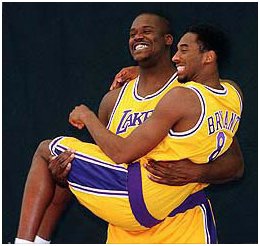
The All-Star game itself was scripted worse than an episode of “The Hills”.  There was the token Shaq-Kobe reunion and excessive coverage of their jovial pregame exchanges, followed by Kobe chucking up 10 shots in the first quarter for an early MVP bid, concluding with Shaq running point, busting crossovers and throwing a few down at the end of a 146-119 West blowout of the East.  The duo took co-MVP honors.  (Wait, you mean LC and Spencer both happened to be at “Les Deux” that night?)

So back to the real world (no pun intended) we go, and an ’09 NBA season that has been pretty nifty.

Eastern Conference Overview: The East is more or less set.  Boston (44-11) and Cleveland (40-11) will jockey for home court throughout the conference playoffs.  Don’t be surprised if an April 12 matchup becomes a de facto elimination game for the number one seed in the conference.  Orlando is locked into the third seed and will serve as an added incentive for the Celtics and Cavs to nail down the top spot.  The Magic (38-13) will not be a friendly second-round opponent for either team.

The fourth through seventh seeds will play out, in some order, with the Hawks (31-21), Heat (28-24), Pistons (27-24) and 76ers (27-24).  Only the fourth and fifth seeds will be able to dodge the power trio in the first round, so look for Detroit and Miami to make strong pushes on Atlanta in the second half.  The final playoff spot is up for grabs, as five teams (Milwaukee, New Jersey, Chicago, New York and Charlotte) are all within three and a half games of one another.

Western Conference Overview: It’s a nine-team race in the West, and considering the struggles the Suns (28-23) have endured (they just fired head coach Terry Porter), it’s possible they’ll be on the outside looking in for the first time since the 2003-04 season.  Still, it’s never wise to bet against Steve Nash and “The Big Cactus”.  Don’t count them out just yet.

The Lakers (42-10) will cruise to the top spot and the road to the Finals will again go through Staples Center.  The Spurs (35-16) have a solid grasp on the second seed, particularly given the run they typically go on after the All-Star break.  The Nuggets (36-17) are in position to be on the top half of the playoff bracket if they can hold off Portland (32-20) and Utah (30-23).  As for how the rest of the west will shake out, only time will tell as the Jazz, Blazers, Rockets, Hornets and Mavericks are all separated by just two and a half games. Expect seven of the eight Western playoff teams to reach the 50-win plateau.

Biggest Surprise: Denver Nuggets The script was fitting:  Chauncey Billups returning to his hometown team, the same team he played briefly for early in his career.  The question was would he be able to adjust to a new set of teammates and a new style of play.  After all, he had spent six full seasons as the floor general of an unchanging core group in a Detroit system predicated on defense.  To make such a fluid transition to Denver’s up and down style of play is a testament to Billups’ hardened veteran mentality.

After letting go of Marcus Camby in the offseason and making the Allen Iverson-for-Billups swap in the first week of the ’08 campaign, the Nuggets seemed due for a step back.  Instead Billups has taken the reigns and forged a fast relationship with Carmelo Anthony on the court.  As a result Denver is tied with San Antonio for the second-best record in the West at the break.  The Nuggets’ defense has been bolstered as well.  For the first time in three years Denver is giving up fewer than 100 points per game.  The Nugs are for real.

Most Significant Addition: Mo Williams/Cavs Lebron James may be a leading candidate for MVP this year, but the acquisition of Mo Williams is the reason why the Cavs are on pace for 64 wins.  And it’s because of Williams that Cleveland is threatening to steal home court from the Celtics in the Eastern Conference playoffs.  For the last few years James has craved and practically begged for a knockdown shooter on the outside.  After nearly single-handedly taking down Boston in the playoffs last year, Lebron was finally rewarded with the first legitimate wingman of his career.

Williams is a proactive point guard with an ability to create, but naturally that isn’t what he’s most needed for on a team with James.  It’s his shooting outbursts that have helped propel the Cavs to a real title contender and serious threat to the Celtics in the East.  At the break he was averaging 17.6 points per game on 47 percent shooting, including 40 percent from beyond the three-point arc.  He erupted for 43 points — a career high — in a Jan. 27 game against Sacramento before besting that with 44 in the last game before the break versus the Suns.

Most Significant Loss: Andrew Bynum/Lakers For the second consecutive year the Lakers lost Bynum to a knee injury just as he appeared to be on the brink of something special.  In the last five full games before he went down Bynum was averaging 26.2 points and 13.8 rebounds per game. Now he’ll have to wait and see if an MCL tear will sideline him for the remainder of the season.

Like last year, the impact of his loss won’t threaten the Lakers in their quest for another top seed in the West.  Nor should it greatly hinder their drive to return to the Finals.  The West has depth, but other than San Antonio (whose number the Lakers have had in recent past) there is no team standing in the path of LA.  It is when they get back to the Finals and meet Cleveland or Boston — two of the best defensive and most physical teams in the league — that they will be ruing the day Bynum went down.  Again.

MVP: Dwyane Wade Look, either Lebron or Kobe is going to win MVP.  They are the two best players in the league on two of the three best teams.  I take issue with the nature of the award, which should be given to the player who is most indispensable to his team.  While their squads wouldn’t be sitting where they are today, both the Cavs and Lakers would still be playoff teams this year without Lebron and Kobe.

There’s no way the same can be said of Miami without Dwyane Wade.  The evidence is already there.  With Wade alternating between being injured and playing hurt last year the Heat won 15 games.  FIFTEEN.  With a healthy Wade this season Miami is 28-24 and occupying the fifth position in the East.  The team’s second-leading scorer is a rookie and the bench is a virtual non-entity (all due respect to Daequan Cook and Chris Quinn).  Wade is averaging 28.3 points, seven assists, five rebounds and two steals per game, meaning he’s accounted for roughly half of Miami’s offensive output.  He takes over close games late more often than anyone else in the game.  Why?  Because he must or Miami will lose.  There is no player more valuable to his team than Wade is to the Heat. The man deserves some votes.

Defining “Dynasty”

With the Pittsburgh Steelers having just captured their second Super Bowl in four years and sixth overall, it seems like a good time to tackle one of the most subjective and contested concepts in sport, “the dynasty”.

How does one define a sports dynasty? Who has rightly deserved the title of dynasty throughout sports history? What does “dynasty” actually mean?

The last question is the easiest to answer. The origin of the word is from the Greek dunasteia, meaning “lordship”.  According to the Merriam-Webster Dictionary, a dynasty is defined as:

1) a succession of rulers of the same line of descent.

2) a powerful group or family that maintains its position for a considerable time.

Not too much help there, although it’s evident why the notion of a sports dynasty is so debated.  There just isn’t a tangible or relevant definition of the term.  It has been up to the professional leagues, teams, writers and fans to determine what has constituted a dynasty over the years.

When exactly the term entered the vernacular is difficult to pinpoint, but two of the original teams to garner the designation — the Boston Celtics of the late 50s and 60s and the UCLA Bruins of the 60s and early 70s — still come the closest to fulfilling the second definition of the word, “a powerful group or family that maintains its position for a considerable time.”

Red Auerbach’s Celtics won 11 of 13 NBA titles from 1957 to 1969, including eight straight.  John Wooden’s Bruins took down 10 of 12 NCAA championships from 1964 to 1975, highlighted by a run of seven in a row.  Those teams — particularly the Celtics — were dynastic in the truest sense of the word, in that they were sports families headed by powerful patriarchs that held their standing over an extended period of time.

Mergers, expansion and free agency have drastically altered the landscape of professional sports since the old school UCLA and Celtics dynasties.  Understanding that, let’s dissect the dynasties of the (semi) modern era. We’ll use the mid-1970s as a jumping off point, considering the ABA-NBA merger took place in 1976, MLB introduced mainstay franchises such as the Mariners and Blue Jays in 1977, and the Super Bowl era was well under way.

In my opinion, there are two parameters that must be met if a team wants to enter the dynasty debate.

1) the team must win back-to-back to titles.

2) the team must win or have won another title within a few years of the successive championships.

In the three major sports there are a handful of squads that have gone back-to-back over the last 40 years, but that was it.  They didn’t win another one before or after the consecutive titles within a reasonable amount of time.  Among these teams are the New York Yankees (’77 and ’78), Detroit Pistons (’89 and ’90), Toronto Blue Jays (’92 and ’93), Houston Rockets (’94 and ’95), and Denver Broncos (’98 and ’99).

It’s an admirable accomplishment to go back-to-back, but there’s an aspect of sustained excellence inherent to the idea of a sports dynasty that those teams didn’t have.  Two in a row without another can still fall in “flash in the pan” territory.  At least in the context of this argument.

As for the teams that are in the running, let’s um, run through them…

The Pittsburgh Steelers of the 70s — the original “Steel Curtain” — set the the standard for Super Bowl dominance.  Led by Terry Bradshaw, Lynn Swann and “Mean Joe” Greene, Pittsburgh won four out of six titles between 1975 and 1980, a mark that is still yet to be met.  Dynasty.

In the 80s, the San Francisco 49ers gave a solid encore performance to the Steel Curtain.  Behind the innovative and groundbreaking West coast offense instituted by Bill Walsh, Joe Montana and Jerry Rice’s 49ers snagged four Super Bowls in a nine-year span (1982-1990).  Included in that run was a back-to-back in ’89 and ’90, which solidified the Niner dynasty.

No other NFL franchise has won four titles in one era, but the Dallas Cowboys (’92, ’93 and ’95) and New England Patriots (’01, ’03 and ’04) have each gone three out of four.  Given the parity that started to take shape in the mid-90s and the establishment of a salary cap in 1994, it could be argued that the Cowboys and Patriots were actually the two most dominant teams in league history.  We’ll keep that on the back burner for now.

Jumping to MLB — which saw 14 different champions between 1975 and 1995 — the only dynasty of the last 35 years is undisputed: the New York Yankees of the late 90s.  With great pitching and a young superstar named Derek Jeter, the Yankees won four out of five World Series between 1996 and 2000.  That seven different teams have won titles in the eight years since New York’s run only underscores how remarkable it was.

Finally to the NBA, which has been the most conducive to dynasties throughout the time period in question.  Let’s begin with the present, and a peculiar team that has heard the term thrown around in reference to it on more than one occasion.  That would be the San Antonio Spurs.

Since Tim Duncan’s sophomore campaign in 1998, the Spurs have won four of the 10 NBA titles to be contested.  They’ve won three of the last six, but all in odd years (’03, ’05 and ’07).

Duncan will probably go down as the greatest power forward of all time, but his lumbering style and passive attitude are generally cited as the chief reasons why the Spurs have yet to repeat as champs.  The guy has simply never exhibited the fire and drive needed to go after it, year after year.  It takes a cold-blooded leader to repeat, and Duncan — while many things — is not that.  Spurs proponents would argue that a miracle three by Derek Fisher in 2004 and Dirk Nowitzki’s historic three-point play in 2006 are the only things standing between San Antonio and five straight titles.  And they would have a point, except there’s no room for “coulda, woulda, shoulda” when talking dynasty.

I’ll argue that San Antonio’s three titles combined with those plays merit them the moniker of “team of the decade”, but a dynasty?  No.

This is where it gets interesting, because at the beginning of the decade we saw a bona fide dynasty in the Shaq/Kobe Lakers.  Three straight crowns starting with the 1999-00 season.  A loss in the 2004 Finals to the chippy Detroit Pistons — with the additions of Gary Payton and Karl Malone no less — cost the Lakers their shot at being the team of the decade.  That is unless they grab another one in ’09…

Now let’s trek back to the 80s, a magnificent era that featured what I must deem a “co-dynasty”.  Magic’s Lakers and Bird’s Celtics won eight of nine NBA titles beginning with the 1979-80 season.  While LA had the upper hand (winning five rings to Boston’s three and two of the three head-to-head showdowns), there’s no doubt that Magic isn’t Magic without Bird and vice versa.  Same goes for their teams.  The iconic franchises fed off one another, spawned a fervent bicoastal fan base and permanently embedded the sport in American culture.  For that reason the 80s Celtics are the only team to warrant the dynasty tag despite a failure to repeat (they won three of six from ’81 to ’86 and appeared in five Finals during that span).

If we’re talking dynasties and iconic players, the argument begins and ends with one man.  Michael Jordan.  The greatest, most prolific champion of the modern era.  His Bulls three-peated from ’91 to ’93, and again from ’96 to ’98.

He took a break (for reasons still not completely determined) and played baseball for a year and half in between, and his team became mortal without him.  After a truncated return in ’95 and a second straight loss in the Eastern Conference playoffs for the Bulls, MJ made it clear that the glory days were again on the horizon, and he lived up to his word.  When it was over Jordan had essentially gone six-for-six in his prime, a surreal stretch of individual dominance in what was historically believed to be a team game.

The dynasty debate is one of the great ongoing discussions in sport.  While it will continue to live on — in locker rooms, through the media, around the dinner table — the 90s Bulls are the greatest dynasty in recent American sports history.

Any beef?

It’s the Steelers … Here’s Why

Something interesting happened this year. I stopped writing about my team. Because the Patriots’ season (of redemption) was derailed — by Bernard Pollard or Kevin Faulk or karma itself — before it had a chance to get rolling, I simply couldn’t bring myself to reprise my role as a de facto Pats beat writer/columnist. It was that role that sprung me to the early success I had in this business (way back when I was chronicling a dynasty for the Fordham University Theyre coming...publication, The Observer) and made me believe sportswriting was what I wanted to do.

So I tried something different. For the first time in a decade I watched football free of bias, hubris and emotion. I watched and rooted for the Patriots every week, but with nothing personal at stake. Merely as a fan of the game. At a Steelers bar no less.

It’s well documented how much animosity Pittsburgh fans harbor towards the Patriots. New England did twice blow through Heinz Field and thwart Steelers outfits (in 2001 and 2004) from reaching the Super Bowl.

As much as they may despise anyone associated with the Pats, I’ve always liked Pittsburgh. Envy its history and blue collar, hard-nosed style. Respect how its fan base embodies the grit and steel will of the franchise and city. And those Terrible Towels are pretty cool.

Naturally it was difficult — to say the least — to coexist with a crew that had undying hate for my team, that somehow knew and responded appropriately every time something bad happened in a Patriots game — even though the Pats were relegated to five or so TVs in an establishment boasting well over a hundred flat screens.

(For a bit of clarification, this bar is no ordinary sports bar, and I’m talking about the clientele. The average gentleman at “200 Fifth” is about two hundred and a fifth of another hundred pounds. You could field an NFL practice squad with the dudes who frequent this spot. I wouldn’t be surprised if there were a handful of Pro Bowls among these guys. And the funny/scary thing is only the latter statement is hyperbole. But I digress.)

Since Patriots and Steelers games rarely coincided, I tended to get to the bar early, catch the Pats game and gravitate to the HD projection screen in the back that always played the Pittsburgh contests. Aside from a small clique of friendlies who knew and were relatively cool with my affiliations — yet still talked lots of smack — I acted largely as an impostor to the majority of the heads. Gotta look out for numero uno.

So there I was, just another tacit Pittsburgh supporter, plain clothes clad. A veritable Steeler Nation operative, rocking my fist when the good guys scored and shaking my head when they erred.

As much of an outsider as I was, over time I started to realize that the team I was faux following actually bore strong resemblance to the one I used to follow, back in The Observer days.

On a few occasions I have made reference to the fact that the 18-0 (and 18-1) Patriots simply weren’t comparable to the three-time champion Patriots. Were they prolific and dominant? Absolutely. But therein lay the problem. Their offensive supremacy covered up what was an aging defense that had seen its best days pass. More importantly, Brady and the offense rendered the defense a subsidiary part of the team for the majority of the season, and when it came time for the unit to step up, it was as if it suddenly couldn’t handle the pressure and stage it had once lived for.

Way back when, the Patriots defense anchored nine consecutive wins in January and February by exhibiting superior schemes, greater intellect, unrelenting toughness over sixty minutes and a knack for always making the handful of big plays and the one monstrous play necessary to move on and/or win a title. Brady, Brown and Vinatieri handled the rest.

I’ve got news for you, but no team — including the Patriots, who have gone a redoubtable 54-18 since their last title — has resembled those Patriots like this year’s Steelers.

The formula for their success has been eerily similar to New England’s circa 2003-04: ups and downs from an offense committed to the run, a defense that consistently keeps the team in games and forces momentum-changing turnovers in crunch time. A quarterback who always makes the most of a drive when he knows it’s his last. A team that finishes.

I’ve seen it happen too many times this year to be chalked up as coincidental. Against San Diego in Week 11. Versus Dallas in Week 14. In Baltimore the following week. And again in the AFC Championship two Sundays ago.

The defense has guys like Casey Hampton in the trenches, James Harrison and LaMarr Woodley on the outside, and Troy Polamalu in center field; guys that have shown time and again that in physical, taxing affairs they will not blink first. And when they hand the ball to their offense late and a drive must be executed, Ben Roethlisberger will lead it with calmness and precision, looking to Hines Ward when the going gets tough.

Simply put, the Steelers never panic. On occasion they don’t come out of the tunnel with their A-game, but their mental resolve is unwavering and their collective patience is a virtue, the reasons why they’ve come from behind multiple times against quality teams.

It was the “sixty minutes mantra” that typified New England during its run, and it’s the same primary tenet that has carried the Steelers to within sixty minutes of a record-breaking sixth Super Bowl title.

Just as the the Panthers and Eagles were exceptional and worthy opponents of the Patriots, so too are the Cardinals for Pittsburgh. One thing Arizona has benefited from this postseason is playing from ahead. Against Atlanta they were Ben is the first to admit he didnt earn that trophy.  up 14-3 and 28-17. They thrashed Carolina. And in the NFC Championship it was 24-6 before the Eagles knew what hit them.

Kurt Warner-to-Larry Fitzgerald is the explanation for all those crooked scores before halftime. But the enabler was actually Edgerrin James, whose rushing outputs — while a modest 203 yards in three games — had opposing defenses thinking “run” in the back of their minds, which was all the old war horse and stud receiver needed.

The Steelers front seven is the best in football and allowed just 73 yards on the ground to Baltimore, the league’s second-ranked rushing offense. Arizona won’t reach 50 yards, meaning Polamalu will not be needed at the line of scrimmage, meaning under no circumstances will he allow any Cardinals receiver to get behind him for a quick-hit score. Arizona will find the end zone a few times but the Pittsburgh D will make them earn it. Nothing will come easy.

On the other side of the ball, Pittsburgh will use its rushing attack to dictate the pace of the game. Willie Parker is fresher and healthier than any back the revived Cardinals defense has faced this postseason, and is no stranger to running wild in the Super Bowl (who can forget his electrifying 75-yard touchdown sprint in Super Bowl XL?).

The Steelers will win the game because they can run the ball and stop the run. They’ll win the game because Ken Whisenhunt vs. Dick LeBeau is a wash. They’ll win the game because they don’t get down big. They’ll win the game because Roethlisberger has something to prove. They’ll win the game because they’ll see the Terrible Towels.

Above all, the Pittsburgh Steelers will win Super Bowl XLIII because their defense will not lose it.

Steelers 26 Cardinals 21

Last Week: 1-1

Playoffs: 8-2